

 English
 Lietuvių
 Latviešu
 Eesti
Eesti Русский
 Polski
 Українська
 Deutsch
 Italiano
 Español
 Français
 Português
 Čeština
 Magyar
 Română
 Ελληνικά
 Türkçe
 日本語
日本語 العربية
 हिन्दी
 Bahasa Indonesia
 Bahasa Melayu
 ไทย
ไทย Tiếng Việt
 বাংলা
বাংলাOnline Reviews and Reputation Management for Local Businesses
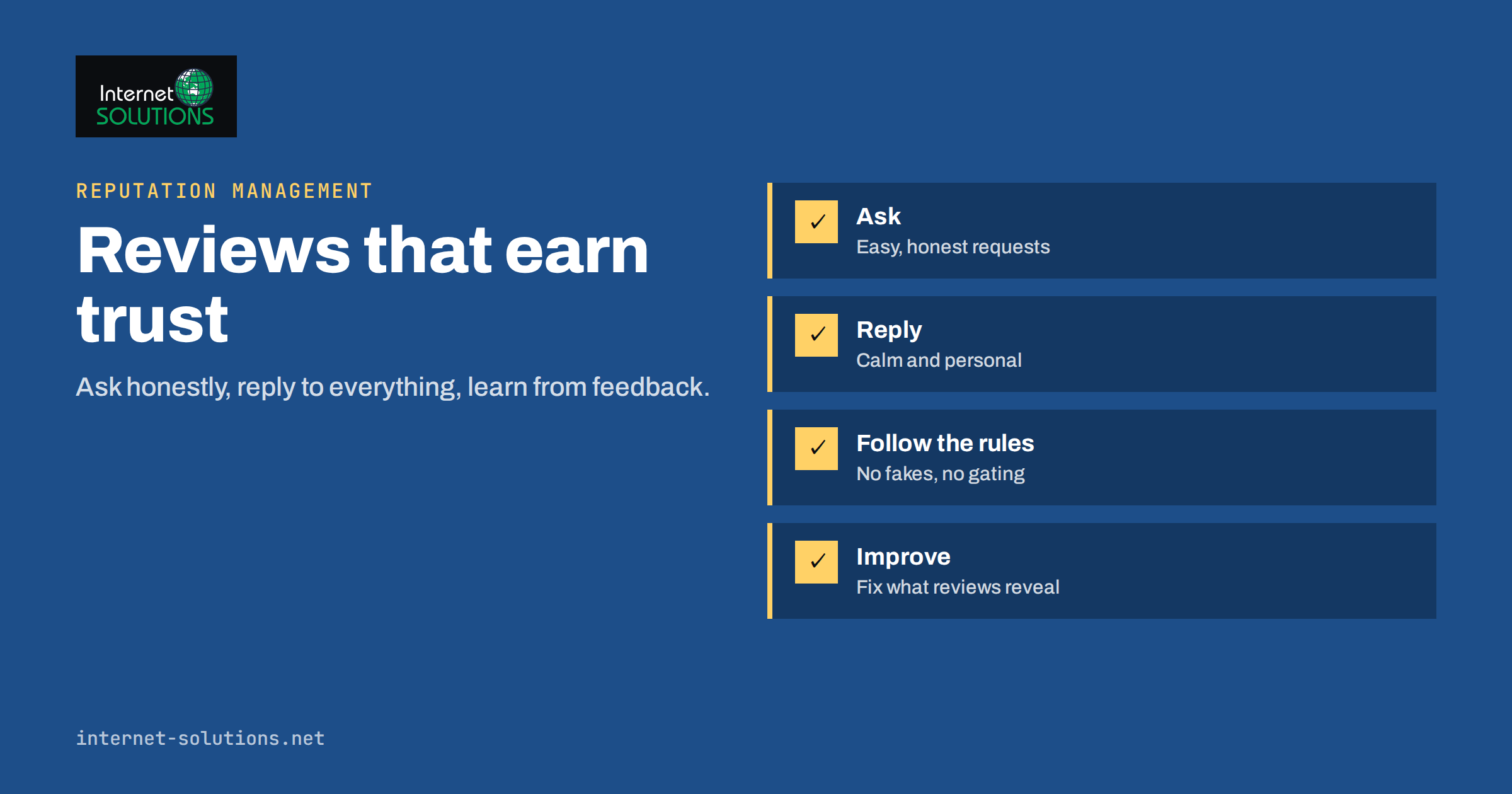
Online reviews have become the first thing many customers read about a business, often before they open its website or pick up the phone. A handful of recent ratings on a map listing can decide whether a person calls you or the competitor two doors down. For a local business, that makes reviews less of a marketing extra and more of a basic part of how customers find and judge you.
Reputation management sounds like a job for large brands, but for a small company it is mostly a routine: ask happy customers to share their experience, read what people write, answer calmly and use the feedback to fix real problems. This guide explains how to do that without gimmicks, which rules to respect, and how reviews connect to the rest of your visibility work, including the ideas in our guide to local SEO for service businesses.
Why Online Reviews Matter Beyond Star Ratings
A star rating is a summary, but the words behind it do more work. Prospective customers read reviews to answer practical questions: Was the work on time? Did the price match the quote? How did the company behave when something went wrong? A review that mentions a specific service, a town or a staff member answers those questions better than a bare five stars.
Reviews also influence how you are found. Search engines and map listings treat the quantity, recency and content of reviews as one of several signals about a local business, and people often search with phrases such as “plumber near me reviews”. The exact weighting is not published, so avoid anyone who promises a ranking boost from a specific number of reviews. What you can rely on is the simpler effect: a listing with many recent, genuine and detailed reviews is easier to trust, so more of the people who see it will contact you.
There is an internal benefit as well. Reviews are free, unfiltered feedback. Patterns appear quickly: slow replies, unclear pricing, a product that arrives damaged, a team member customers love. Treat the review stream as a regular input for improving the business, not only as public relations.
Know Where Your Reviews Live
Customers leave opinions in many places, and you cannot manage what you cannot see. Start by listing every place your business can be reviewed.
| Source | What it is good for | What to watch |
|---|---|---|
| Google Business Profile | Map and local search visibility, the most common first impression for local services | Reviews can be flagged, replies are public, and the profile must be verified and kept accurate |
| Facebook page recommendations | Community trust, especially for consumer services | Comments and recommendations appear in different places, so check both |
| Industry directories and marketplaces | Reach inside a niche such as trades, travel, hospitality or software | Each has its own rules for replies and removal requests |
| Review sites and forums | Independent opinions that rank for your brand name | Often outside your control, so monitoring matters more than editing |
| Your own website | Testimonials and case studies you can present in full context | Must be real, attributable and kept up to date |
Search for your business name, your name plus “reviews” and your name plus “complaints” in a private browser window once a month. What appears on the first page is what a cautious customer sees. Note anything that is outdated, wrong or missing, such as an old phone number or a closed branch.
For most local businesses, Google Business Profile deserves the most attention. Google publishes guidance on how to manage customer reviews and a separate page of tips for getting more reviews, and both are worth reading before you plan any request campaign.
Ask for Reviews the Honest Way
Most satisfied customers never write a review unless somebody asks. The goal is to make asking a normal part of finishing a job, not a special campaign.
- Ask at the right moment. The best time is shortly after a good outcome: the work is complete, the order has arrived and works, or the customer has just thanked you.
- Make it easy. Send a direct link to your review page by email, text message or a QR code on the invoice, so the customer does not have to search for your listing.
- Ask everyone, not only the happy ones. Selecting only customers you expect to be positive, or offering to review only if the experience was good, is called review gating. Major platforms discourage it, and it undermines the honesty that makes reviews valuable.
- Do not write the review for them. Suggest what they might mention, such as the service they bought and what stood out, but let them use their own words.
- Thank people, whatever they write. A short note after a review keeps the relationship warm and encourages repeat customers.
A simple message works well: “Thank you for choosing us. If you have a minute, an honest review helps other customers find us. Here is the link.” Avoid anything that sounds like pressure. A customer who feels pushed is more likely to write something negative or nothing at all.
Rules You Must Not Break
Reviews are regulated by platform policies and, in many countries, by consumer protection law. The core principles are consistent, so build your process around them.
- No fake reviews. Do not write reviews yourself, ask staff or relatives to post them, or buy them. Consumer protection authorities in several regions treat fake reviews as a deceptive practice, and platforms remove them and can penalise the business.
- No payment for positive reviews. Incentives that depend on the content or the rating of the review are not acceptable. Some platforms forbid incentives of any kind, so read the policy of each one.
- No suppression of genuine criticism. Threatening customers, or making them sign contracts that forbid reviews, is risky and in some jurisdictions unlawful.
- Disclose connections. If you publish testimonials on your own website, make clear that they are from real customers and avoid editing them to change the meaning.
- Respect privacy. When you reply publicly, do not reveal details of a customer’s order, health, finances or identity that they have not already shared. Take sensitive discussions to a private channel.
Rules differ by country and platform and change over time, so treat this list as a starting point and check the current policies of each platform you use. Google, for example, publishes a policy on prohibited and restricted content for contributions on Maps, which is useful when you need to decide whether a review can be reported.
Reply to Every Review, Especially the Bad Ones
Replies are public, and future customers read them as carefully as the reviews. A thoughtful reply shows how you behave under pressure, and that is often more persuasive than a perfect rating.
Replying to positive reviews
Keep it short and personal. Thank the customer by first name, mention one detail from the review and invite them back. Avoid copying the same sentence into every reply, since repeated templates look automated and add nothing to the page.
Replying to negative reviews
- Wait until you are calm. Never reply in anger. A draft written in the first hour is rarely the one you want to publish.
- Check the facts. Find the order, the job or the conversation. If the person was never your customer, say that politely and ask them to get in touch, or report the review if it breaks the platform rules.
- Acknowledge and apologise where it is deserved. A sincere “we are sorry this happened” costs nothing and defuses many situations.
- State what you will do. Offer a concrete next step, such as a call from the owner, a replacement or a re-visit, and give a way to reach you.
- Move the details offline. Public replies should be brief. Resolve the case by phone or email.
- Follow up. If the customer is satisfied afterwards, they may update the review. You can politely mention this, but never ask them to delete it as a condition of a refund.
Take the same care with tone as you would in live conversations with customers. Our article on writing replies customers trust covers wording that works equally well in a review response: plain language, no jargon, no defensiveness.
Handling Fake, Unfair or Defamatory Reviews
Not every negative review is genuine. Some come from competitors, former staff or people who confuse you with another company. Others are simply unfair. Distinguish between a review you dislike and one that breaks the rules.
- Report reviews that violate policy, such as spam, off-topic content, conflicts of interest or personal attacks, using the platform’s reporting tool. Keep a record of what you reported and when.
- Reply politely anyway while the report is pending. A calm reply that states the facts helps readers decide for themselves.
- Do not retaliate. Posting your own negative reviews of a competitor, or arguing in public, damages your reputation more than the original review.
- Consider legal advice for serious cases. If a review contains false statements of fact that cause real harm, a lawyer can explain the options in your country.
Expect that a removal request may be declined. A genuine review that is critical but within the rules will stay, and the best response is a good reply and better service.
Use Reviews Across Your Marketing
Once you collect reviews, put them to work in more than one place. A good review is evidence, and evidence is what visitors look for when they decide whether to trust you.
- On service and landing pages. Show two or three relevant reviews close to the call to action, with the name or initials and the service mentioned. Our guidance on showing experience and trust explains how such proof supports credibility.
- In structured data, with care. Review markup must reflect content that visitors can actually see on the page, and rules limit the use of self-serving reviews for your own business, so follow Google’s documentation on review snippets before adding any.
- In advertising. Short quotes and the overall rating can strengthen ads and assets, as long as they are accurate and current.
- In email and social posts. A monthly “what customers said” post is easy content that also thanks the people involved.
- In sales conversations. A prepared list of recent reviews answers the “how do I know you are good?” question quickly.
Keep a simple log of the best quotes, with permission where you plan to reuse names or photos. It saves time when you update the website or prepare a proposal.
Turn Feedback Into Operational Fixes
The biggest gain from reviews often comes from acting on them. Once a month, read the last thirty to fifty reviews and sort them into themes: communication, punctuality, price clarity, product quality, aftercare and staff behaviour. Count how often each theme appears and whether it is positive or negative.
If three customers mention that quotes were unclear, change the quote template. If several mention slow replies to messages, review who answers the inbox and when. Assign one owner to each recurring problem and check the next month whether the theme has declined. Over time, the stream of reviews becomes a record of how the business is improving.
A Simple Monthly Routine
A reputation process only works if it is small enough to keep doing. This schedule takes under an hour a month for most small businesses.
- Weekly: check new reviews and reply to each within two working days. Turn on email notifications so none are missed.
- After each job or order: send the review request with the direct link.
- Monthly: search for your business name, review the themes, update the log of quotes and report any reviews that break the rules.
- Quarterly: check that your name, address, phone number, hours and categories match across listings, and that your website’s contact details are the same.
- Yearly: read your policies and templates again, and confirm that staff know who answers reviews and how complaints are escalated.
Assign a named person, with a deputy for holidays. Reviews that sit unanswered for weeks send the same message as an empty shop counter.
Measure What Reviews Do for You
You can track the effect without complicated tools. Record the number of new reviews each month, the average rating of recent reviews, the share of reviews you answered and the time it took. On your listing’s insights, watch calls, direction requests and website clicks. Ask new customers how they found you, and add “saw your reviews” as an option on your enquiry form. Over a few months you will see whether more reviews coincide with more contact, and which sources matter most.
If you want help building review requests into your website, forms and email follow-ups, our SEO services team can connect the technical details, from listing consistency to structured data.
Frequently Asked Questions
How many online reviews does a small business need?
There is no magic number. A steady flow of recent, genuine reviews matters more than a large total from years ago. Aim for a few new reviews each month and compare yourself with the competitors your customers actually consider.
Can I offer a discount in exchange for a review?
It is risky. Many platforms prohibit incentives tied to reviews, and consumer protection rules in various countries restrict them. If you want to thank customers, do it for the purchase, not for the review, and check each platform’s policy first.
Should I delete or hide negative reviews?
You cannot remove genuine reviews from most platforms, and you should not try to pressure customers to do so. Report only those that break the rules, reply professionally to the rest and focus on solving the problem.
How quickly should I reply to a review?
Within one or two working days is a sensible target. Faster is better for complaints, because a prompt, calm response can prevent the situation from escalating.
Do reviews help SEO?
Reviews are widely considered one of the factors in local search, and they affect how many people click and call. Search engines do not publish the exact weight, so treat them as part of building trust rather than a trick for ranking.
What if a competitor posts fake reviews about my business?
Collect evidence, report the reviews through the platform and reply politely and factually. If the content is clearly false and damaging, speak to a legal adviser about the options available in your country.
The Bottom Line
Good reputation management is quiet, regular work. Know where reviews appear, ask every customer in an honest and easy way, follow the platform rules, reply to everything with care and use what you read to fix real problems. Put the best proof where visitors make decisions, and keep a short monthly routine so that the process continues when the business is busy. The result is not only a better rating but a business that listens, and that is visible to every new customer who searches for you.