

 English
 Lietuvių
 Latviešu
 Eesti
 Русский
 Polski
 Українська
 Deutsch
 Italiano
 Español
 Français
 Português
 Čeština
 Magyar
 Română
 Ελληνικά
 Türkçe
 日本語
 العربية
 हिन्दी
 Bahasa Indonesia
 Bahasa Melayu
 ไทย
 Tiếng Việt
 বাংলা
Case Studies and Testimonials: Social Proof for Business Websites
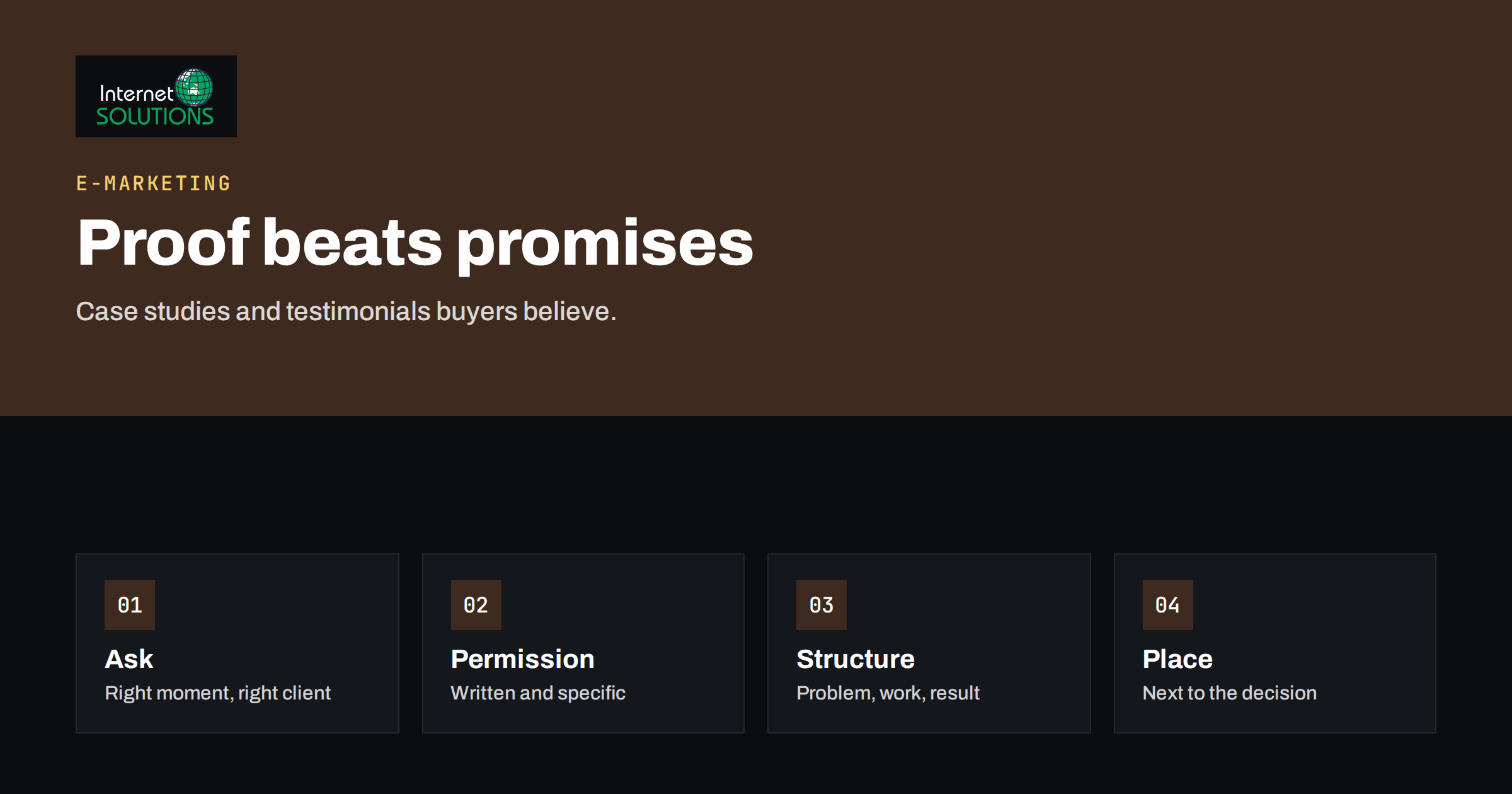
Case studies and testimonials do the job that a company’s own claims cannot. “We deliver on time” is something every supplier says; “they migrated our shop over a weekend and we lost no orders”, with a name and a company next to it, is something a buyer can believe. Social proof, the evidence that other people like them chose you and were satisfied, is one of the strongest influences on a purchase decision, and it is also one of the most neglected parts of a business website. Most sites have a handful of vague quotes on the home page and nothing else.
This guide covers how to ask clients for proof at the right moment, what permissions you need and how to record them, how to structure a case study that a buyer will actually read, how to collect testimonials that say something specific, where to place proof so it supports a decision, how to keep it current and how to avoid the mistakes that make proof look fake. It applies to service businesses, agencies, software companies and online stores, and it reflects what we see working on the sites we build and promote in our e-marketing work.
Why Specific Proof Beats General Praise
A testimonial that says “great service, highly recommended” is almost worthless, because it could be about anyone and could have been written by anyone. A testimonial that says “the new booking form cut our phone calls by about half within a month” is believable because it is specific, measurable and slightly unexpected. Specificity signals that a real person had a real experience, and it tells the next buyer what to expect.
The same applies to case studies. A buyer reading one wants to recognise their own situation, see what was actually done, and learn what happened afterwards, including what was hard. A case study that reads like an advertisement, with no numbers and no friction, is skipped. One that reads like an honest account of a project is read to the end and often shared internally with the people who approve budgets.
When and How to Ask
The best moment to ask is when the client has just experienced the result: the site launched and the first enquiries arrived, the campaign hit its target, the server problem that kept them awake was solved. Satisfaction is highest and the details are fresh. Build the ask into your process at that point rather than remembering it months later.
Make the ask easy to say yes to. For a testimonial, send three short questions rather than asking for “a few words”: what problem did you have, what did we do, what changed. The answers, lightly edited and approved, are the testimonial. For a case study, ask for a twenty-minute call and offer to write the draft yourself for their approval; the client’s time cost is then an interview and a read-through, which most are happy to give. Offer anonymity as an option: “a Lithuanian logistics company” is weaker than a name, but far stronger than no case study.
Not every client should be asked. Choose the ones whose situation matches the customers you want more of, whose results are clear and whose relationship is good. Three strong, relevant case studies outperform twelve mixed ones.
Permissions and Record Keeping
Publishing a client’s name, logo, quote or results is use of their reputation and sometimes their data, so get permission in writing and keep it. A short email exchange is enough for a testimonial: send the final text, ask for an explicit yes, and store the reply with the date. For a case study, confirm which details may be published, whether the logo may be used, whether figures may be stated exactly or only as ranges, and whether the client wants to review future edits. Check your contracts: some include confidentiality clauses that require a separate consent for any public reference.
Keep a simple register: client, what was approved, who approved it, the date, and where it is used. When a contact leaves the client company or the client asks to be removed, you can act quickly, which protects the relationship and keeps you on the right side of consumer protection rules on endorsements, which in the EU are covered by rules on unfair commercial practices such as the Unfair Commercial Practices Directive. Never publish a testimonial you invented or adapted beyond what the client approved; the reputational cost of being found out far exceeds any benefit.
How to Structure a Case Study
A structure that works for almost any business project:
- Headline with the result. “Online bookings up 40% after a site rebuild for a dental clinic” tells the reader whether to continue.
- Summary box. Client type, industry, what was done, key result, timeframe. Many readers stop here, and that is fine.
- The situation. What the client was dealing with, in their words where possible. Include the constraint: budget, deadline, legacy system, a team of two.
- What was done. The decisions and the work, with enough detail to be credible and not so much that it becomes a technical report. Mention what you chose not to do and why.
- What happened. Results with numbers where permitted, including the time it took to see them. Include one thing that was harder than expected; it makes the rest believable.
- A quote from the client. Specific, attributed, approved.
- What’s next, and a call to action. Ongoing work with the client if any, and a route for the reader to talk to you.
Length is usually 600 to 1,200 words. Add two or three images: the before and after, a screenshot of the result, the team on site. Case studies make good blog content and good pages on their own; they also support trust signals for search engines, which we discuss in our article on E-E-A-T for business websites.
Testimonials That Say Something
Collect testimonials with the three-question approach above and edit only for length and clarity, never for meaning. Attribute each with a name, role and company, and a photo if the person agrees; a face increases trust noticeably. Where the client prefers less, use first name and industry. Date them, or at least keep the date in your register, so you can retire quotes that refer to services you no longer offer.
Video testimonials are more persuasive than text when they are natural, and less when they are scripted. A thirty-second phone recording of a client explaining what changed, lightly trimmed, beats a polished studio piece that sounds like an advertisement. Offer the option but do not push it.
Third-party reviews on platforms the buyer already trusts carry extra weight because you do not control them. Link to them, embed a rating summary where the platform allows it, and respond to them. Our guide to online reviews and reputation management covers that side in detail.
Types of Proof Compared
| Type | Effort to collect | Persuasive power | Best placement | Watch out for |
|---|---|---|---|---|
| Specific text testimonial with name and company | Low | High | Service pages, pricing, contact | Vague praise, missing attribution |
| Anonymous testimonial | Low | Medium | Supporting rows, blog | Reads as invented if there are too many |
| Full case study | Medium to high | Very high for considered purchases | Own page, linked from services | Advert tone, no numbers, no friction |
| Video testimonial | Medium | High when natural | Home page, service pages | Scripted delivery, long length |
| Third-party review ratings | Low to maintain | High for local and consumer | Footer, contact, product pages | Unanswered negative reviews |
| Logos of clients | Low | Medium | Home page strip | Permission; logos of one-off clients |
| Numbers (years, projects, clients served) | Low | Medium | About page, home page | Inflated or unverifiable figures |
Where to Place Proof
Proof works when it sits next to the decision it supports. A testimonial about fast delivery belongs on the delivery page; a case study about a shop migration belongs on the e-commerce service page; a quote about responsive support belongs near the support plan. Home page strips of logos and quotes set the tone but rarely close anything. Pricing pages, contact pages and forms are where hesitation is highest and where a single relevant quote measurably helps.
Match proof to the reader. A case study page should link to related case studies in the same industry, and service pages should pull the one or two most relevant quotes rather than a rotating carousel of all of them. For buyers deep in comparison, a dedicated case studies section with filters by industry and service lets them find their own situation. If you run live chat, the chat assistant can point visitors to the relevant case study when they ask about experience in their industry; this is the kind of content we give Talkmio to answer from on our own site.
A Note on Structured Data
It is tempting to mark up testimonials with review schema so that star ratings appear in search results. Do not do it for reviews of your own business on your own site: Google’s review snippet guidelines treat self-serving reviews as ineligible, and marking them up can draw a manual action. Review markup belongs on product pages with genuine customer reviews collected through a system visitors can see. Testimonials and case studies still help search visibility, but through trust and content rather than through stars.
Keeping Proof Current
Proof ages. A testimonial from six years ago about a service you have since redesigned raises questions rather than answering them. Review the register twice a year: retire quotes about discontinued services, refresh case studies with updated results where the relationship continues, and add new proof from recent projects. Aim for at least one new case study a quarter if the business does project work. When a client’s results change or the relationship ends badly, take their proof down promptly and without being asked.
Mistakes That Make Proof Look Fake
- Stock photos as “clients”. Readers recognise them. Use real photos or none.
- Perfect grammar in every quote. Real people write unevenly; heavy editing removes the signal.
- Only five-star everything. A case study that admits a delay or a change of plan is more credible than one that does not.
- Unverifiable numbers. “Thousands of happy clients” without a basis is noise; “214 websites launched since 2011” is a fact you can stand behind.
- Proof with no date, no name and no context. The absence of detail is read as absence of truth.
- Fabricated or paid reviews. Illegal in many jurisdictions, and platforms detect them. Not worth it under any circumstances.
Frequently Asked Questions
How many case studies does a business website need?
Three strong, relevant ones are enough to start, ideally covering the main services or industries you serve. Add roughly one per quarter from recent work and retire those about services you no longer offer.
Do I need written permission to publish a testimonial?
Yes. Send the final text, get an explicit approval by email and keep it with the date. For case studies, confirm what may be named, whether the logo may be used and whether figures may be exact. Check contracts for confidentiality clauses.
What should a case study include?
A result-led headline, a summary box, the client’s situation and constraints, what was done and why, results with numbers where permitted, one honest difficulty, an attributed quote and a call to action. Six hundred to twelve hundred words with two or three images is typical.
Where should testimonials appear on the site?
Next to the decision they support: service pages, pricing, contact and forms. Home page strips set the tone but rarely close a sale. Match each quote to the page topic rather than rotating all of them everywhere.
Are anonymous testimonials worth publishing?
Yes, when the client will not be named. Use a role and industry, such as “operations manager, logistics company”, and keep the content specific. Too many anonymous quotes with no named ones start to look invented.
Can I edit a client’s testimonial?
Only for length and clarity, and only with the client’s approval of the final text. Never change the meaning, add claims or invent quotes. Light unevenness in the writing is part of what makes it credible.
The Bottom Line
Case studies and testimonials convert because they let a buyer hear from someone like them. Ask at the moment of success, make the ask easy, get and keep written permission, structure case studies around situation, work and result, keep quotes specific and attributed, and place each piece of proof next to the decision it supports. Review the register twice a year and never publish anything a client did not approve. Done this way, social proof becomes the most persuasive content on the site, and it is content only your clients can write.