

 English
 Lietuvių
 Latviešu
 Eesti
 Русский
 Polski
 Українська
 Deutsch
 Italiano
 Español
 Français
 Português
 Čeština
 Magyar
 Română
 Ελληνικά
 Türkçe
 日本語
 العربية
 हिन्दी
 Bahasa Indonesia
 Bahasa Melayu
 ไทย
 Tiếng Việt
 বাংলা
Company Name vs Trademark: Why a Business Registration Is Not Enough
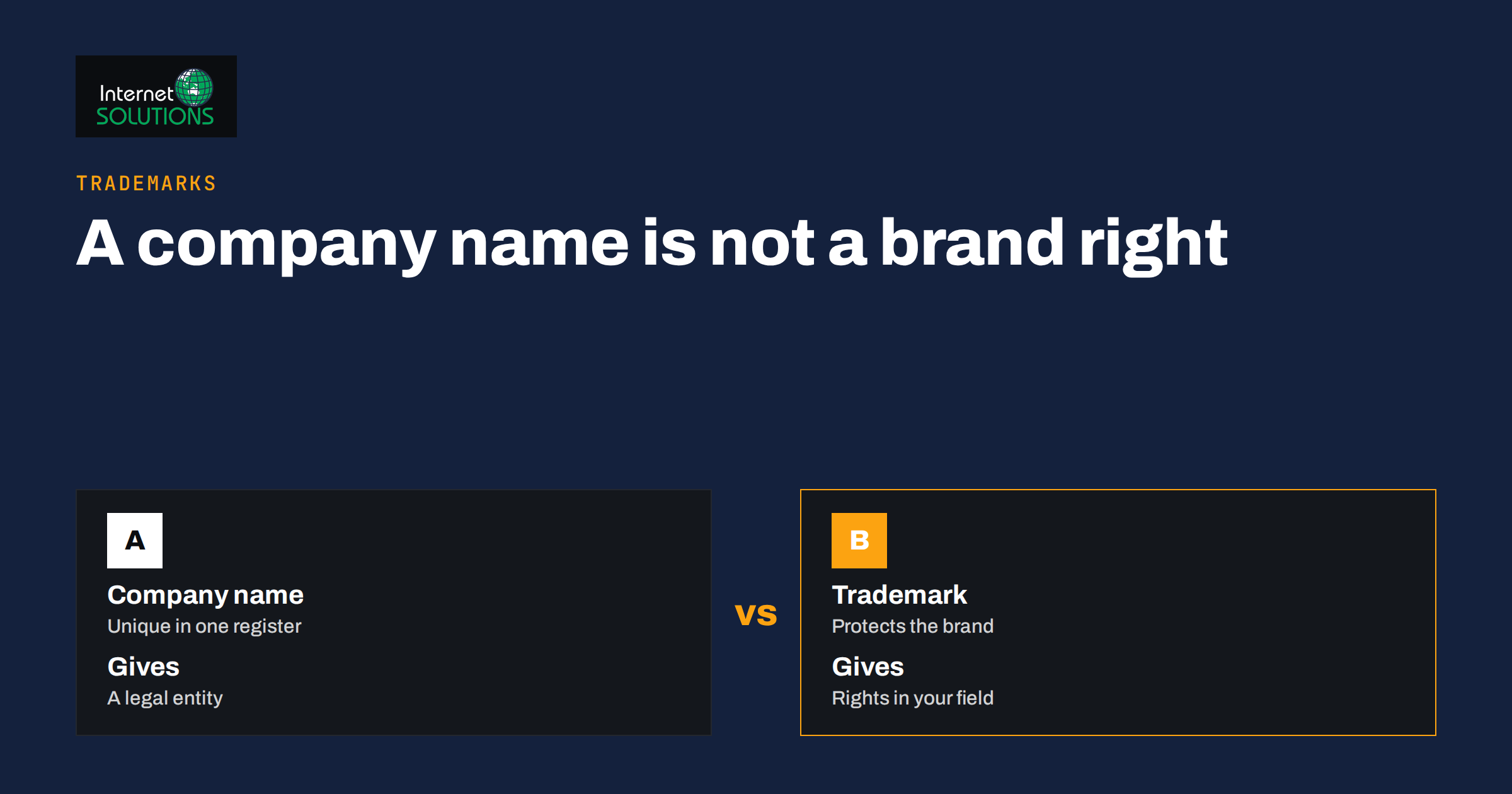
Company name vs trademark is a distinction that surprises many founders. You register a company, receive a certificate with a name on it, open a bank account, buy a domain and print business cards. It feels as though the name now belongs to you. In a limited sense it does: nobody else can register a company with exactly the same name in the same register. But that registration says very little about your right to use the name as a brand in the market, and it does not stop a competitor from selling similar products under a confusingly similar name, even in the same town. A trademark does exactly that, and it is a separate right, obtained through a separate process, from a separate office.
This guide explains the difference between a company name, a trade name, a domain name and a trademark, what each gives you and what it does not, how conflicts arise, what to do before and after you register a business, and how to choose the right order of steps. It is general information, not legal advice. Rules differ between countries, and for any decision with real money behind it, you should consult a qualified trademark attorney.
Four Names, Four Different Things
People use the word “name” for four different legal and practical objects. Keeping them apart avoids most of the confusion.
| Name type | What it is | Where it is registered | What it gives you |
|---|---|---|---|
| Company name | The legal name of the entity that signs contracts, pays tax and owns assets | The company or business register | A unique name in that register, and legal identity |
| Trade name | The name under which you do business, which may differ from the legal name | Sometimes a local register, often nowhere | Limited protection, often only through use and local law |
| Domain name | An address on the internet | A registrar and a domain registry | Exclusive use of that address while you renew it |
| Trademark | A sign that identifies the source of goods or services | A trademark office, national, regional or international | The right to stop others from using confusingly similar signs for related goods or services |
These systems are independent. A company register does not check trademarks, a trademark office does not check company names, and a domain registrar checks neither. Each one answers a narrow question, such as whether this exact name is already taken in this list, and none of them answers the question that matters for branding: whether you may use the name for these goods and services without infringing someone else’s rights, and whether you can stop others from using it.
What a Business Registration Does and Does Not Do
Registering a company establishes a legal person. It reserves the exact name within the register, so that no other company can register the same name there, though many registers also refuse names that are too similar. It lets you open accounts, sign contracts and limit liability in the way the law allows. What it does not do is create an exclusive right to use the name as a brand. In particular:
- It does not stop others from using a similar brand. A competitor in another town, or in the same town but with a slightly different name, can trade under a confusingly similar brand without registering a company at all.
- It does not cover other countries. The register applies in one jurisdiction.
- It does not examine similarity to trademarks. Your company may be registered under a name that infringes an earlier trademark, and you will learn that only when the owner writes to you.
- It does not protect product names, slogans or logos. Those are separate signs.
- It can even create risk. Using a name for years without checking can build a business around a name that you may later have to abandon.
The reverse is also true. A trademark does not make you the legal owner of a company name, and does not reserve a domain. If someone else registers a company with a similar name in another register, or registers the matching domain, the trademark may help you challenge them, but it does not block them in advance.
What a Trademark Gives You
A registered trademark is a right to use a sign, such as a word, logo or combination, for specified goods and services in a specified territory, and to prevent others from using confusingly similar signs for identical or similar goods and services there. The World Intellectual Property Organization describes trademarks as signs that distinguish the goods or services of one business from those of others. Typical benefits include:
- Exclusivity in your field. You can oppose later applications and take action against infringers.
- A clear asset. A registered mark can be sold, licensed, used as security and shown in due diligence.
- Platform and marketplace leverage. Many online marketplaces, social networks and advertising platforms give registered owners faster routes to remove copies and counterfeits.
- Customs and enforcement tools in some regions.
- Deterrence. A registration shows up in searches, so others avoid the name.
In most countries, rights can also arise from use without registration, but these rights are narrower, harder to prove and often local. Relying on them is risky if you plan to grow.
How Conflicts Arise
The typical story is simple. A founder registers a company, builds a website and invests in branding. After months or years of growth, a letter arrives from another business or its attorney. It says that the name is confusingly similar to a registered trademark, demands that the use stop and may ask for compensation. Alternatively, the founder applies for a trademark and the application is refused or opposed because of an earlier mark. In either case, the registration of the company offers no defence. The name must change, often at the worst moment: after packaging, advertising and customer recognition have been built.
Other conflicts arise in the opposite direction. A competitor registers a trademark for a name you have used for years but never registered, and then claims the right to stop you. Local law may protect your earlier use, but proving it takes time and money. A business that did its homework early avoids both situations.
The Right Order of Steps
- Choose a short list of names. Aim for distinctive, invented or arbitrary words, which are easier to protect than descriptive terms.
- Search before you fall in love. Check trademark registers, company registers, domains, social handles, marketplaces and the open web in the territories that matter. A thorough search is described in our guide to the trademark clearance search.
- Decide what the business will sell. The goods and services determine the classes of protection. Our article on trademark classes explains how to describe them.
- File the trademark application early, ideally before you launch publicly and before you spend heavily on branding. Priority generally goes to the first to file in many systems.
- Register the company and domain at the same time, using the cleared name, and secure obvious social handles.
- Use the mark consistently, in the form you registered, on products, website and packaging.
- Plan the territories. Start with the main market, and plan international filings within the priority period. Our guide on the EU trade mark or national registration compares the options, and the Madrid Protocol article explains international extension.
- Monitor and maintain. Watch for similar applications and keep up with renewals.
If the company already exists, the steps are the same, only later. Search first, then file. Even a company that has traded for years can usually apply, although earlier conflicts may surface.
Domains, Handles and the Rest of the Brand
Domain names and social handles are first-come, first-served, and they are not trademarks. They matter commercially, because customers find you there, but they do not create rights against others. Register the main domain and the sensible variants early, and register handles on the networks where your customers are. If someone registers a domain that copies your registered trademark in bad faith, you may have remedies through dispute procedures, which are explained in our article on domain names and trademarks. Conversely, owning a domain that contains another company’s mark does not give you the right to use it. For the sequence of what to register at each stage, see our guide on what to register before you launch.
Descriptive Names and Weak Marks
Not every name can be protected. Trademark offices refuse signs that are purely descriptive of the goods, generic or deceptive. A company called “Best Cheap Flights Ltd” can register as a company easily, but it will struggle to register that phrase as a trademark for flight booking. Even if it succeeds, the protection is narrow, because others have a right to use ordinary words. Invented words such as “Zentrix” and arbitrary words such as “Apple” for computers are strongest, and suggestive names that hint at a quality without describing it sit in between. If your company name is descriptive, consider a distinctive brand name for the product or service, and register that as a trademark. The company name can stay for contracts and invoices.
A Worked Example
Two friends start a small company that produces organic dog food. They choose the name “Pawlora”, check that the company register has no identical entry, register the company, buy the domain and launch an online shop. Two years later, with growing sales, they decide to apply for a trademark. The search shows that a company in the same country registered “Paulora” for pet products five years earlier.
The owner of the older mark sends a letter, pointing to the similarity of the names and the identical goods. The friends argue that their company registration came first in the register, but the register did not assess trademark conflicts, and the older owner’s rights in the trademark system are what count. After negotiation, they agree to change the brand and sell their remaining stock under a transition period. The cost includes packaging, a new domain, lost search visibility and months of customer confusion. A one-week search and an application before launch would have shown the conflict and allowed them to pick a different name at almost no cost.
Common Mistakes
- Believing that a company certificate gives exclusive rights to the brand.
- Registering the company, building the brand and only then checking for trademarks.
- Choosing a descriptive name that cannot be protected.
- Filing a trademark only in one country while selling in several.
- Letting an agency or freelancer register the trademark or domain in their own name.
- Using the mark in a different form from the one registered, or not using it at all.
- Forgetting renewal deadlines.
Frequently Asked Questions
If I registered my company name, can anyone else use it?
Nobody can register an identical company name in the same register, but others may use similar brands, and the owner of an earlier trademark may stop you from using yours. The company register does not settle brand rights.
Do I need a trademark if I only trade locally?
Local use can give you some rights in some countries, but they are limited and hard to prove. A registration is stronger and cheaper to enforce, and it is wise if the brand matters to the business.
Should I register the company name or the logo as a trademark?
Often both, in separate applications, because a word mark protects the name in any style, and a logo mark protects the design. Your attorney can advise which form fits your budget and risk.
Can I register a trademark that is already used as a company name by someone else?
The trademark office will examine against earlier trademarks, not company names, but the company may have rights from use, and may oppose. Searches should include companies and unregistered use.
How long does a trademark last?
Registrations usually last for ten years and can be renewed indefinitely, as long as you pay fees and, where required, use the mark.
Who can help me file?
A trademark attorney or a specialist service can search, file and monitor. Our trademarks team can guide you through the process. The UK government’s guide is an example of an official, plain-language walkthrough of how an application works.
The Bottom Line
A company registration gives you a legal entity and a unique name in one register, but it does not give you the exclusive right to use the name as a brand. That right comes from a trademark, which is obtained separately, covers specified goods and services and applies only in the territories where it is registered. Search before you commit to a name, file the trademark early, register the company, domain and handles together, and keep the mark in use and renewed. A few days of work at the start can save you a forced rename after you have built a business on the name.