

 English
 Lietuvių
 Latviešu
 Eesti
 Русский
 Polski
 Українська
 Deutsch
 Italiano
 Español
 Français
 Português
 Čeština
 Magyar
 Română
 Ελληνικά
 Türkçe
 日本語
 العربية
 हिन्दी
 Bahasa Indonesia
 Bahasa Melayu
 ไทย
 Tiếng Việt
 বাংলা
Customer Feedback Surveys: NPS, CSAT and Asking at the Right Moment
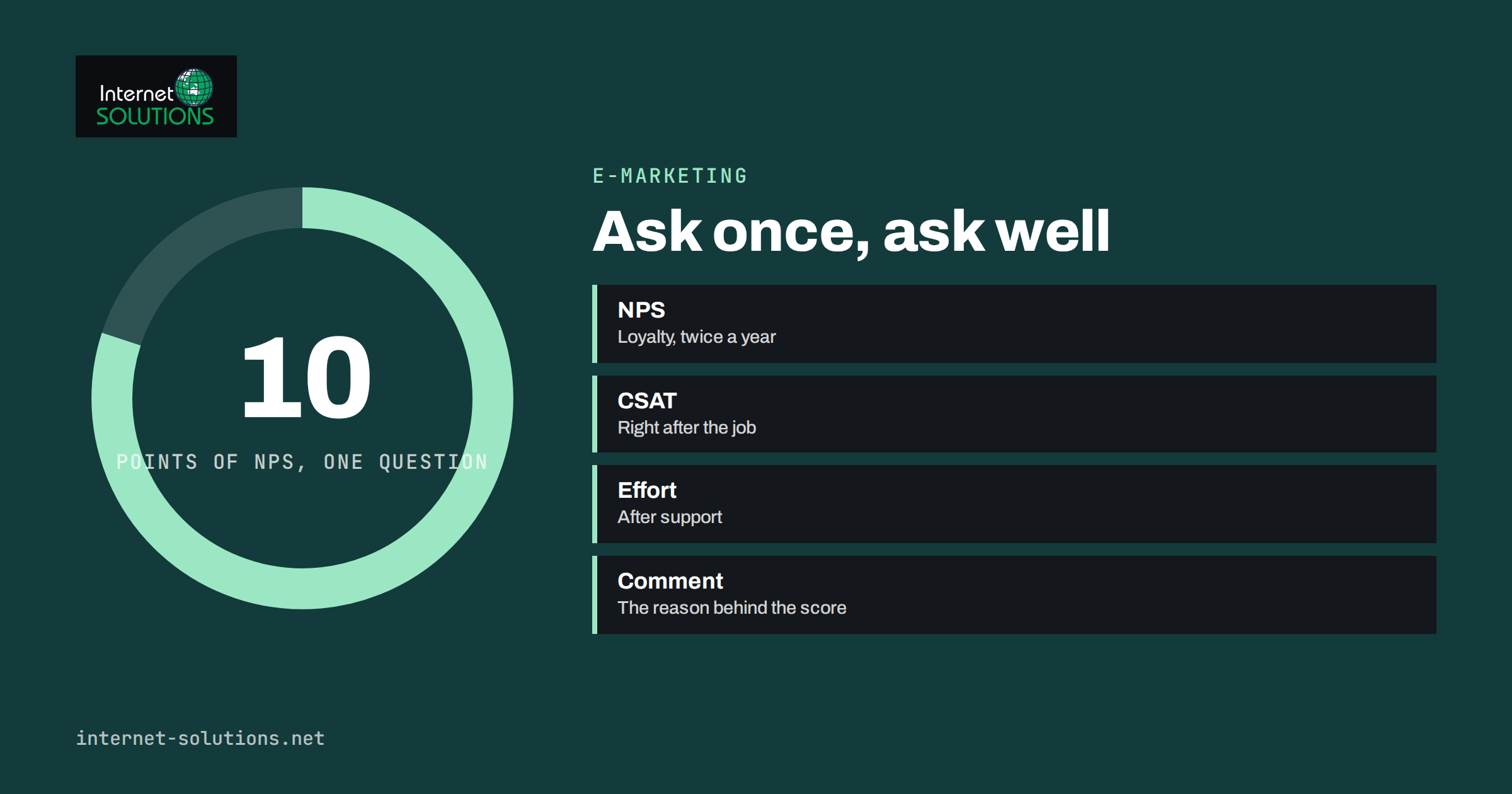
Customer feedback surveys are the cheapest market research a business can run, and one of the most often done badly. A long questionnaire emailed to everyone once a year produces a handful of answers from people who are either delighted or furious, while the large silent middle tells you nothing. A short question asked at the right moment, to the right person, and followed by visible action does the opposite: it tells you what is working, what is quietly losing customers and what to fix first. The difference lies in design, timing and what you do with the answers.
This guide covers the three most widely used measures (NPS, CSAT and customer effort), when to ask each one, how to write questions that give honest answers, where to place surveys so people actually respond, how to handle consent, and how to turn results into decisions. It suits small and medium businesses that sell services, products or software and want a practical feedback system without buying an enterprise platform.
Why Customer Feedback Is Worth the Effort
Customers who are unhappy rarely tell you. Many simply leave, and the only sign is a cancelled order, a lapsed subscription or a quiet decline in repeat purchases. A survey gives them an easy way to speak while you can still act. It also shows what you do well, which is just as useful: knowing that customers value fast replies or a particular product feature tells you what to protect and what to promote.
Feedback also feeds marketing. The words customers use to describe your strengths are better copy than anything written in a meeting. Recurring complaints point to website content that needs clarifying, onboarding that needs rewriting or a product problem that needs engineering time. Used well, a survey programme supports e-marketing, support and product decisions at the same time.
The Three Measures That Matter
Net Promoter Score
NPS asks one question: how likely are you to recommend us to a friend or colleague, on a scale from 0 to 10? Respondents scoring 9 or 10 are promoters, 7 or 8 are passives and 0 to 6 are detractors. The score is the percentage of promoters minus the percentage of detractors. The method is described in the overview of the Net Promoter Score. NPS measures overall loyalty and is best asked periodically, such as every quarter or six months, rather than after each interaction.
Customer Satisfaction Score
CSAT asks how satisfied the customer was with a specific interaction, such as a purchase, a delivery or a support conversation, typically on a five-point scale. It is reported as the percentage who chose the top two answers. CSAT is transactional: it is asked right after the thing it measures, which makes it good for finding problems in specific parts of the process.
Customer Effort Score
CES asks how easy it was to get something done, such as resolving an issue or completing a purchase. Ease is a strong predictor of loyalty, particularly in support, where customers care less about delight than about not having to try repeatedly. It is useful after support contacts, onboarding steps and checkout.
Choosing the Right Measure
| Measure | Question it answers | When to ask | Typical scale | Best used for |
|---|---|---|---|---|
| NPS | How loyal are customers overall? | Quarterly or twice a year, to existing customers | 0 to 10 | Tracking relationship health over time |
| CSAT | Was this interaction good? | Immediately after a purchase, delivery or support chat | 1 to 5 | Finding weak points in specific steps |
| Customer effort | Was it easy? | After support, onboarding or checkout | 1 to 5 or 1 to 7 agreement | Reducing friction and repeat contacts |
| Open question | What should we change? | With any of the above, as a follow-up | Free text | Understanding the reasons behind scores |
Most small businesses do not need all three. A service business might run CSAT after each completed job and NPS twice a year. An online shop might use a one-question rating after delivery and an effort question in support. A software team might use NPS quarterly and an effort question after onboarding. Start with the one that answers your most pressing question, and add others only when you have the time to read and act on the results.
Writing Questions That Give Honest Answers
Ask one thing at a time
“How satisfied were you with our speed and quality?” asks two questions. A customer who liked the speed and disliked the quality cannot answer. Split it, or choose the one that matters most.
Keep the wording neutral
“How excellent was your experience?” pushes people toward a high score. “How would you rate your experience?” does not. Avoid loaded adjectives and avoid telling people what you hope to hear.
Use consistent scales
If you vary the direction or length of scales between surveys, comparisons become meaningless. Pick a scale, label the ends clearly and keep it.
Add one open question
A number tells you how someone feels; the sentence next to it tells you why. A single optional question such as “What is the main reason for your score?” produces most of the useful insight. Make it optional so that it does not reduce response rates.
Keep it short
Every extra question loses respondents. For transactional surveys, one rating and one optional comment is enough. For a relationship survey, five questions is a sensible ceiling. The principles of clear labels, few fields and helpful errors from our guide to web form design apply directly to survey forms.
Asking at the Right Moment
Timing determines both the response rate and the quality of the answer. Ask too early and the customer has not experienced the thing. Ask too late and memory fades, or other events colour the answer. A few reliable patterns:
- After a support conversation: within a minute or two of it closing, while the experience is fresh, in the same channel where it happened.
- After delivery: a day or two after the product arrives, not when it ships. The customer needs time to open and use it.
- After onboarding: when a new customer has completed the first meaningful action, such as sending a first campaign or finishing setup, and again after a few weeks of use.
- After a service job: on the day it is finished, with a follow-up question a few weeks later if the result takes time to show.
- Relationship surveys: at a steady rhythm that avoids busy seasons and avoids asking the same people too often.
Never ask for feedback in the middle of a task, and avoid surveying the same customer more than once in a short period. Survey fatigue lowers response rates and irritates people who gave their opinion last week.
Where to Place the Survey
Meet customers where they already are. In-conversation ratings work well for support: our guide to live chat metrics explains how ratings after a chat can sit alongside response-time and resolution measures, and live chat tools such as Talkmio report ratings in the same place as the rest of the conversation data. Email works for post-purchase and relationship surveys, ideally with the first question embedded so the customer can answer with one click. On-site surveys suit visitors who have not bought yet, for example a single question on a pricing or help page asking whether the page answered their question. Printed cards or a link in a receipt suit local businesses with in-person customers.
Whichever route you choose, make the survey work on a phone. Most responses will come from small screens, and a form that needs zooming or scrolling horizontally loses people immediately.
Consent, Privacy and Fair Use
A survey collects personal data, even if it is only an email address and an opinion. In the European Union and many other places, that brings obligations: tell people why you are asking, what you will do with the answers, who sees them and how long you keep them. Keep anonymous surveys genuinely anonymous. If you link answers to customer records, say so. Do not use a survey as a disguised marketing message; sending promotional content under the label of feedback can breach marketing consent rules. The European Commission’s pages on data protection are a sound starting point, and your own privacy policy should mention survey data.
Be careful with incentives. A small thank-you for completing a survey is acceptable in most cases, but offering rewards for positive scores corrupts the data and can be misleading if the results are later published. Never ask only happy customers for ratings that you then display as if they were representative.
Turning Answers Into Action
Close the loop with detractors
When someone gives a low score and a reason, reach out within a day or two. Thank them, acknowledge the problem and fix it if you can. Many unhappy customers become loyal when they see a real response, and it shows the rest of your team that surveys lead to action.
Group comments into themes
Read comments in batches and tag them: delivery, price, quality, support, ease of use, documentation. A simple spreadsheet with counts per theme and a few representative quotes is enough. The goal is to see which two or three themes cause most of the negative scores.
Track trends, not single numbers
A score of 42 means little alone. A score that rose from 31 to 42 after you changed delivery, or fell from 50 to 38 after a price change, tells you something. Record the result, the sample size and what changed that period. With few responses, avoid over-reading small movements.
Share results and decisions
Tell the team what customers said and what you decided to change. Tell customers too: a short note such as “You told us delivery updates were unclear, so we now send tracking messages” shows that answering is worthwhile and raises future response rates.
Turn praise into proof
With permission, use strong comments as testimonials and feed positive customers toward public review sites. Our guide to online reviews and reputation management covers how to ask without breaking platform rules.
Common Mistakes
- Surveying without a plan to act. If nobody owns the results, the programme dies after the first report.
- Chasing the score. Coaching staff to ask for a nine rather than fixing the cause distorts the number and the service.
- Ignoring non-response. If only a few percent answer, results reflect extremes. Improve the timing and the ease of answering before trusting the number.
- Over-surveying. Asking after every tiny interaction trains people to ignore you.
- Averaging everything. One average can hide a very good product line and a very bad one. Segment by product, channel or customer type when volume allows.
- Comparing with other companies blindly. Benchmarks vary widely by industry and method. Compare yourself with your own past results first.
A Simple Starter Plan
- Pick your most important moment, usually the end of a support conversation or the delivery of an order.
- Ask one rating question and one optional comment question at that moment.
- Add a relationship NPS survey twice a year to current customers.
- Name one person who reads comments weekly and replies to low scores within two working days.
- Review themes and trends monthly, and choose one improvement to ship each quarter.
- Tell customers what changed.
After three months, review whether response rates and comment quality are good enough to rely on. If not, change the timing or the placement before adding more questions.
Frequently Asked Questions
What is a good NPS for a small business?
There is no universal good number, because it varies by industry and method. Track your own score over time, compare like with like and focus on the reasons behind detractor and promoter answers.
How many survey questions should I ask?
For a transactional survey, one rating and one optional comment. For a relationship survey, about five questions at most. Each extra question lowers the number of people who finish.
When is the best time to send a survey?
Right after the interaction you want to measure: within minutes for support, a day or two after delivery for products and when setup is complete for software. Avoid asking in the middle of a task.
Do I need consent to send a customer survey?
You need a lawful basis and must be transparent about how you use the answers. Transactional feedback requests are often allowed, but marketing messages disguised as surveys are not. Check local rules and your privacy policy.
What should I do with negative feedback?
Reply quickly, acknowledge the problem and fix what you can. Then tag the comment with a theme, so repeated issues become visible and can be prioritised.
Should I offer a reward for completing a survey?
A small thank-you for completing it is usually fine. Never tie rewards to positive scores, since that corrupts the data and can mislead anyone who sees the results.
The Bottom Line
A good feedback programme is small, timed well and acted upon. Choose the measure that fits the moment, whether that is NPS for loyalty, CSAT for a specific interaction or effort for friction, ask one clear question plus an optional comment, and place the survey in the channel where the experience happened. Handle personal data openly, reply to unhappy customers quickly and group comments into themes so the same few issues stop recurring. Do that consistently and surveys stop being a form-filling exercise and become the clearest source of improvement ideas your business has.