

 English
 Lietuvių
 Latviešu
 Eesti
 Русский
 Polski
 Українська
 Deutsch
 Italiano
 Español
 Français
 Português
 Čeština
 Magyar
 Română
 Ελληνικά
 Türkçe
 日本語
 العربية
 हिन्दी
 Bahasa Indonesia
 Bahasa Melayu
 ไทย
 Tiếng Việt
 বাংলা
Customer Retention for Service Businesses: Keeping Clients Longer
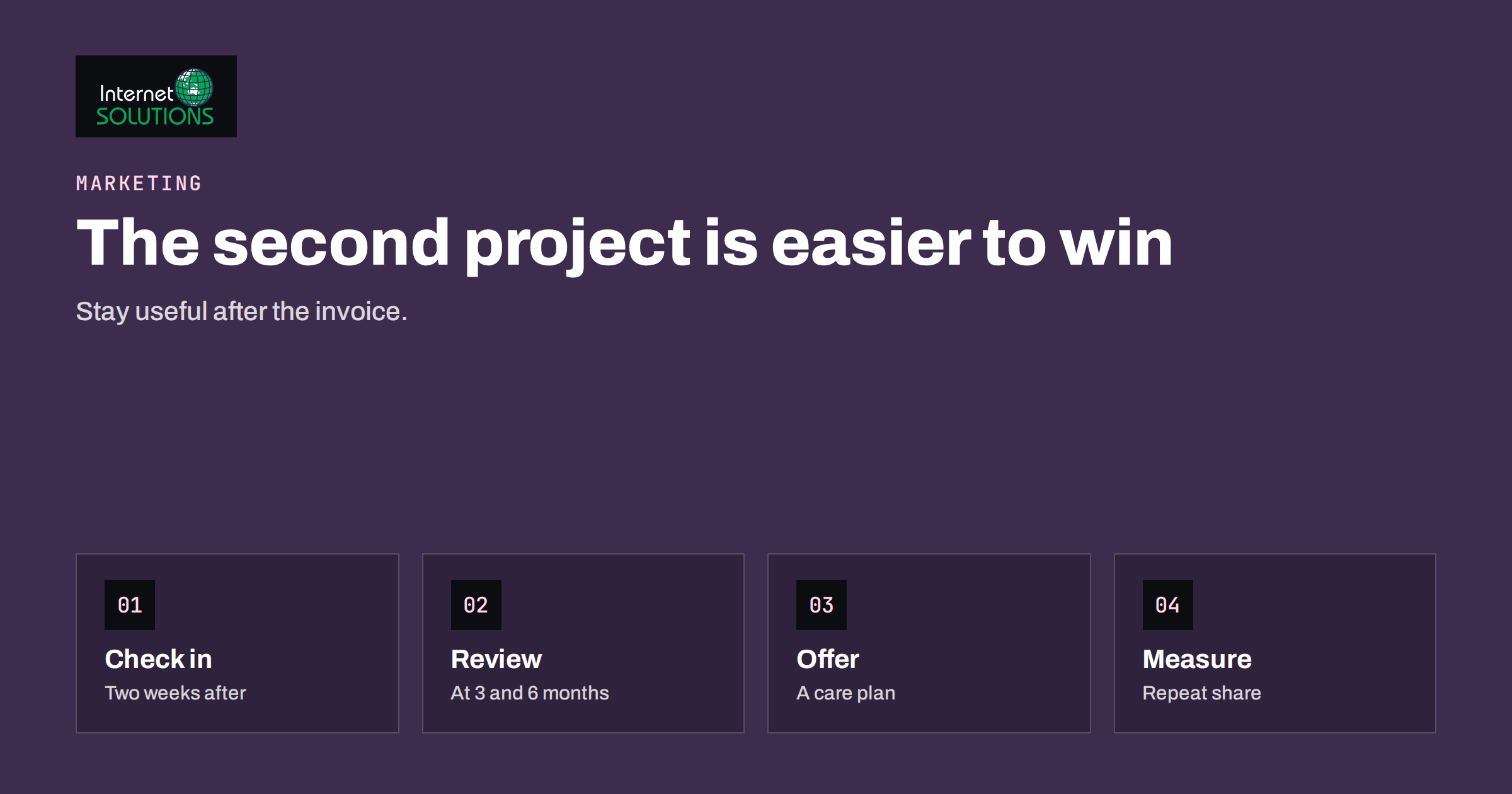
Customer retention is the quiet half of growth for every service business. Agencies, installers, consultants, accountants, repair shops and trades spend heavily to win a first project, and then too often vanish after the invoice is paid. The client moves on, forgets who did the work and, a year later, hires someone else for the next job. Keeping existing clients is usually cheaper than finding new ones, the sales cycle is shorter, and the trust is already built.
This guide describes a practical retention routine for service firms of any size: how to finish projects in a way that invites a second one, what to do in the first weeks and months afterwards, how to offer ongoing care without being pushy, and how to measure whether it works. It focuses on habits you can start this month with a spreadsheet and a calendar.
Why Retention Is Often Neglected
Service teams are busy with delivery. Once a project closes, attention moves to the next one, and nobody owns the relationship. Marketing budgets go to acquisition, because new leads are visible and countable. Retention work is quieter: a message here, a check-in there, a yearly review. Because the benefits arrive later, they are easy to postpone.
The cost of that neglect is not always obvious. A client who simply never returns does not complain. You only see it as a slightly lower revenue line and a constant need to find new work. Looking at the share of revenue that comes from repeat clients, if you have never measured it, is often surprising.
What Makes Clients Stay
Clients return when four things are true. The work was good, and they can explain what they got. Communication was easy and honest. They know you are available and what you can do next. And leaving would cost them something: knowledge of their systems, speed, history or a relationship they value. Retention is mostly the sum of many small acts that keep those four conditions true after the project ends.
- Results they can describe. Send a short summary of what was done and what changed, in their language.
- Easy contact. One named person, one address, a known response time.
- Visible next steps. A short list of recommended improvements, with rough priorities.
- Switching cost that comes from value. Documentation, accumulated knowledge and a care plan make you hard to replace without trapping anyone.
Finish the Project Properly
Retention starts before the project ends. A tidy handover gives the client confidence and gives you a reason to contact them again. Make the close-out a defined step, not an afterthought.
- Hand over documentation. Passwords in a secure manager, instructions, contact details and a list of what was built or changed.
- Review the results. A short call or message: what worked, what did not, what surprised them.
- Ask for feedback. Two or three questions, answered in a minute. If the client is happy, ask for permission to use a short quote or a review.
- Agree the next step. Even if it is only “we will check in in three months”, write it down.
- Send a final summary. A one-page recap with dates and recommendations.
Be cautious with testimonials and public claims. Use only what the client has approved, and never invent numbers. Reviews and local reputation matter, and our guide to reputation management for local businesses shows how to ask for them politely.
A Follow-Up Calendar That Works
Put follow-ups in a calendar the moment the project closes. The aim is helpful contact, not a sales push. A simple pattern covers most firms.
| When | Contact | Purpose | Example message |
|---|---|---|---|
| Two weeks after delivery | Short check-in | Catch problems early | “Is everything working as expected? Any questions I can answer?” |
| Three months | Review call or email | Measure results, spot new needs | “Here is what changed since launch. Two ideas for the next step.” |
| Six months | Useful update | Share a relevant change or tip | “A rule that affects your sector changed; here is what it means for you.” |
| Twelve months | Annual review | Plan the next year | “Shall we review what you needed this year and what is coming?” |
| Any renewal date | Reminder | Prevent surprises | “Your domain, certificate or licence renews on this date.” |
Keep notes in one place, such as a shared client sheet or a simple customer system, with the last contact, next planned contact and open ideas. Our article on routing leads into one pipeline explains how to keep contact history together so that no client is lost between inboxes.
Offer a Care Plan Without Pressure
Many service businesses can offer ongoing care: maintenance, monitoring, regular reports, updates, priority support or a block of hours. The offer works when it solves a problem the client already feels, such as worry about security, a wish for steady improvement or a lack of time. It fails when it feels like a subscription for nothing.
- Define what is included. A short list with clear limits, and what costs extra.
- Show the value in their terms. Fewer outages, faster fixes, predictable cost.
- Make it easy to say no. A client who feels trapped will leave and tell others.
- Report regularly. A one-page monthly or quarterly summary proves that work is done.
- Review annually. Adjust the plan to what the client really used.
For a website business, a monthly plan is a natural fit; the question of what such a plan should include is covered in our guide to website maintenance plans.
Send Useful Content, Not Just Offers
Clients hear from many suppliers. The ones who stay in mind send something genuinely useful: a short note on a change that affects them, a checklist, a seasonal reminder or a link to a good article. A brief quarterly email to former and current clients, written like a personal note, is usually enough. It should have one idea, one call to action and an easy way to reply. Email rules still apply, including consent and an unsubscribe option where required; see our guide to email marketing fundamentals.
Handle Problems as Retention Opportunities
How you deal with a mistake often decides whether the client returns. Respond quickly, acknowledge the issue plainly, explain what you will do and by when, and follow up when it is fixed. Do not blame third parties unless it is truly necessary and factual. Many clients become more loyal after a problem that was handled well than after a project where nothing went wrong, because they have seen what you do under pressure.
Track complaints and near misses in one list, and look for patterns every quarter. If the same problem appears in several projects, change the process, not just the apology.
Measure Retention Simply
You do not need complex software. Three numbers are enough to start.
- Repeat revenue share. What percentage of revenue last year came from clients who had bought before?
- Repeat rate. Of the clients you finished a project for 12 months ago, how many hired you again?
- Time to second project. How many months pass on average between the first and second?
If you later want a more formal measure, the background on customer retention and the Net Promoter Score explains the common metrics, though a simple repeat rate is enough to begin. Review them twice a year. If the numbers are low, test one change at a time, such as a three-month review call, and see whether the rate moves. Keep records of why clients leave, since a short exit question can reveal fixable causes.
A Worked Example
A small company installs and maintains office networks. Historically, it completed about forty projects a year and heard from clients again only when something broke. The owner adds a close-out checklist: documentation, a one-page summary and a short feedback question. A calendar reminder triggers a check-in after two weeks, a review call at three months and an annual review.
The company also introduces a simple monthly care plan with remote monitoring, a quarterly visit and priority response, written in half a page. Within a year, a third of new network clients choose the plan, repeat projects such as extra wireless coverage and device upgrades increase, and the owner spends less on advertising because more work arrives through existing clients and their referrals. When a switch fails, the team replaces it the same day, reports what happened and the client renews without a discussion.
Scripts and Templates That Save Time
Retention habits survive when they are easy. Prepare a small set of templates once, and personalise them in a minute each time. Here are four that work for most service firms.
- The two-week check-in. A short message that thanks the client, asks whether everything works, offers help with questions and says who to contact. Keep it to four sentences, and end with one clear question.
- The three-month review. A one-page summary of what changed since delivery, with a number or two where possible, followed by two suggestions for the next step and an offer of a short call.
- The useful update. A message that begins with a fact relevant to the client’s situation, such as a rule change, a seasonal deadline or a security issue, and explains what, if anything, to do about it. Offer help only at the end.
- The renewal reminder. A note a month before a domain, certificate, licence or contract renews, with the date, the price and the options.
Store the templates where everyone can find them, and record each use in the client sheet. Ask the person who handles the client to adapt the first sentence so that it refers to something specific from the project. A generic message is better than silence, but a message that shows you remember the work is far more effective. Over a year, these small touches create a visible rhythm of contact, and clients begin to think of you whenever a related need arises.
Common Mistakes
- Treating the final invoice as the end of the relationship.
- Contacting clients only to sell.
- Promising ongoing work without defining what is included.
- Having no owner for client relationships.
- Failing to record what was promised or discussed.
- Ignoring small complaints until they become cancellations.
- Measuring only new leads and never repeat business.
Frequently Asked Questions
Why is customer retention cheaper than finding new clients?
Existing clients already know and trust you, so the sales cycle is shorter and the marketing cost is lower. They also understand your process, which makes projects smoother.
How soon after a project should I contact the client?
A short check-in after about two weeks works well, because the client has used the result and problems are fresh. Then schedule a review at three months and a yearly review.
What is a care plan?
A care plan is an ongoing agreement for maintenance, monitoring, support or regular improvements, usually for a fixed monthly fee. It should list what is included and be easy to cancel.
How often should I email former clients?
Often enough to stay in mind but rarely enough to stay welcome. One useful message a quarter is a reasonable pattern for most service firms.
How do I ask for a review without pressure?
Ask after a successful handover, make it a single clear request with a direct link and thank the client either way. Never offer payment for positive reviews.
What should I do when a client wants to leave?
Listen first, ask what is missing and offer to fix real problems. If they still leave, hand over their materials cleanly and ask for brief feedback. A good exit often brings clients back later.
The Bottom Line
Customer retention in a service business is a routine, not a campaign. Close projects with documentation and a review, put follow-ups in a calendar, offer clear care plans where they solve a real problem and send useful messages rather than constant offers. Handle mistakes openly, track repeat revenue and repeat rate, and improve one habit at a time. The second project becomes easier to win because you stayed useful after the first.