

 English
 Lietuvių
 Latviešu
 Eesti
Eesti Русский
 Polski
 Українська
 Deutsch
 Italiano
 Español
 Français
 Português
 Čeština
 Magyar
 Română
 Ελληνικά
 Türkçe
 日本語
日本語 العربية
 हिन्दी
 Bahasa Indonesia
 Bahasa Melayu
 ไทย
ไทย Tiếng Việt
 বাংলা
বাংলাSEO for AI Search: Getting Cited in AI Overviews and AI Answers
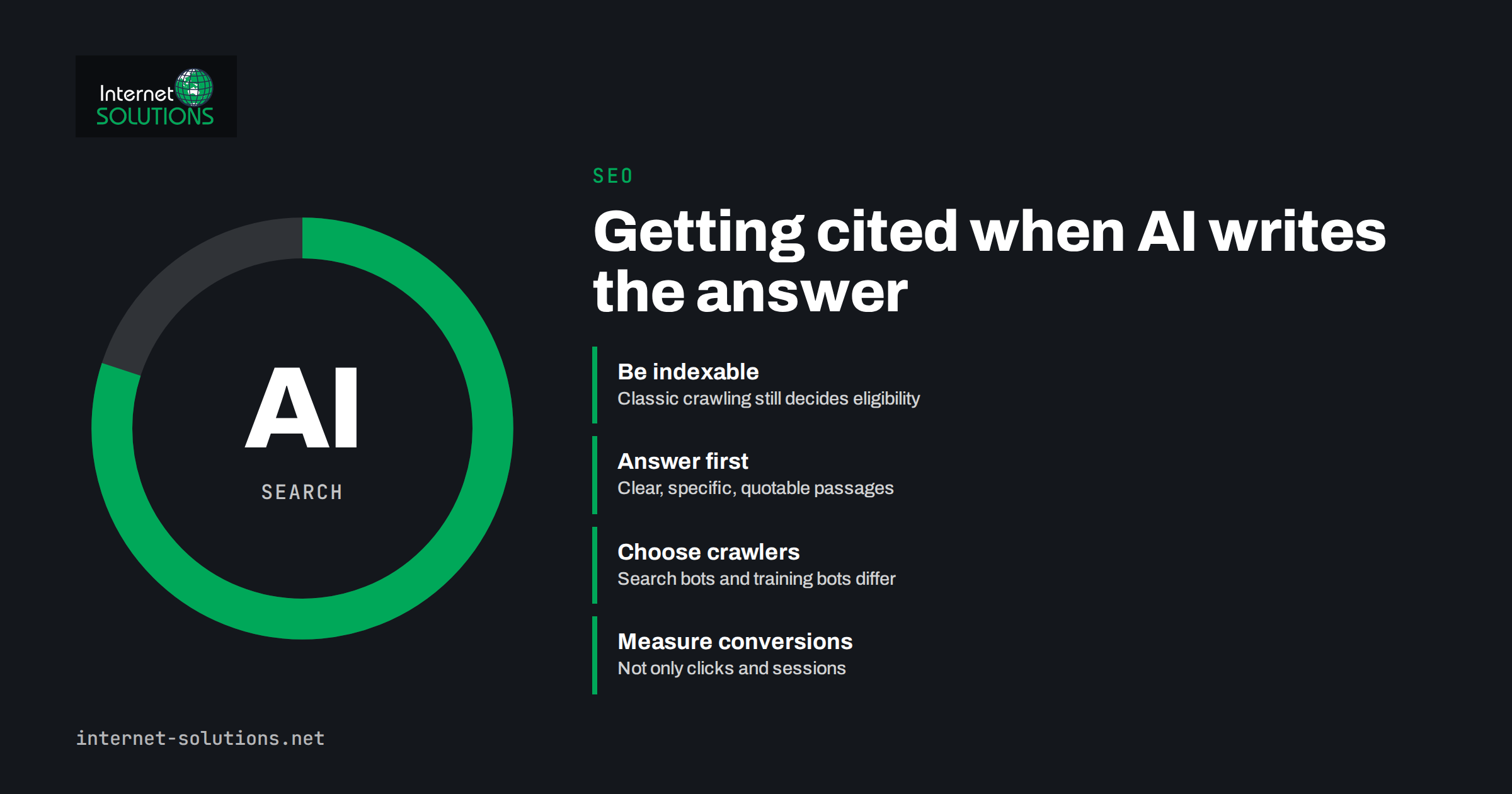
Search no longer ends with ten blue links. Google shows AI Overviews above many results, AI assistants answer questions directly and cite a handful of sources, and a growing share of people ask a chatbot before they ever open a search engine. Business owners reasonably ask what this means for their website. SEO for AI search is the practice of making sure your pages are found, understood and cited when an AI system builds an answer, and of measuring what that visibility is actually worth.
This guide separates the evidence from the hype. It explains how AI answers choose their sources, why the foundations of traditional SEO still carry most of the weight, which adjustments help pages get cited, how to handle AI crawlers, and how to measure results when fewer searches end in a click. It is written for businesses that rely on their website for leads and sales, not for specialists chasing the latest acronym.
How AI Answers Choose Their Sources
AI search features differ in detail, but most follow the same broad pattern. The system interprets the question, retrieves relevant documents from an index, often a regular search index, and then generates an answer that summarises and links to some of those documents. That means two conditions must be met for your page to be cited: it must be retrievable, which is classic crawling and indexing, and it must contain a clear, trustworthy passage that answers part of the question.
Google states this plainly in its documentation on AI features and your website: to appear as a supporting link in AI Overviews or AI Mode, a page must be indexed and eligible to be shown in Google Search with a snippet, and there are no additional technical requirements. The same SEO best practices apply.
What this rules out
There is no special markup that forces an AI citation, no secret file that AI systems prioritise and no shortcut around quality. Offers to “optimise for ChatGPT” that promise guaranteed mentions deserve the same scepticism as old offers of guaranteed first-page rankings.
What it rules in
Everything that helps a page rank and earn a snippet also helps it become a source for AI answers: crawlable pages, clear structure, content that directly answers questions, evidence of expertise, and a site that other reputable sources reference.
The Foundations Still Carry the Weight
Before thinking about AI-specific tactics, check the basics. In our experience, sites that are invisible in AI answers are usually also weak in ordinary search, for the same reasons.
- Indexing: the important pages are indexed, not blocked by robots rules, noindex tags or canonical mistakes. If you are unsure, our guide to why Google is not indexing your pages walks through the checks.
- Content in HTML: the main text is present in the page’s HTML, not only loaded later by scripts or hidden in images and PDFs.
- Speed and stability: pages load quickly and reliably, so crawlers can fetch them without errors.
- Internal linking: important pages are reachable in a few clicks and linked with descriptive anchor text.
- Authority: other relevant sites mention and link to you, which remains one of the clearest signals of trust.
Writing Content That Gets Cited
AI systems cite passages, not whole websites. A page that buries its answer in the fifth paragraph of a long introduction is less useful to them than a page that states the answer clearly and then supports it. Google’s guidance on creating helpful, reliable, people-first content is the best single reference for what quality means here.
Answer first, then explain
Under each heading that poses or implies a question, give a direct answer in the first one or two sentences, then add detail, examples and exceptions. This is good writing for human readers who scan, and it gives AI systems a clean passage to quote.
Be specific
Specific facts, numbers, steps and conditions are more useful than general statements. “Delivery to Germany takes 2 to 4 working days” is citable; “we offer fast delivery across Europe” is not. Where you state figures, keep them current; outdated prices or specifications are a fast way to be quoted wrongly.
Show first-hand experience
AI answers increasingly draw on sources that add something beyond what everyone else says: original data, case studies, tested procedures, clear opinions from people who do the work. A page that restates the consensus in slightly different words has little reason to be chosen over the dozens of pages it copies.
Structure for scanning
Descriptive headings, short paragraphs, lists for steps and tables for comparisons make it easier for both people and machines to extract the right part. Frequently asked questions sections work well when they contain real questions customers ask, answered concisely.
Cover the follow-up questions
AI answers often break a question into several sub-questions. Pages that anticipate the natural follow-ups, such as cost, time, alternatives and common mistakes, have more passages that match. Good keyword research reveals those follow-ups in the form of related searches and questions.
Structured Data and Entity Clarity
Structured data does not guarantee AI citations, but it helps machines understand what a page is about and who is behind it. Organisation details, products with prices and availability, articles with authors and dates, and local business information all reduce ambiguity. Our guide to structured data and schema markup covers which types a business website should add.
Equally important is consistency. Your company name, address, services and key facts should be the same on your website, your Google Business Profile, directories and social profiles. AI systems combine information from many sources; contradictions make them less confident about citing you or, worse, lead them to state the wrong version.
AI Crawlers and Robots Rules
Several AI companies run their own crawlers, and many website owners are unsure whether to allow them. The key is to understand that different crawlers serve different purposes, and that blocking the wrong one can remove you from search features you want to appear in.
| Crawler or control | Operated by | What it is for | Effect of blocking |
|---|---|---|---|
| Googlebot | Crawling for Google Search, including AI Overviews and AI Mode | Pages drop out of Google Search entirely | |
| Google-Extended (robots token) | Controls use of content for training and grounding Gemini models | Does not affect ranking or inclusion in Google Search | |
| OAI-SearchBot | OpenAI | Finding pages to show and link in ChatGPT search results | Pages are less likely to appear as sources in ChatGPT search |
| GPTBot | OpenAI | Collecting content that may be used to train models | Content is not used for training; search appearance unaffected |
| Bingbot | Microsoft | Crawling for Bing, which also supplies results to other services | Pages drop out of Bing and services built on it |
Google lists its crawlers and tokens in its overview of common crawlers, and OpenAI documents its user agents in its bots documentation. A sensible default for most businesses that want visibility is to allow search crawlers and decide separately, as a business question, whether to allow training crawlers. Check your robots.txt and any firewall or bot-protection service, because some security settings block AI crawlers without the site owner knowing.
Measuring Visibility When Clicks Decline
AI answers satisfy some questions without a click. For simple factual queries that is a real loss of traffic. For complex or commercial queries, people who do click through from an AI answer have often already understood the basics and arrive closer to a decision. Measuring only sessions misses that shift.
What to track
- Search Console data: impressions and clicks for your important queries over time. Google includes AI feature appearances in Search Console’s overall performance data, so watch for queries where impressions rise while clicks fall. Our guide to using Google Search Console shows how to read it.
- Referral traffic from AI assistants: analytics tools show visits referred by AI chat services; track them as their own channel.
- Conversions, not just visits: leads and sales from organic and AI referrals. A drop in visits with stable conversions is a very different story from a drop in both.
- Manual spot checks: ask the main AI assistants the questions your customers ask and note whether and how you are cited. Record the answers monthly, since they change.
- Brand searches: growth in searches for your company name often reflects visibility in places where you cannot see the click.
Mistakes to Avoid
The rush to adapt to AI search has produced a few habits that waste money or backfire.
- Mass-producing thin AI-written pages. Publishing hundreds of generic articles in the hope of being cited adds nothing AI systems cannot already generate themselves, and it can drag down how search engines judge the whole site.
- Rewriting everything into question-and-answer fragments. Clear answers help, but pages still need to read naturally and cover the topic properly. Chopped-up content serves neither people nor machines.
- Blocking crawlers by accident. Aggressive bot protection or a copied robots.txt can shut out the very systems you want to be cited by. Review these settings deliberately.
- Chasing mentions instead of customers. Being cited for a trivial question that brings no business is worth less than ranking for a query that produces leads. Prioritise the questions your buyers ask before they buy.
- Ignoring outdated pages. Old prices, discontinued services and stale statistics can be quoted back to potential customers as current facts. Review and update key pages regularly.
A Practical Plan for the Next Three Months
- Month one: foundations. Audit indexing, robots rules and bot-protection settings; fix technical problems; make sure key facts about the business are consistent everywhere.
- Month two: content. Pick the ten pages that matter most for revenue. Rewrite their key sections to answer first and explain second, add specific facts, examples and a real FAQ, and update anything outdated.
- Month three: authority and measurement. Earn mentions on relevant industry sites, publish at least one piece of original data or a detailed case study, set up tracking for AI referrals and start a monthly log of how AI assistants answer your customers’ main questions.
If you would rather have this done for you, it fits naturally into our SEO services, where technical audits, content improvements and reporting already cover both traditional and AI search.
Frequently Asked Questions
What is SEO for AI search?
SEO for AI search means making your pages easy for AI-driven search features and assistants to find, understand and cite. In practice it builds on traditional SEO: indexable pages, clear answers, trustworthy content and consistent information about your business.
Do I need special markup or files to appear in Google AI Overviews?
No. Google says a page must be indexed and eligible to show with a snippet in Search, and that no additional technical requirements apply. Structured data helps understanding but is not a requirement.
Should I block AI crawlers?
It depends on what you want. Blocking search crawlers removes you from their search results, while blocking training crawlers only affects model training. Decide separately for each, and check that security tools are not blocking crawlers you want to allow.
Does blocking Google-Extended remove my site from AI Overviews?
No. Google-Extended controls the use of content for Gemini models, while AI Overviews in Search rely on Googlebot. Blocking Google-Extended does not affect ranking or inclusion in Google Search.
How can I tell whether AI answers cite my website?
Check referral traffic from AI services in your analytics, watch Search Console for impression and click changes, and regularly ask the main AI assistants your customers’ typical questions to see which sources they cite.
Will AI search replace traditional SEO?
Not in the foreseeable future. AI search features rely on the same crawling, indexing and quality signals as traditional search, so strong SEO remains the basis for visibility in both.
The Bottom Line
SEO for AI search is not a separate discipline with its own secret rules. AI answers draw on pages that are indexable, clearly written, specific, trustworthy and consistent with what the rest of the web says about you. Fix the technical foundations, write key pages so they answer first and explain second, add original experience and data, keep business facts consistent, make deliberate choices about AI crawlers and measure conversions rather than clicks alone. Businesses that do this will be cited more often, and the visitors who do click through will arrive better informed and more ready to buy.