

 English
 Lietuvių
 Latviešu
 Eesti
Eesti Русский
 Polski
 Українська
 Deutsch
 Italiano
 Español
 Français
 Português
 Čeština
 Magyar
 Română
 Ελληνικά
 Türkçe
 日本語
日本語 العربية
 हिन्दी
 Bahasa Indonesia
 Bahasa Melayu
 ไทย
ไทย Tiếng Việt
 বাংলা
বাংলাFacebook Ads Learning Phase: Why Results Swing and How to Exit It
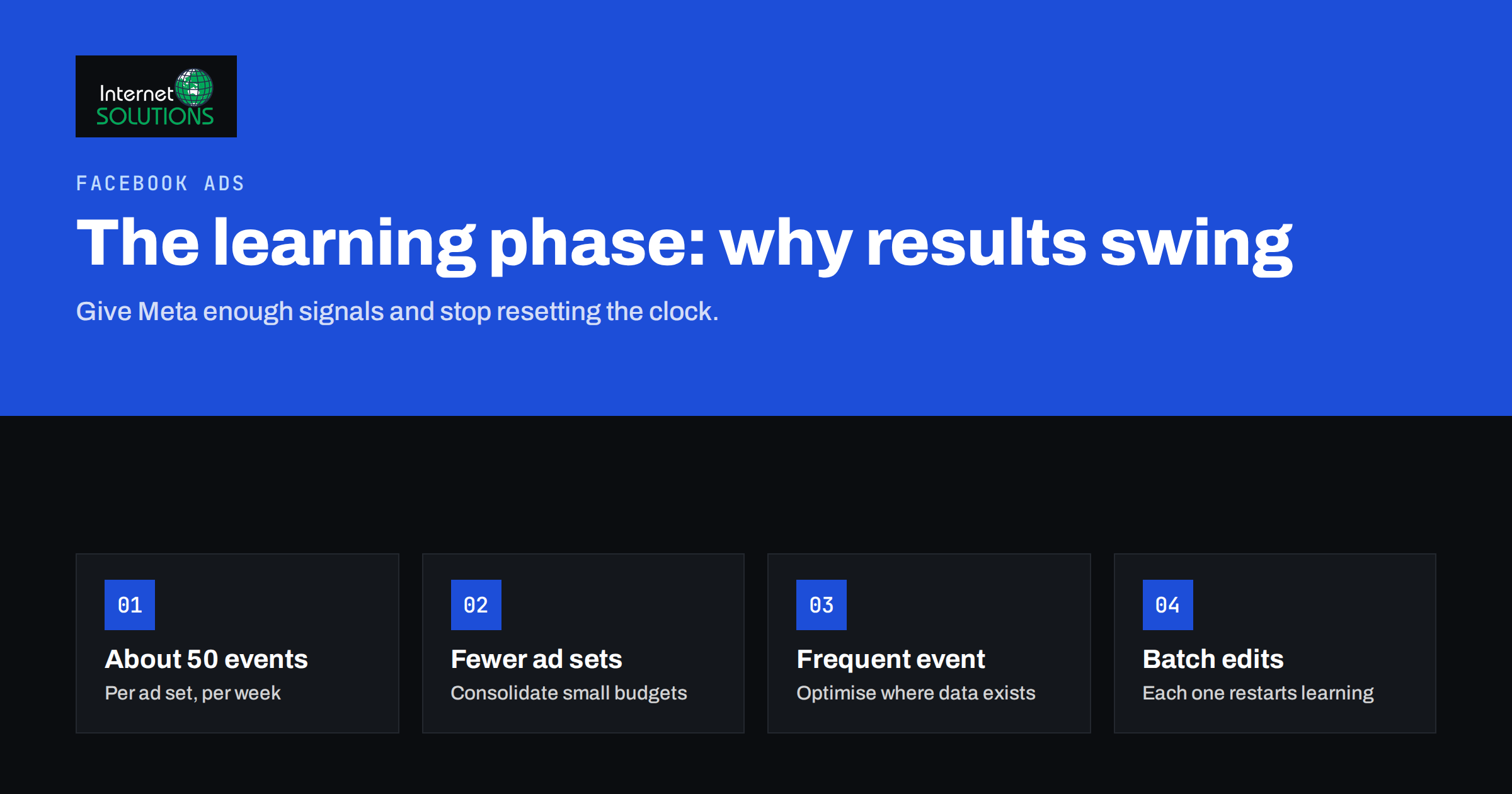
The Facebook ads learning phase is the period after you launch or significantly change an ad set, when Meta’s delivery system is still working out how to spend your budget. During this phase, results tend to be unstable: costs per result jump up and down, delivery may be uneven and yesterday’s great numbers may disappear today. Many advertisers react by editing the campaign again, which restarts learning and keeps the ad set stuck in the most unpredictable stage indefinitely.
Understanding the learning phase helps you make calmer, better decisions. This guide explains what happens during learning, why results swing, what “Learning limited” means, which changes reset learning and how to structure campaigns so ad sets exit the phase sooner. It reflects how our Facebook ads team manages Meta campaigns for small and medium-sized budgets.
What the Learning Phase Is
When an ad set starts delivering, Meta’s system does not yet know which people, placements and times are most likely to produce the result you selected, such as a purchase, a lead or a landing page view. It explores: it shows ads to different segments of your audience, in different placements, and observes what happens. As results come in, it shifts delivery towards the combinations that perform best.
Meta’s help article about the learning phase explains that an ad set generally needs around 50 optimisation events within a week after its last significant edit to exit learning. An optimisation event is the result the ad set is optimised for. If you optimise for purchases, it means about 50 purchases; if you optimise for landing page views, it means about 50 landing page views.
The Delivery column in Ads Manager shows the status of each ad set: Learning while the system is still exploring, Active once learning is complete, and Learning limited when the ad set is unlikely to collect enough events to exit.
Why Results Swing During Learning
Unstable results during learning are normal and expected. Several things contribute:
- Exploration costs money. The system deliberately shows ads to people and placements it is unsure about. Some of those impressions will not convert.
- Small numbers are noisy. With only a handful of conversions, one extra or missing sale changes the cost per result dramatically. Two good days and one bad day can look like a trend when they are simply chance.
- Auction conditions change. Competition varies by day of the week, time of day and season, and these effects are stronger when the system has little data to smooth them out.
- Reporting delays. Conversions can be attributed days after the click, so the most recent days in reports often look worse than they eventually will.
The practical lesson is to avoid judging an ad set on its first few days. Unless results are clearly broken, such as spending with no clicks at all or an obvious tracking error, give it time.
What Resets the Learning Phase
Learning restarts when you make what Meta calls a significant edit. Typical examples include:
- Changing targeting, such as audiences, locations or age ranges.
- Changing creative, or adding a new ad to the ad set.
- Changing the optimisation event, for example from leads to purchases.
- Changing the bid strategy or bid amount significantly.
- Large budget changes, especially sudden big increases.
- Pausing the ad set for a longer period and then turning it back on.
Small budget adjustments and minor edits usually do not reset learning, but frequent changes of any kind make results harder to interpret. Each reset sends the ad set back to exploring, with the volatility that comes with it.
Learning Limited: What It Means and What to Do
“Learning limited” appears when Meta predicts that the ad set will not reach enough optimisation events to exit learning. It is not a penalty, and the ad set keeps delivering, but performance tends to be less stable and less efficient than it could be.
The common causes, and their usual fixes, are summarised below.
| Cause | What it looks like | Typical fix |
|---|---|---|
| Budget too low for the cost per result | A few conversions per week at the current cost | Increase budget or consolidate ad sets so each receives more |
| Too many ad sets splitting the same budget | Several small ad sets, each with few events | Combine similar audiences into fewer ad sets |
| Audience too narrow | Small potential reach, high frequency | Broaden targeting or use broader audience options |
| Optimisation event too rare | Optimising for purchases on a low-traffic store | Optimise for an event further up the funnel, such as add to cart |
| Bid or cost controls too restrictive | Delivery stalls below budget | Raise the cap or switch to a strategy without strict limits |
| Frequent significant edits | Learning restarts every few days | Plan changes in batches and leave ad sets alone between them |
How to Help Ad Sets Exit Learning Faster
Consolidate Your Structure
The single most effective change for small accounts is usually fewer ad sets. If your total budget is split across eight ad sets targeting similar people, each one collects only a fraction of the events it needs. Combining them into one or two ad sets with broader audiences lets each gather data faster. Campaign-level budget, where Meta distributes spend across ad sets automatically, can also help when ad sets are similar.
Choose a Realistic Optimisation Event
Optimising for the event you ultimately care about is ideal, but only if it happens often enough. If a store gets ten purchases a week from ads, optimising for purchases will keep the ad set in Learning limited. Optimising for add to cart or initiate checkout gives the system more signals to learn from. As volume grows, you can move the optimisation event closer to the final purchase.
Set a Budget That Matches Your Costs
A rough check: multiply your expected cost per result by about 50 and compare it with your weekly budget for the ad set. If the budget is far lower, the ad set is unlikely to exit learning on that event. Either raise the budget, consolidate, or choose a more frequent event.
Be Careful With Bid Controls
Cost caps and bid caps can protect profitability, but caps set too low prevent the system from spending enough to learn. Meta’s overview of bid strategies explains how each option affects delivery. Many small advertisers do best starting with the default highest-volume strategy and adding controls only once they have stable data.
Give Creative Enough Variety From the Start
Because adding new ads resets learning, launch an ad set with several strong creative variations rather than adding one new ad every few days. Our article on Facebook ads creative testing on a small budget describes how to plan tests without constant resets.
Making Changes Without Losing Progress
Campaigns still need adjustments. The goal is to make them deliberately rather than reactively.
- Batch changes. Collect the edits you want to make and apply them together, once, rather than one each day.
- Scale budgets gradually. Moderate increases every few days are less disruptive than doubling the budget overnight.
- Test in a separate ad set or experiment. When you want to try a new audience or message, launch it alongside the existing ad set instead of changing the one that is working.
- Decide in advance what you will judge and when. For example: “We review cost per lead after seven days and at least 30 leads.” This prevents decisions driven by one bad afternoon.
- Keep a change log. A simple note of what was changed and when makes it much easier to explain later shifts in performance.
Make Sure Tracking Is Reliable
The learning phase depends entirely on the events Meta receives. If conversion tracking is incomplete or inaccurate, the system learns from the wrong signals, and no amount of patience will fix that. Before blaming the learning phase for poor results, check that:
- The Meta Pixel and, where possible, the Conversions API send the events you optimise for.
- Events are not duplicated or missing on key pages, such as thank-you and order confirmation pages.
- Your domain and events are configured correctly in Events Manager.
- The conversion window and attribution settings match how your customers actually buy.
Our guide to conversion tracking with GA4, Google Tag Manager and the Meta Pixel covers the setup in detail.
A Practical Example
Consider a small online shop with a weekly budget of 350 euros and an average cost of 25 euros per purchase from Meta ads. That budget produces about 14 purchases a week, far below the roughly 50 needed to exit learning. If the shop also splits the budget across four ad sets, each one receives only a few purchases.
A better setup would be one or two ad sets with broad targeting and several creative variations, optimised for add to cart if that event occurs four or five times as often as purchases. The ad sets now have a realistic chance of leaving learning, results become more stable, and the shop can still judge success on purchases and revenue in its reports. As sales volume grows, it can test switching the optimisation event to purchases.
How to Report Results During Learning
Clients and managers often see campaign numbers before anyone has explained the learning phase. A few reporting habits prevent unnecessary panic and rushed changes.
- Label the period. Mark in reports which days an ad set spent in learning, so early volatility is not compared directly with stable periods.
- Use longer date ranges. Weekly or fortnightly figures are far more meaningful than daily ones for small budgets.
- Show the number of results alongside the cost per result. “Cost per lead 40 euros from 3 leads” tells a very different story from the same figure based on 60 leads.
- Explain planned review dates and what will be decided at each one, so stakeholders know when changes will happen.
This kind of transparency makes it much easier to leave a campaign alone long enough for it to stabilise.
Common Mistakes to Avoid
- Editing every day because results fluctuated, keeping ad sets in learning permanently.
- Splitting small budgets across many ad sets and audiences.
- Optimising for rare events with budgets that cannot produce enough of them.
- Judging performance after two or three days instead of after a meaningful number of results.
- Ignoring tracking problems and treating the learning phase as the explanation for everything.
- Doubling budgets overnight when a campaign starts working, then wondering why results drop.
Frequently Asked Questions
How long does the Facebook ads learning phase last?
There is no fixed duration. An ad set exits learning once it has collected enough optimisation events, which Meta describes as around 50 within a week after the last significant edit. With low budgets or rare events, this can take much longer or not happen at all.
Should I turn off ads that perform badly during learning?
Not immediately, unless something is clearly broken. Early results are noisy. Set a review point based on time and number of results, and decide then.
Does increasing the budget reset learning?
Large, sudden budget changes can trigger a reset. Moderate, gradual increases are less likely to disrupt delivery.
Is Learning limited bad for my campaign?
The ad set still delivers, but it may perform less efficiently. Treat it as a signal to consolidate ad sets, broaden targeting, raise the budget or choose a more frequent optimisation event.
Can I add new ads without resetting learning?
Adding a new ad to an ad set is usually a significant edit. To keep testing without constant resets, launch ad sets with several variations or test new creative in a separate ad set.
Does the learning phase apply to Advantage+ campaigns?
Automated campaign types also need data to optimise delivery, so the same principles apply: give them enough budget and events, and avoid frequent significant changes.
The Bottom Line
The Facebook ads learning phase is not a problem to fight but a process to plan for. Results swing because the system is exploring with limited data. Help it by consolidating ad sets, choosing an optimisation event that happens often enough, matching budgets to your costs, keeping bid controls realistic and making changes in deliberate batches. Above all, make sure tracking is reliable so the system learns from the right signals. If you would like an expert review of your Meta campaigns, our online advertising team can assess your account structure and suggest changes that lead to steadier results.