

 English
 Lietuvių
 Latviešu
 Eesti
 Русский
 Polski
 Українська
 Deutsch
 Italiano
 Español
 Français
 Português
 Čeština
 Magyar
 Română
 Ελληνικά
 Türkçe
 日本語
 العربية
 हिन्दी
 Bahasa Indonesia
 Bahasa Melayu
 ไทย
 Tiếng Việt
 বাংলা
Facebook Ads for Local Businesses: Radius, Offers and Walk-Ins
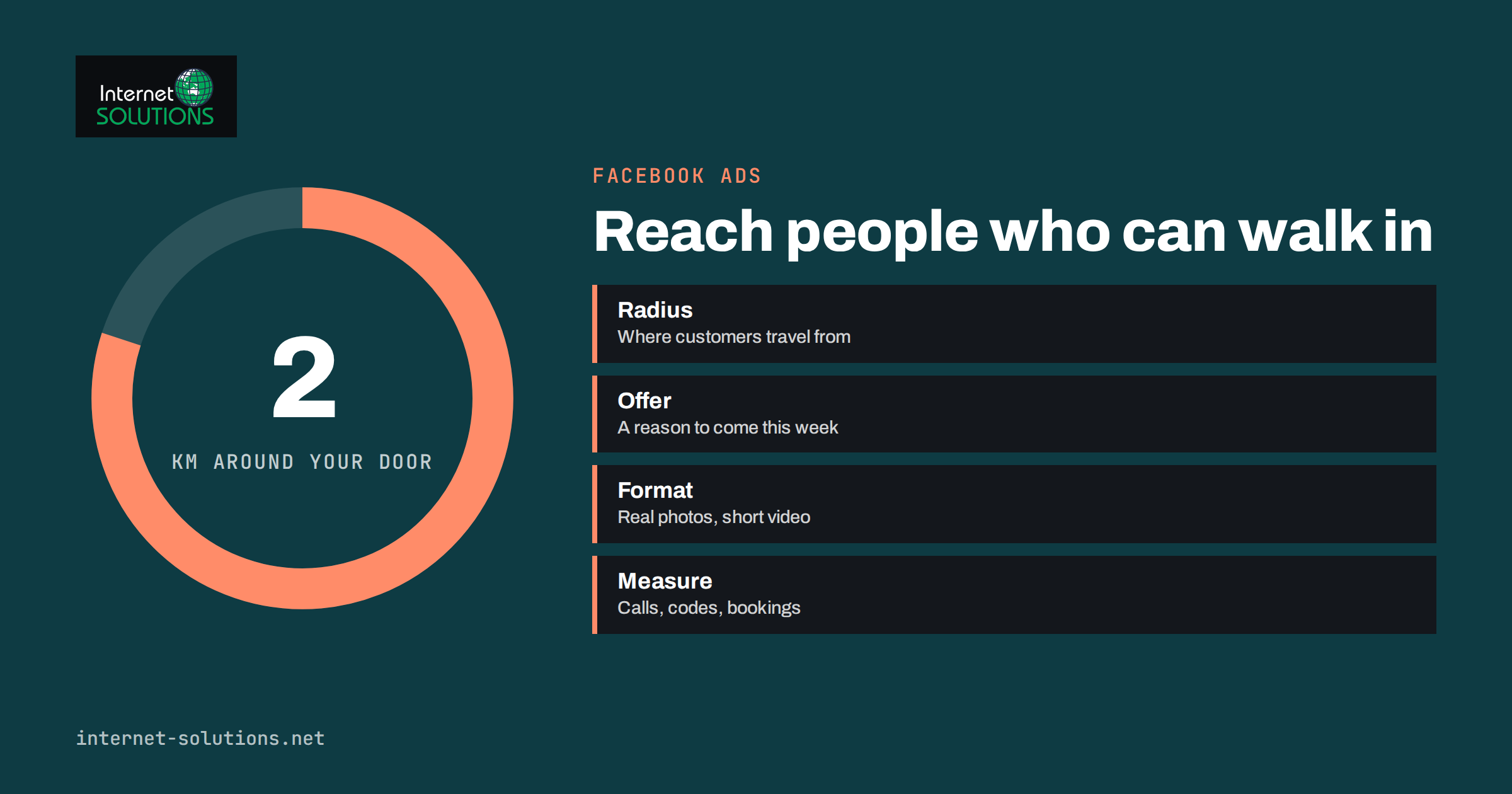
Facebook ads for local businesses work differently from ads for online shops or software companies. A dentist, a restaurant, a hair salon, a garage or a fitness studio does not need clicks from across the country. It needs people within a short distance who can walk in, book an appointment or pick up the phone this week. That changes almost everything about the campaign: how you target, what you offer, which objective you choose, how you read the results and how much money is worth spending.
This guide shows how to set up Facebook and Instagram ads for a business with a physical location or a defined service area. It covers radius targeting, the types of offers that bring people through the door, creative that looks local rather than generic, the objectives and budgets that suit small spending, and ways to measure visits and calls when no online purchase takes place.
What Makes Local Advertising Different
Four things set local campaigns apart.
- The audience is small. A town of 30,000 people might contain 8,000 adults within a ten-minute drive. You cannot show the same ad to the same people for months without wearing it out.
- Distance is a filter and a cost. People will travel only so far for a haircut or a car service. Showing ads outside that range wastes budget.
- The goal is an action in the real world. A booking, a call, a visit or a coupon redeemed at the till. Clicks and likes are only steps along the way.
- Trust matters more than cleverness. Neighbours choose businesses that look real, local and reliable. Photos of your actual premises, staff and work beat stock images.
Keep these points in mind and many decisions become obvious. For example, a campaign aimed at “everyone in the country interested in coffee” is poor value for a single cafe, while a campaign aimed at everyone within two kilometres of the shop is much more likely to succeed.
Location Targeting: Radius, Areas and Travellers
In Ads Manager you set locations at ad set level. You can choose a country, a region, a city, a postcode or a point on the map with a radius around it. Each option suits a different kind of business.
| Option | Best for | Advantage | Risk |
|---|---|---|---|
| Radius around a pin | Shops, cafes, clinics, studios | Matches how far people will really travel | A radius that is too small gives a tiny audience and fast ad fatigue |
| City or town | Service businesses covering one place | Simple, matches how customers describe their location | Includes areas far from your premises |
| Postcodes or districts | Delivery areas, trades covering named districts | Precise control of the service area | More setup; can leave out people who work nearby |
| Several pins with radii | Businesses with multiple branches | Each branch gets its own audience | Overlaps can make branches compete |
| Excluded areas | Cutting out places you do not serve | Avoids wasted impressions | Easy to forget when you add areas later |
Besides the shape of the area, Meta lets you choose who in that area to reach. The options typically include people who live there, people who were recently there and people who are travelling there. For most local businesses, “people who live in this location” or “people living in or recently in this location” is the sensible default. Tourist businesses may add travellers, but the audience tends to be broader and less predictable, so test it separately. The platform’s own Business Help Centre describes the current location options and any limits on radius size, which can change.
A practical way to choose a radius is to look at where your existing customers come from. If you have postcodes from invoices, bookings or deliveries, map them and take the distance that covers about three quarters of your regular customers. For a city centre cafe this may be one or two kilometres; for a garage in a small town, fifteen or twenty. Start there, then widen only if frequency rises too quickly or results are too thin to judge.
Choosing Offers That Bring People Through the Door
Local advertising lives or dies on the offer. A pretty picture of your shop is nice, but the question every viewer silently asks is “why should I act now?” Good local offers share several traits.
- They are specific. “Free parking check with every service this month” beats “great deals”.
- They lower the risk of a first visit. A free consultation, a trial class, a tasting, a no-obligation quote or a first-visit discount.
- They have a deadline or limit. A date, a number of places or a season gives a reason not to postpone.
- They are easy to redeem. Booking link, phone number or a simple code to say at the till.
- They protect your margin. A discount that attracts only bargain hunters who never return is expensive. Offer something that costs you little but feels valuable, such as an extra service or a free upgrade.
Match the offer to the stage of the customer. People who have never heard of you respond to introductory offers. People who visited before respond to reminders, loyalty benefits and seasonal service prompts, such as winter tyres or an annual check.
Objectives and Formats That Suit Local Goals
Ads Manager asks for an objective, and the choice influences who sees your ad. For local businesses a few objectives cover most needs.
- Leads. Best when you collect enquiries, bookings or quote requests. Instant forms keep the process inside the app, which suits phone users. Our guide to Facebook lead ads covers how to design the form and follow up quickly.
- Traffic or sales. Choose these when people can book or buy on your website. Make sure the page works well on a phone and that conversion tracking is installed.
- Engagement with messages. Useful when customers prefer to ask a question in a chat, for example about availability or price. The ad opens a conversation, and speed of reply determines results.
- Awareness. Suitable for a new opening or a rebrand, with a small budget and a short run. It is rarely the best choice for steady lead generation.
On the format side, short vertical video made on a phone often performs well for local businesses. A 15-second tour of the premises, a stylist at work, the chef plating a dish or a mechanic explaining a fault feels authentic. Carousels work for menus, services or before-and-after photos. A single strong image with a clear offer is a reliable starting point. See our article on creative testing on a small budget for a method of comparing versions without wasting money.
Writing Ads That Look Local
People respond to familiarity. A few simple habits make ads feel like they come from a neighbour rather than a national brand.
- Name the place in the first line: “Shoppers in Kaunas Old Town” or “Drivers near the ring road”. It filters the audience and makes people feel addressed.
- Show real faces, premises and results. Use photos taken on your own phone, in good light, with permission from anyone recognisable.
- Give practical details: opening hours, parking, nearest landmark, how to book.
- Include one clear call to action: call, book, message or get directions.
- Use reviews. A short quote from a real customer, with their permission, builds trust more than any slogan.
- Write in the language your customers use. In multilingual areas, test ads in each language separately.
Follow the advertising rules. Meta’s Advertising Standards restrict claims about personal attributes, health outcomes and some other categories that matter to clinics, gyms and beauty businesses. Read them before you write, because a rejection costs time at the start of a promotion.
Budgets and Timing for Small Spend
Local campaigns do not need large budgets, but they need enough to leave the learning phase and produce a readable result. A common starting range is a modest daily budget for at least two weeks, rather than a large amount over two days. The number depends on your average customer value. If a new client is worth several hundred euros over a year, you can afford a higher cost per enquiry than a business selling a single low-priced item.
Some timing considerations:
- Run when you can answer. Ads that generate calls at eight in the evening are wasted if the phone is off until nine the next morning. Respond fast, or use ad scheduling and message auto-replies.
- Plan around your calendar. Promote a quiet period, not a fully booked one. Start a few days before a seasonal peak, not on the day.
- Watch frequency. In a small audience, frequency can climb fast. When people see the same ad too often, results fall. Refresh creative on a schedule; our article on frequency and ad fatigue explains what to look for.
- Avoid too many ad sets. Splitting a small budget between several tiny audiences starves each of them.
Read our guide to campaign and ad set budgets if you are not sure which type to use.
Measuring Visits, Calls and Bookings
The hardest part of local advertising is measurement. When the sale happens at a counter, the platform cannot see it. You can still build a reliable picture with a few simple methods.
- Dedicated tracking phone number or booking link. A separate number or a link with campaign parameters shows which enquiries came from the ad.
- Offer codes. A phrase to mention or a coupon to show at the till lets staff count redemptions.
- Ask every new customer. A single question at booking, “How did you hear about us?”, is cheap and effective. Record the answer in a spreadsheet.
- Website events. Track button clicks for calls, directions and booking forms. Conversion tracking with GA4, Tag Manager and the Meta Pixel explains the setup.
- Offline records. Compare weekly bookings or footfall with ad periods, remembering that other factors, such as weather and holidays, also play a part.
Look at cost per enquiry and cost per new customer, not at reach or likes. If the booking rate from enquiries is low, the problem may be follow-up speed, not the advert.
Connecting Ads, Your Page and Your Reputation
A person who sees your ad will often check your page and reviews before acting. Make sure the Facebook page and Instagram profile are complete: correct address, opening hours, phone number, service list, recent posts and a profile picture that matches your branding. Recent, genuine reviews help conversion more than most ad tweaks. Our guide to online reviews and reputation management shows how to ask for them politely and how to answer negative ones. If your website has live chat, visitors who arrive from the ad can ask a question straight away, which suits the “is this open on Sunday?” kind of enquiry.
Common Mistakes to Avoid
- Targeting a radius far wider than customers will travel.
- Running one generic ad with no offer and no deadline.
- Using stock photos that make the business look like anyone else.
- Sending clicks to a home page instead of a booking page or a local landing page.
- Failing to answer messages and calls quickly.
- Judging success by likes and reach.
- Changing everything at once, so no lesson can be learned.
- Forgetting to pause the promotion after the offer ends.
If you want help planning and running local campaigns, our Facebook Ads service covers setup, creative and reporting.
Frequently Asked Questions
What radius should a local business use?
Use the distance that covers most of your current customers. For city shops this is often one to three kilometres, for suburban or small-town businesses more. Start there and widen only if the audience is too small or frequency rises too fast.
How much should a local business spend on Facebook ads?
Spend what you can afford relative to the value of a new customer, and run long enough to learn. A modest daily budget for two weeks gives more useful data than a large spend over a weekend.
Is boosting a post enough?
Boosting is quick but gives limited control over objective, placement and measurement. Creating a campaign in Ads Manager is better when you want leads, bookings or clear tracking.
Which objective is best for getting phone calls or bookings?
Leads or sales, depending on whether the booking happens in a form or on your website. Use message ads when customers prefer to ask questions first. Whatever you choose, make the next step simple.
How do I know whether ads brought people into the shop?
Use offer codes, a tracking phone number or booking link, and a standard question for new customers. Compare these records with your spend, and do not rely on likes or reach.
Should I advertise in several languages?
If your area has several language communities, yes. Create separate ad sets or ads in each language, so that you can see which one performs better and avoid mixed messages.
The Bottom Line
Local Facebook advertising succeeds when it is small, specific and connected to real-world action. Choose a radius that matches how far customers travel, craft an offer that makes a first visit easy and write ads that look and sound local. Use an objective that fits your booking process, keep the budget realistic and refresh creative before the audience gets tired. Measure with phone numbers, codes and simple questions rather than likes, and make sure the page and reviews they find back up the promise. With those basics in place, a modest budget can keep a local calendar full.