

 English
 Lietuvių
 Latviešu
 Eesti
 Русский
 Polski
 Українська
 Deutsch
 Italiano
 Español
 Français
 Português
 Čeština
 Magyar
 Română
 Ελληνικά
 Türkçe
 日本語
 العربية
 हिन्दी
 Bahasa Indonesia
 Bahasa Melayu
 ไทย
 Tiếng Việt
 বাংলা
SMS Marketing for Small Businesses: Consent, Timing and Tools
SMS marketing is the practice of sending promotional or service text messages to customers who have agreed to receive them. Text messages are read quickly, they reach people without an app or an account and they work on every phone, which is why a bakery, a dentist, a garage or an online shop can all use them successfully. They are also the most personal marketing channel that a small business can use: a message arrives on the same screen as messages from family and friends. That closeness is the reason SMS works and the reason it is regulated more strictly than most channels. A careless campaign can annoy customers, trigger complaints and bring penalties in a way that a careless email rarely does.
This article explains when SMS is the right channel and when it is not, how to obtain consent properly, which rules typically apply, how to write messages that respect the character limits and the reader, when to send, which kinds of tool exist and how to measure the result. It is general guidance and not legal advice. The rules differ by country and by type of message, so confirm the details with an adviser before you send to a new market.
When SMS Is the Right Channel
SMS is best for short, time-sensitive and personally relevant messages. It is a poor fit for long content, images that carry the message or anything that the reader will want to study. Compare it with email and with push notifications.
| Feature | SMS | App push | |
|---|---|---|---|
| Reach | Any mobile phone number | Anyone with a mailbox | Only people who installed the app and allowed notifications |
| Typical use | Reminders, delivery updates, short offers, codes | Newsletters, long offers, receipts, stories | Alerts and engagement inside an app |
| Length | Very short | Unlimited | Very short |
| Cost per message | Paid for each message | Very low | Very low |
| Intrusiveness | High | Medium | Medium |
| Rules | Strict, with explicit consent in most places | Strict but familiar | Platform and consent rules |
Good uses for a small business are appointment reminders, order and delivery updates, booking confirmations, a one-time code, a limited-time offer for loyal customers and a notice that a requested item is back in stock. Weak uses include general promotion to a bought list, long newsletters and anything that could wait for an email. Our introduction to email marketing fundamentals will help you decide what belongs in each channel.
Consent: The Foundation
The central rule is simple: only send marketing messages to people who have clearly agreed to receive them by SMS. The details vary, but the principles are consistent in most places.
- Ask specifically. A consent request for text messages must say that the person will receive text messages, who will send them and roughly what kind. A tick box that is hidden in the terms or pre-ticked does not meet the standard in many jurisdictions.
- Keep proof. Record the phone number, the date and time, the wording that was shown and how the consent was given. This record is your defence if a complaint arrives.
- Separate marketing from service messages. A booking confirmation or a delivery notice is part of a service, and rules for it are different from rules for promotion. Do not slip a promotion into a service message.
- Make opting out easy. Every marketing message should say how to stop, usually with a keyword such as STOP, and the opt-out should work immediately and free of charge.
- Do not buy lists. Numbers collected by someone else have no valid consent for your messages.
In the European Union, the ePrivacy rules and the General Data Protection Regulation apply together. The GDPR defines conditions for consent, including that it must be freely given, specific, informed and as easy to withdraw as to give. National laws implementing the ePrivacy Directive generally require prior consent for electronic marketing, with a limited exception in many countries for existing customers who were offered an opt-out when their details were collected and who receive marketing for similar products. Whether that exception applies to SMS in your country, and under which conditions, needs checking. In the United States, the Telephone Consumer Protection Act and related rules generally require prior express written consent for automated marketing texts, and industry bodies publish detailed best practice such as the CTIA messaging principles. Other countries have their own regulators and registers. Treat this as a prompt to check, not as an answer.
Collecting Numbers the Right Way
Because consent must be explicit, think about where you can ask for it naturally.
- At checkout or booking. A separate, unticked option such as “Send me text updates about my order and occasional offers”. Service updates may be allowed without the offers option, depending on your rules.
- Signup forms on the website. A short form with the number and clear wording, ideally with a confirmation text. The principles of good forms are covered in our guide to lead magnets and signup forms.
- In store or at the counter. A paper or tablet form with the same wording, and a staff member who explains it honestly.
- Keyword opt-in. The customer texts a word to a number, which proves ownership of the phone and consent at once.
- Double confirmation. Send a message asking the person to reply YES to confirm. It reduces typing errors and fake numbers, as explained for email in our article on double opt-in.
Give an honest reason to subscribe. A promise of exclusive early access, a useful reminder service or a welcome discount works better than vague wording, and it attracts people who actually want the messages.
Writing Messages That Fit
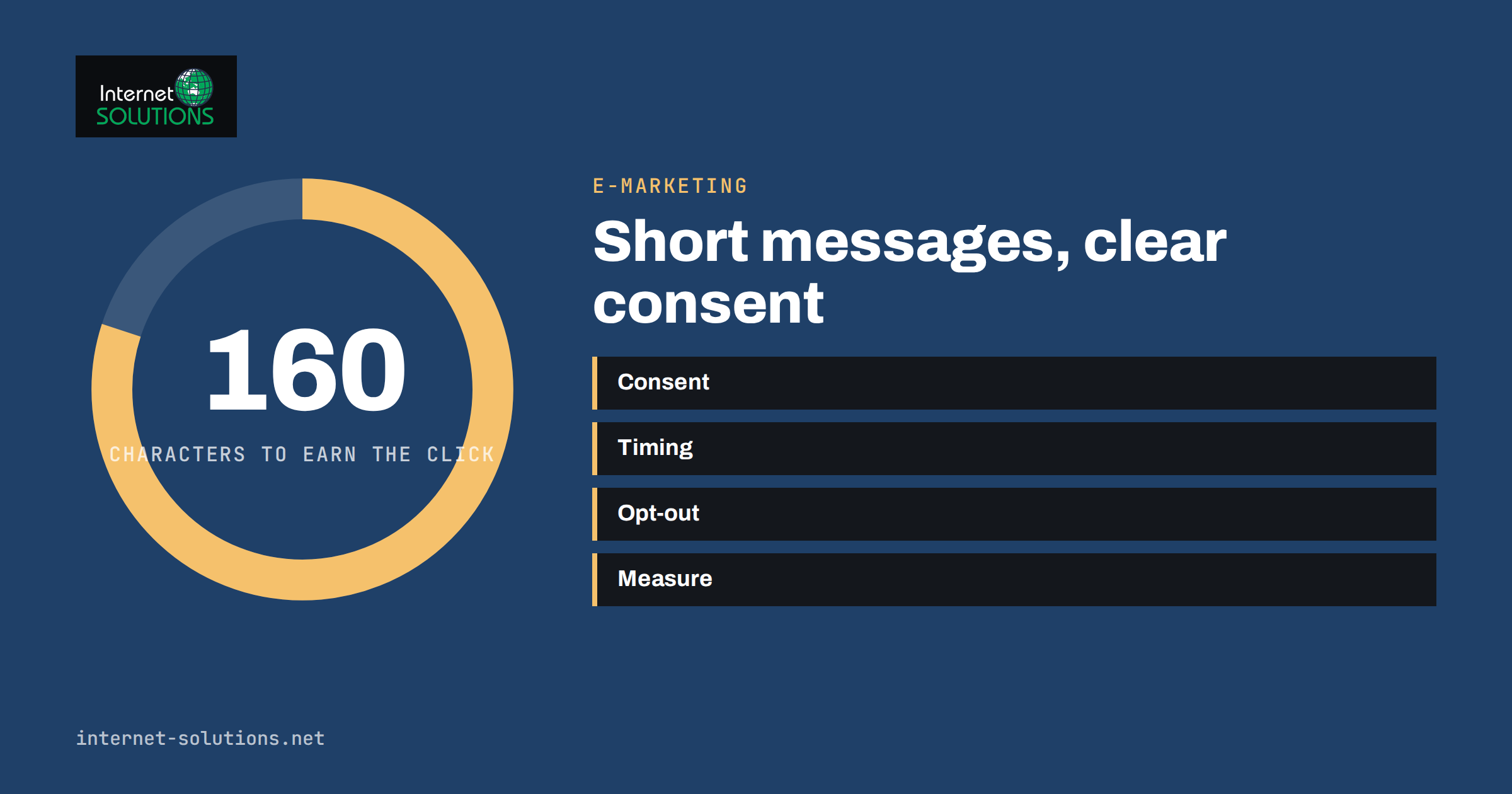
A standard text message has a limited length. With the common GSM alphabet, a single message holds 160 characters, and longer ones are split into linked parts of about 153 characters each. If a message contains characters outside that alphabet, such as many accented letters, some symbols or emoji, the encoding changes and a single message holds only about 70 characters, so the same text may be billed as several messages. Check how your provider counts, and test with the languages that you use.
- Say who you are first. Start with the business name, because the sender may show only a number or a short name.
- One purpose per message. A reminder, an offer or an update, not all three.
- Put the useful part early. The time of the appointment, the offer and its end date, the order status.
- Use a clear call to action. A short link, a phone number or a reply keyword.
- Include the opt-out. For marketing, add a line such as “Reply STOP to opt out”.
- Write like a person. Avoid capital letters, repeated exclamation marks and promotional phrases that look like spam.
Examples that work: “Bright Smiles: reminder of your visit on Thu 14 Nov at 10:30. Need to change it? Reply or call 0123 456 789.” Or “Green Garden Shop: your plants are back in stock until Sunday. Shop: [short link]. Reply STOP to opt out.” Use a link on a domain that you control, because anonymous link shorteners are often blocked by carriers and look suspicious to readers. Our article on UTM parameters explains how to tag links, so that your analytics shows which message brought a visit.
Timing and Frequency
Because a text interrupts, timing is part of the rules and of good manners. Many countries restrict the hours during which marketing messages may be sent, and some have special rules for weekends and public holidays. Even where no rule exists, sending a promotion at night is a quick way to lose a customer. A sensible approach is to send between mid-morning and early evening in the recipient’s own time zone, to avoid early mornings and late nights and to leave Sundays and public holidays for essential service messages.
Frequency matters as much as time. For promotional messages, a small business can usually manage with one to four messages a month, and fewer for those who rarely respond. Let people choose: offer a weekly option and a monthly option, in the same way as the preference options described in our article on email preference centres. Time-sensitive messages such as reminders do not count towards that limit, but they must stay relevant.
Choosing a Tool
Several kinds of tool can send text messages, and the right one depends on volume, countries and integration needs.
- SMS platforms. Dedicated services for campaigns, lists, scheduling and reports. They usually charge per message and sometimes a monthly fee.
- Tools inside your email or shop system. Some email and e-commerce platforms include SMS as an add-on, which makes it easy to connect orders and customer data.
- Appointment and booking software. Many include reminder messages, which is the safest first use of SMS.
- Gateway APIs. Providers that let developers send messages from their own systems, good for transactional messages such as codes and order updates.
When comparing options, check which countries are supported, how sender names are handled, whether opt-outs are processed automatically, how delivery reports are provided, where data is stored, what the price per message is in your target countries and whether numbers need registration. In some countries, sending business messages requires a registered sender identity or campaign, and unregistered traffic may be blocked. Ask the provider before you plan a launch.
Measuring Results and Keeping the List Healthy
SMS gives clear numbers if you track them. Watch the delivery rate, the click rate on links, the number of replies, the opt-out rate and, most importantly, the conversions and revenue that you can link to each campaign. An opt-out rate that climbs after a campaign is a sign that the offer, the timing or the frequency is wrong. Since each message costs money, compare the revenue per message with the cost, and compare SMS with email for the same offer.
- Remove numbers that bounce or are disconnected, and honour every opt-out immediately.
- Keep your consent records and update them when a person changes preferences.
- Review the list regularly, as described in our guide to list hygiene, and drop contacts who have not engaged for a long time.
- Protect the data. Phone numbers are personal data, so limit access and use strong authentication.
A Worked Example
A family-run garden centre has an online shop and a physical store. For years, it sent a monthly newsletter by email. The owner adds an optional text message checkbox at checkout and a counter form in the shop with the wording “Text me when plants and seasonal items I want are in stock, and occasional offers. Reply STOP anytime.” Within three months about one in six customers opt in.
The centre sends three kinds of message: an order-ready notice, a back-in-stock alert for items that the customer asked about and two offers a month, never before ten in the morning or after seven in the evening. Every offer carries a link on its own domain with a campaign tag and the opt-out line. The first spring campaign brings a noticeable increase in sales for the featured plants at a cost per message that is easily covered, and the opt-out rate stays low. When the owner tests a third offer in a month, the opt-outs rise, and she returns to two. She reviews the numbers monthly and keeps the consent records in the customer system.
Common Mistakes
- Texting people who gave their number for another purpose, such as a delivery.
- Using pre-ticked boxes or burying SMS consent in the terms.
- Failing to include or honour the opt-out.
- Sending at night, at weekends or in the wrong time zone.
- Using link shorteners that carriers block.
- Sending too often, so that loyal customers leave.
- Ignoring character encoding, so that costs double without notice.
- Keeping no proof of consent.
Frequently Asked Questions
Do I need consent to send text messages to customers?
For marketing, in most countries yes, and it should be specific to text messages. Service messages that are strictly necessary for a purchase or booking may be treated differently, but check the rules that apply to you.
Can I text people who gave me their number at a purchase?
Not automatically for marketing. Some countries allow messages about similar products to existing customers under conditions, others do not. Ask for explicit consent at the point of purchase to be safe.
What is a good opt-out wording?
Short and obvious, such as “Reply STOP to opt out”, in the language of the message. Process the opt-out at once and confirm it with a single message.
How long can a text message be?
A single message holds about 160 characters in the standard alphabet and about 70 when special characters or emoji are used. Longer texts are split and billed as several parts.
Is SMS better than email?
Neither is better in general. SMS gets read quickly but costs more per message and is more intrusive, while email is cheaper and suits long content. Many businesses use SMS for reminders and urgent offers and email for everything else.
Should I use WhatsApp instead?
Messaging apps can be useful, but they have their own business rules, costs and consent requirements. SMS works on any phone without an app, which is why it remains useful for reminders and codes.
The Bottom Line
SMS marketing works for small businesses when it is built on explicit consent, kept short and relevant, sent at respectful times and measured by results rather than volume. Start with reminders and order updates, add a few well-judged offers, keep proof of consent, honour every opt-out and review the numbers each month. If you want to combine messages, email and your website into one consistent programme, see our e-marketing service.