

 English
 Lietuvių
 Latviešu
 Eesti
 Русский
 Polski
 Українська
 Deutsch
 Italiano
 Español
 Français
 Português
 Čeština
 Magyar
 Română
 Ελληνικά
 Türkçe
 日本語
 العربية
 हिन्दी
 Bahasa Indonesia
 Bahasa Melayu
 ไทย
 Tiếng Việt
 বাংলা
B2B Cold Email: Compliance, Targeting and Deliverability
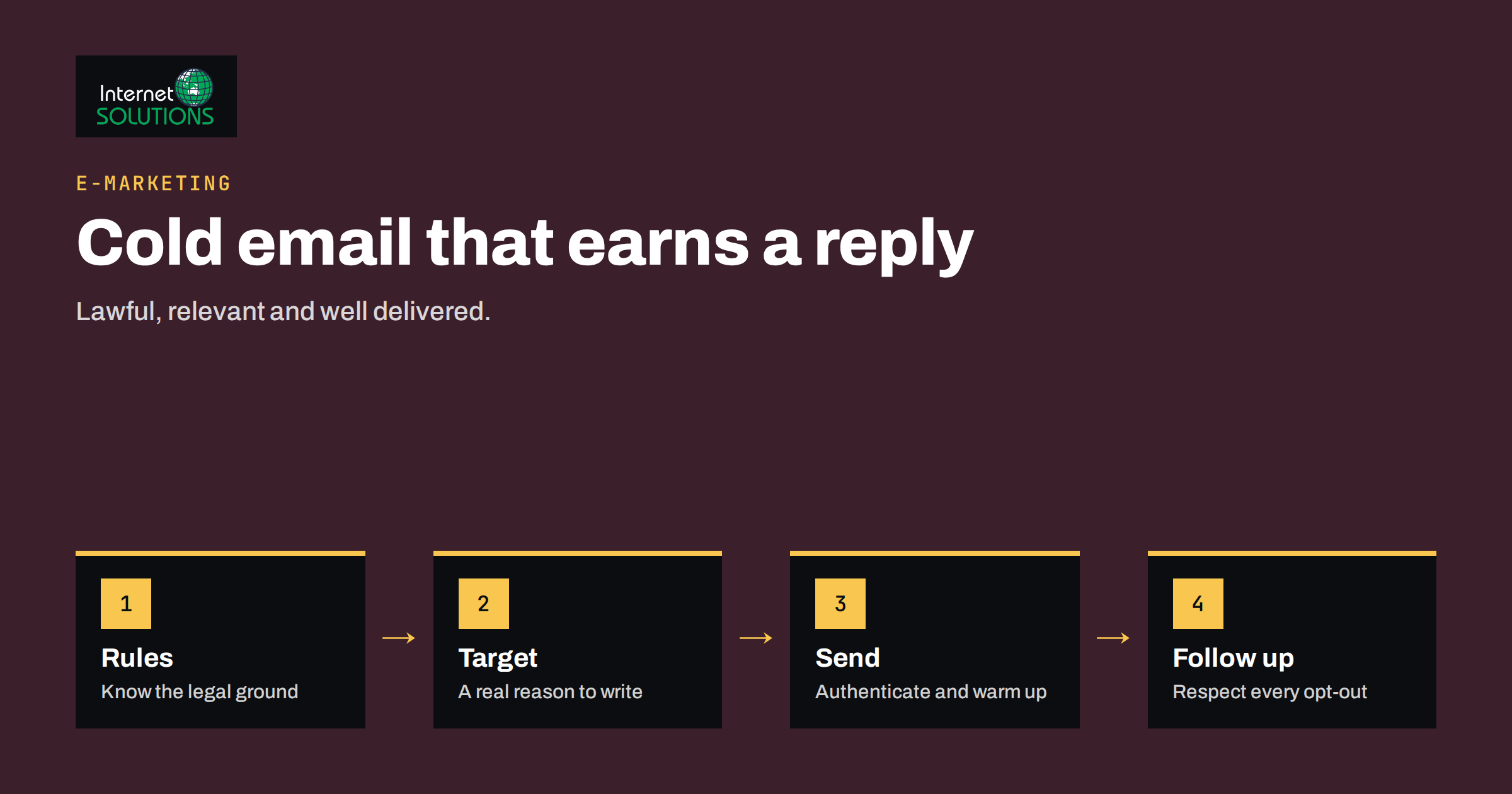
B2B cold email is a first message sent to a business contact who has not asked to hear from you. Done carelessly, it is spam: it damages your domain’s reputation, annoys prospects and can break the law. Done carefully, it is a legitimate way to start conversations with companies that have a real need for what you sell, and for many service businesses it remains one of the cheapest sources of new customers.
This guide covers the three things that decide whether cold outreach works at all: staying within the rules, choosing the right people, and landing in the inbox rather than the junk folder. It also covers writing, follow-ups and measurement. It is general information, not legal advice; rules differ by country and change over time, so confirm the requirements for your market with a qualified adviser before you send anything.
Cold Email Is Not Mass Email
The first decision is philosophical. Mass email sends the same message to thousands of addresses and hopes that a fraction replies. Cold outreach, done properly, sends a small number of relevant, individually considered messages to people who plausibly have the problem you solve. The two behave differently in every respect: replies, complaints, reputation and legal risk.
A practical test: if the recipient could reasonably ask “why are you writing to me?” and your message cannot answer in one sentence, you are not ready to send. The answer might be “you run a clinic with three locations and your website has no online booking”, or “you posted a job for an IT administrator, and we provide outsourced IT support”. Specific reasons make a message relevant, and relevance is what separates outreach from noise.
Keep volume modest, especially at the start. A few dozen well-targeted emails a day from a warmed-up mailbox will usually produce better results than hundreds from a cold one, with far less risk to the domain you use for everything else.
Know the Legal Ground
The legal position on unsolicited business email varies. In some countries, email to business addresses is allowed as long as the message is relevant to the recipient’s role, identifies the sender and offers an easy opt-out. In others, prior consent is required, even for business contacts, or there are different rules for individual traders and companies. Data protection law adds another layer, because a person’s work email address is usually personal data, and you need a lawful reason to process it. The European Commission explains the general framework on its data protection page, and national authorities publish guidance on direct marketing.
- Check the rules for the recipient’s country, not only your own.
- Identify yourself clearly: real name, company, postal address and a way to reply.
- Offer a simple opt-out in every message and honour it quickly, ideally immediately, and never later than the legal deadline.
- Do not mislead in the subject line, the sender name or the content.
- Record the source of each contact, such as a company website or professional directory, so that you can explain where you got it.
- Keep a suppression list of people who opted out or complained, and check every new list against it.
- Be ready to answer requests for access to or deletion of data.
Our guide to email marketing compliance explains consent, unsubscribes and sender rules in more detail. If you are unsure whether outreach to a specific group is allowed, treat that group as off limits until you have confirmed.
Choose Who to Contact
Targeting is the biggest lever on results. A perfect message sent to the wrong person fails; a modest message sent to the right person can succeed. Define your ideal customer in concrete terms before you build a list.
| Dimension | Questions to answer | Example |
|---|---|---|
| Company type | Industry, size, location, business model | Dental clinics with two to five locations |
| Trigger | What event suggests a need now? | New website launched, hiring for a relevant role, new premises |
| Role | Who feels the problem and who decides? | Practice manager for the problem, owner for the budget |
| Problem | What pain do you solve? | Missed appointment requests outside opening hours |
| Proof | What evidence can you show? | A short, relevant example or result |
Build the list from sources you can justify: the company’s own website, public registers, industry directories and genuine professional profiles. Avoid bought lists of unknown origin; they are often out of date, contain spam traps and make it hard to explain where you obtained the data. Verify addresses before sending, and remove role addresses such as “info@” unless they are the proper route for your offer. Quality beats quantity: a list of two hundred carefully chosen contacts can outperform two thousand scraped ones.
Prepare Your Sending Setup
Deliverability starts before the first message. Mailbox providers judge a sender by authentication, reputation, content and recipient behaviour. Make sure the basics are right.
- Use a suitable domain. Many teams send outreach from a separate but related domain to protect the main one. It must be clearly linked to your brand, with a website that explains who you are.
- Set up authentication. SPF, DKIM and DMARC should be correct. Our article on SPF, DKIM and DMARC explains each one.
- Warm up gradually. A new mailbox should build volume slowly, with real conversations; see email warm-up.
- Keep sending limits low. Stay well under the limits recommended by providers, and spread messages across the day.
- Follow sender guidelines. Large providers publish requirements for bulk and unsolicited senders; Google’s email sender guidelines are a good starting point.
- Monitor reputation. Watch bounce rates, complaints and blocklists; see how to check and avoid blacklists.
Avoid practices that look like spam to filters: many links, large images, tracking pixels on every message, URL shorteners, all-capital subject lines and identical text sent to hundreds of recipients. Plain, short messages from a real person’s address with a signature are both friendlier and safer.
Write a Message People Answer
A good cold email is short, specific and easy to answer. Aim for fewer than one hundred and fifty words. The structure is simple.
- Subject line: brief, honest and relevant, such as “Online booking at your three clinics”.
- Opening: one sentence showing why you are writing to them, based on something real.
- Problem and value: one or two sentences about the issue and how you help, with a concrete example.
- Call to action: a small, low-pressure question, such as “Would it be useful if I sent a one-page example?”
- Signature and opt-out: your name, company, contact details and a clear way to decline further messages.
Avoid flattery that is obviously automated, exaggerated claims and attachments from unknown senders. Do not pretend you have had previous contact, and do not use fake “Re:” subject lines. If you use personalisation fields, check them; a wrong company name or a blank space ruins credibility instantly. Personalise the part that matters, the reason for contacting this company, not just the name.
Follow Up Without Becoming a Nuisance
Most replies come after a follow-up, because the first message arrives at the wrong moment. A sensible sequence has three or four messages over two to three weeks, each adding something new: a relevant example, a short question or a useful resource. Do not simply repeat “just checking in”. Stop when the person replies, even with a refusal, and stop immediately if they ask to be removed.
When someone responds positively, reply quickly and personally. When someone replies that now is not the time, thank them and ask whether you may contact them again in a few months. If they say no, record it and leave them alone. People who feel respected, even when they decline, often remember you favourably, and some will come back later. Move interested prospects into a proper nurture process; see lead nurturing for B2B services.
A Sample Message and Why It Works
Here is an example for an IT support provider writing to a small accountancy firm that has just posted a vacancy for an office administrator. Subject: “Who looks after IT while you hire?” Body: “Hello Anna, I saw that your firm is hiring an office administrator. In small offices the new person often ends up handling printers, passwords and backups as well. We provide outsourced IT support for firms of five to twenty people, with a fixed monthly fee and a named technician. Would it help if I sent a one-page checklist of what we usually take over from the first week? If this is not relevant, tell me and I will not write again. Regards, Peter, Example IT Ltd, address, phone.”
The message works because it contains a real trigger, a clear audience, a concrete service, a small request and an honest opt-out. It does not claim a relationship that does not exist, it does not exaggerate and it is easy to answer with one word. Notice what is missing: attachments, links to a long brochure and promises about results.
Handling Replies, Objections and Opt-Outs
Prepare answers for the replies you will receive. The most common are “not now”, “we already have a supplier”, “send more information” and “remove me”. For “not now”, ask when a better time might be and set a reminder. For “we already have a supplier”, acknowledge it and ask whether they would like a second opinion or a backup option, without criticising the current provider. For “send more information”, send something short and tailored, not a generic presentation. For “remove me”, confirm politely, add the address to the suppression list the same day and do not send another message.
Keep your replies consistent across a team by sharing a short document with approved wording and rules for escalation. Record the outcome of each contact in your CRM with the source, date and status, so that follow-ups are timed correctly and nobody writes twice. Treat a pattern of complaints as a signal to stop and review: you may have targeted the wrong group, or used a message that sounded like a mass mailing. Responding quickly and honestly to a complaint often prevents it from escalating to a report with a mailbox provider or a regulator.
Measure the Right Things
Open rates are unreliable because privacy features and image blocking distort them. Focus on measures tied to outcomes.
- Bounce rate. High bounces signal poor list quality and harm reputation. Keep it very low.
- Complaint and opt-out rates. Any complaint is a warning; many mean the targeting or message is wrong.
- Reply rate, separated into positive, neutral and negative replies.
- Meetings or qualified conversations per hundred contacts.
- Cost and time per meeting, including list building and writing.
Test one thing at a time: the subject line, the opening, the call to action or the target segment. Keep notes of what you learn and update the message regularly. If results are poor, look first at targeting, then at the offer, and only then at wording. For wider campaign planning, our e-marketing service combines outreach, email and tracking.
Frequently Asked Questions
Is B2B cold email legal?
It depends on the country and on how you do it. Some places allow relevant business email with identification and an opt-out; others require consent. Check the rules for each market and take legal advice.
How many cold emails can I send per day?
Start with a few dozen from a warmed-up mailbox and increase slowly while watching bounces and complaints. Lower volumes with better targeting usually perform best.
Should I use my main business domain?
Many teams use a separate, clearly branded domain for outreach to protect the main domain’s reputation. Whatever you choose, authenticate it properly.
Do I need an unsubscribe link in one-to-one outreach?
You need a clear and easy way to opt out. A line inviting the person to reply to stop messages can work in some markets, but follow the rules that apply to you.
How long should the message be?
Short: usually under one hundred and fifty words, with one idea and one question.
Can I buy email lists?
It is risky. Bought lists are often outdated, contain traps and make compliance hard to demonstrate. Build lists from sources you can explain.
The Bottom Line
Successful B2B cold email depends less on clever wording than on discipline. Know the rules, choose recipients with a real reason to care, authenticate and warm up your sending, write short and honest messages, follow up politely and respect every opt-out. Measure bounces, complaints and conversations, not vanity numbers, and treat each contact as a person who may become a customer.