

 English
 Lietuvių
 Latviešu
 Eesti
 Русский
 Polski
 Українська
 Deutsch
 Italiano
 Español
 Français
 Português
 Čeština
 Magyar
 Română
 Ελληνικά
 Türkçe
 日本語
 العربية
 हिन्दी
 Bahasa Indonesia
 Bahasa Melayu
 ไทย
 Tiếng Việt
 বাংলা
Domain Names and Trademarks: Cybersquatting, UDRP and Brand Protection
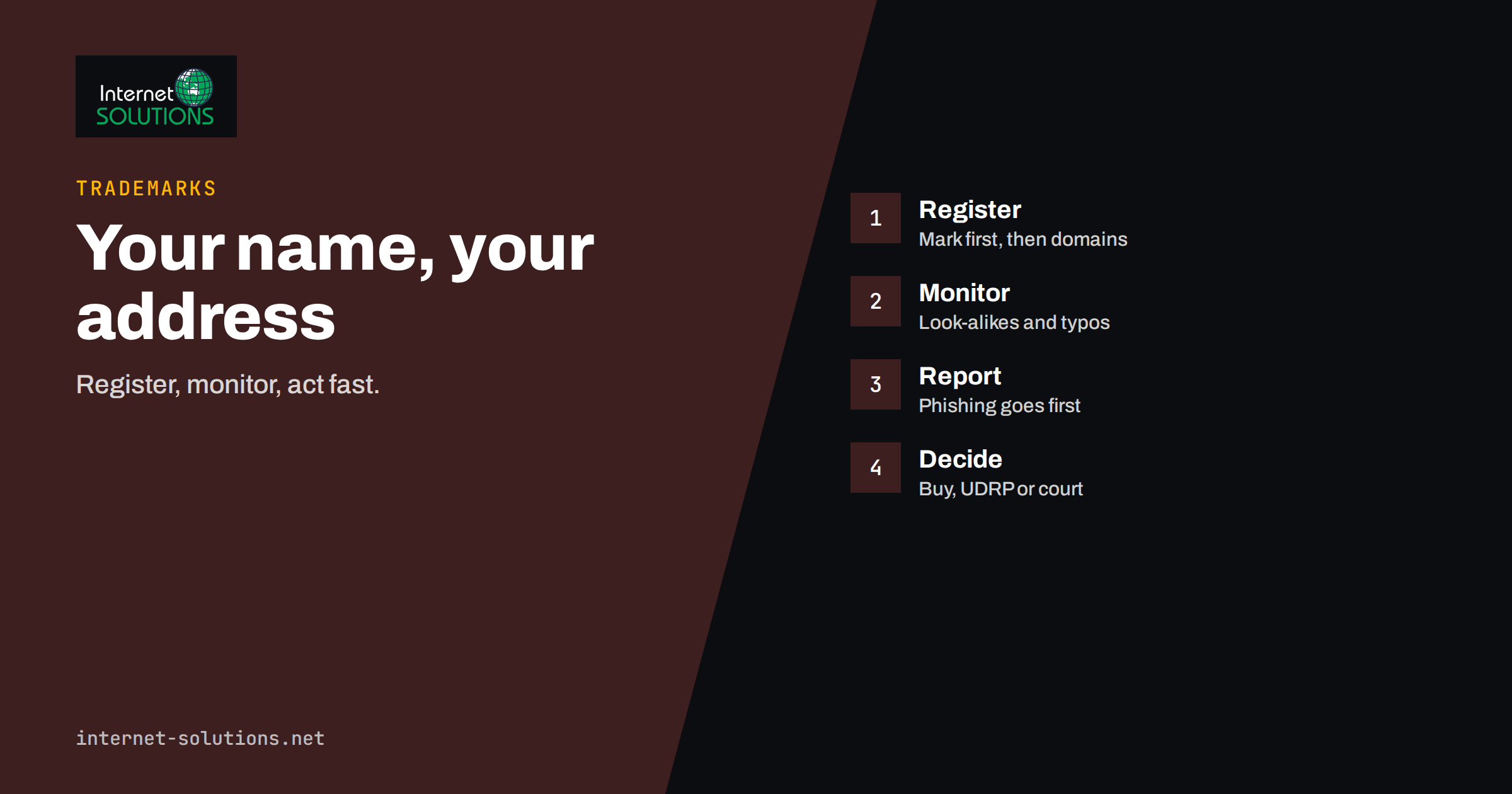
Domain names and trademarks are two different kinds of right that meet in an awkward place: the address bar. A trademark protects a brand name for particular goods and services, in particular territories, against confusingly similar use. A domain name is a unique address handed out on a first-come, first-served basis by a registrar, with no check on whether the name matches anyone’s brand. That mismatch is the source of a large share of brand disputes online: a competitor registers a near-identical name, a speculator buys a name and waits, a scammer copies your spelling with one letter changed and emails your customers a fake invoice.
This guide explains how the two systems relate, what cybersquatting is, how the Uniform Domain Name Dispute Resolution Policy, known as UDRP, works as a faster alternative to court, what you can do to prevent trouble, and how to react when someone else holds a name that looks like yours. It is general information, not legal advice. Disputes turn on facts and local law, so involve a trademark attorney before sending demands or filing complaints.
Two Systems, One Address Bar
Domain registration is administrative. You choose an available name, pay the registry through a registrar and keep it by renewing. Nobody checks whether the name infringes anyone’s trademark before you register it. Trademark rights come from use and, in most countries, from registration, and they are limited by territory and by the type of goods or services. Two businesses in different industries or countries can legitimately own the same trademark, but only one can own a given domain name. So a domain name does not create trademark rights by itself, and a trademark does not give you an automatic claim to every domain that contains the words.
The practical consequence is that brand protection has two parallel tasks: securing the trademark in the right places and classes, and securing the domain names and other online identifiers that customers will use to find you. Neglecting either one leaves a gap. Our article on what to register before you launch explains the order of work.
What Cybersquatting Is
Cybersquatting is the registration or use of a domain name that matches or resembles someone else’s trademark, typically in bad faith, to profit from the confusion or to extract money from the trademark owner. Typical patterns include:
- Straight squatting. Registering a well-known brand name as a domain and offering to sell it to the owner at a high price.
- Typosquatting. Registering common misspellings to catch visitors who make a typing mistake, often to show advertisements or malicious content.
- Look-alike and phishing domains. Names that add a word such as “support” or “login”, or swap similar characters, used to impersonate the brand and steal credentials or payments.
- Different-extension squatting. Taking your name under another extension to divert customers or trade on your reputation.
- Drop-catching. Registering a name the moment a previous owner lets it expire, then using its history and links.
Not every similar domain is abusive. People register generic words, personal names, fan sites and criticism sites in good faith, and unrelated businesses may share a name. The general background on the problem is summarised in the article on cybersquatting, and the legal tests differ by country. Telling abuse from coincidence is the first step of any response.
How the UDRP Works
The UDRP is a policy adopted by ICANN and incorporated into the registration agreements for generic top-level domains such as .com, .net and .org, and many country-code registries use similar procedures. It lets a trademark owner bring an administrative complaint to an approved provider instead of suing in court. WIPO is the best-known provider and explains the process on its pages about domain name disputes. The policy text is published by ICANN as the Uniform Domain Name Dispute Resolution Policy.
A complainant must prove three things, all of them:
- The domain name is identical or confusingly similar to a trademark or service mark in which the complainant has rights.
- The registrant has no rights or legitimate interests in the domain name.
- The domain name was registered and is being used in bad faith.
Evidence of bad faith can include registering primarily to sell the name to the trademark owner or a competitor for more than out-of-pocket costs, registering to prevent the owner from using the name in a corresponding domain as part of a pattern, registering to disrupt a competitor’s business, or using the name intentionally to attract visitors for commercial gain by creating a likelihood of confusion. Panels look at the facts: when the trademark was first used, what appears on the website, how the registrant behaved and whether they have registered other brand names.
The remedies are limited. A successful complaint results in the transfer or cancellation of the domain name. There are no damages and no orders to stop using a similar name elsewhere. Proceedings are conducted online and usually finish in a couple of months, which is far quicker and cheaper than litigation, though a respondent can still go to court. A complainant who brings a baseless case can be found guilty of reverse domain name hijacking, so do not file a weak complaint as a bargaining move.
UDRP, URS and Court at a Glance
| Route | Speed | Outcome | Best used when |
|---|---|---|---|
| Direct contact or purchase | Days to weeks | Transfer by agreement | The name is lightly used, and a fair price is cheaper than a dispute |
| UDRP complaint | About two months | Transfer or cancellation | Clear bad-faith registration of a name matching your mark |
| Rapid suspension (for some newer extensions) | Faster than UDRP | Temporary suspension, not transfer | Obvious abuse where you need quick takedown |
| Local arbitration for country-code domains | Varies | Transfer or cancellation under local rules | The abusive name is in a country extension with its own policy |
| Court action | Months to years | Injunction, damages and transfer possible | Serious or repeated infringement and need for damages |
| Registrar or host abuse report | Hours to days | Content or site removed | Phishing or fraud that must stop immediately |
Prevention: Do These Before a Dispute
- Register your trademark first, or at least file the application, in your key markets and classes. A registered right makes a UDRP complaint simpler and strengthens negotiations.
- Secure the core domain and sensible variants. Your main name under the extensions your customers expect, common misspellings and the singular or plural forms, without buying hundreds of names you will never use.
- Use registrar locks and strong account security. Domain hijacking through a compromised account is a separate and serious risk. Our article on domain name management explains renewals and locks.
- Keep ownership details correct and register in the company name, not a freelancer’s personal account.
- Set up auto-renewal and a calendar reminder, because an expired name can be snapped up within minutes.
- Reserve matching social media handles early, even if you do not use them yet.
- Use email authentication so that impersonators find it harder to send credible mail from your domain.
Monitoring for Trouble
You cannot protect what you do not watch. Watch services alert you to newly registered domains containing your brand name or close variants, and to new trademark applications that resemble yours. Many registrars and specialist providers offer them, and you can run basic checks yourself by searching for your name and typical misspellings. Review alerts regularly and sort them into harmless, worth watching and urgent. Our guide to trademark monitoring describes how watch services work and how to respond to what they find.
What to Do When You Find a Problem
- Capture evidence. Take dated screenshots, record the registration details from a public lookup and note what the site does.
- Assess the case. Do you have prior trademark rights? Is the name used for phishing, competition or just parking? Is the registrant a known squatter?
- Choose the response. For phishing, report to the registrar and hosting provider immediately. For commercial confusion, a cease-and-desist letter from a lawyer is a common first step. For a name held for resale, consider a discreet purchase through a broker, which can be cheaper than a dispute.
- File a UDRP complaint if the three elements are met and negotiation fails.
- Protect customers meanwhile. Warn staff and customers about fake domains, and make sure your official addresses are easy to find.
- Review your own setup, so the same gap does not appear under a different extension.
Be careful about your own behaviour too. Registering someone else’s trademark as a domain, even to sell later, can expose you to a complaint. If you plan to use a name that includes another brand, such as a reseller or review site, check the rules, use clear disclaimers and take legal advice.
A Worked Example
A company that sells a software product under a registered word mark discovers that a new domain with its brand name plus the word “login” has appeared under a different extension. The page copies the company’s logo and layout and asks visitors to enter their account details. The company acts in order of urgency. First, it screenshots the page and records the registration details and the date. Second, it reports the site to the hosting provider and the registrar as phishing, with the evidence, and warns customers through its real website and support channels. Within a day the page is taken down.
The domain itself is still registered, so the company’s lawyer considers the next step. The three UDRP elements are easy to show: the name is confusingly similar to the mark, the registrant has no rights, and the use for phishing is clear bad faith. Because the site is already offline, the company decides to file a complaint to take control of the name and prevent its reuse, and the panel orders a transfer. The company then adds the domain to a defensive portfolio, sets up monitoring for similar names, and updates its customer education page with the real addresses to trust.
Now compare a second case. A hobbyist registers a domain with the brand name and the word “fans” for a discussion forum about the product, with no ads and a clear disclaimer. Sending a demand letter would be heavy-handed and might fail a UDRP test, since the registrant has a plausible legitimate interest. The company chooses to contact the owner politely, ask for a clear notice of non-affiliation and keep the relationship friendly. The two cases show why facts matter more than the mere similarity of names.
Common Mistakes
- Assuming that owning a domain name gives you trademark rights.
- Launching a brand and buying the domain, but never filing the trademark.
- Letting a key domain expire or leaving it in a former employee’s account.
- Buying every possible extension and typo, without a plan to maintain them.
- Sending aggressive demands without checking whether the other party has legitimate rights.
- Filing a UDRP complaint with weak evidence of bad faith.
- Ignoring look-alike domains used for phishing until customers complain.
Frequently Asked Questions
Do I need a registered trademark to bring a UDRP complaint?
You need trademark rights, and registration is the clearest proof. In some cases unregistered rights acquired through use can be enough, but you must prove them with evidence, which is harder.
How much does a UDRP complaint cost?
Provider fees depend on the number of domains and panellists, and legal costs depend on whether you use an attorney. Check the provider’s current fee schedule, and compare it with the value of the name.
Can I recover damages in a UDRP?
No. The only remedies are transfer or cancellation of the domain. Damages require a court action.
Does the UDRP cover country-code domains?
Some country registries have adopted it or a similar procedure, and others use their own rules. Check the policy of the registry for the extension in question.
Is a domain that contains my brand always infringing?
No. Fair use, criticism, resellers with disclaimers, generic meanings and coincidental names can be legitimate. The facts and local law decide.
What is the quickest way to stop a phishing domain?
Report it to the registrar and the hosting provider, with evidence, and to relevant security services. This is usually faster than any legal procedure.
The Bottom Line
Treat domain names and trademarks as a pair. Register the trademark in your key markets, secure the main domain and sensible variants under good account security, monitor for look-alikes and act quickly on phishing. When a dispute arises, collect evidence, choose the lightest effective route and use the UDRP when the three elements are clearly met. Seek legal advice before you send demands or file a complaint. For help planning a brand protection strategy, see our trademarks page.