

 English
 Lietuvių
 Latviešu
 Eesti
Eesti Русский
 Polski
 Українська
 Deutsch
 Italiano
 Español
 Français
 Português
 Čeština
 Magyar
 Română
 Ελληνικά
 Türkçe
 日本語
日本語 العربية
 हिन्दी
 Bahasa Indonesia
 Bahasa Melayu
 ไทย
ไทย Tiếng Việt
 বাংলা
বাংলাE-E-A-T for Business Websites: Showing Experience and Trust
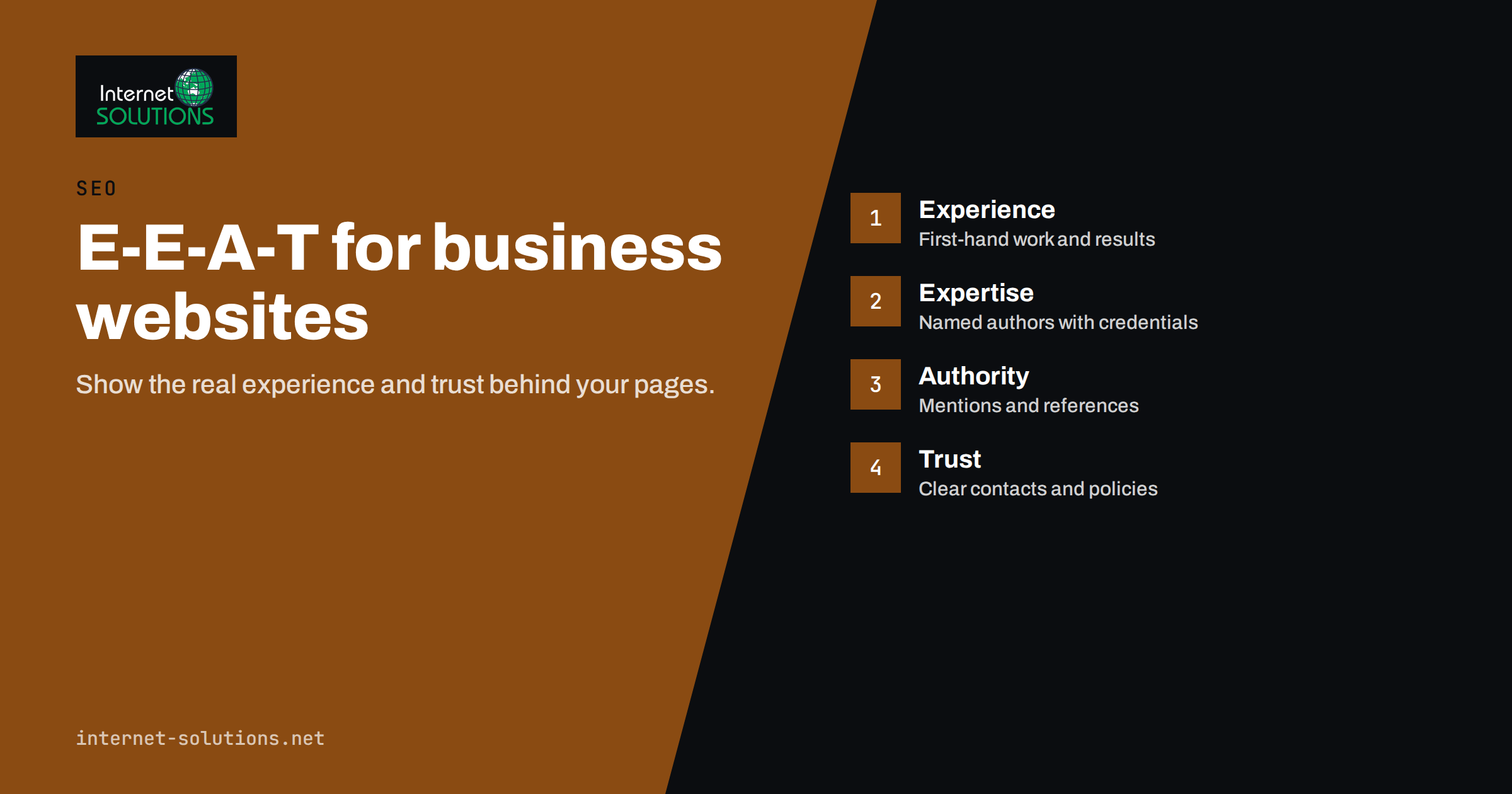
E-E-A-T stands for experience, expertise, authoritativeness and trust. It is the framework Google uses to describe what makes content reliable, and it has become one of the most discussed ideas in SEO. It is also widely misunderstood. E-E-A-T is not a score, a plugin setting or a single ranking factor you can switch on. It is a description of the qualities that Google’s systems try to reward, and the good news for business websites is that most of those qualities already exist inside the company. They simply are not visible on the site.
This article explains what E-E-A-T really means, why it matters more for some pages than others, and the practical changes that show real experience, expertise, authority and trust to both visitors and search engines. The focus is on company websites: service businesses, B2B firms, online shops and software providers.
What E-E-A-T Actually Is
The term comes from Google’s Search Quality Rater Guidelines, a long public document used to train the people who evaluate search results for Google. Raters do not change rankings directly. Their assessments help Google test whether changes to its algorithms produce better results. In December 2022, Google added the extra “E” for experience, explaining in a Search Central blog post that first-hand experience with a topic is an important signal of quality.
The four components are:
- Experience: the creator has actually done, used or lived through what the content describes. A review written by someone who used the product, or a guide written by someone who performs the service every day.
- Expertise: the creator has the knowledge or skill the topic requires. For medical or legal topics, that usually means formal qualifications; for practical topics, demonstrated skill can be enough.
- Authoritativeness: the creator or the website is recognised as a go-to source for the topic, for example through references from other respected sources.
- Trust: the content is accurate, honest and safe, and the website is transparent about who runs it. The guidelines describe trust as the most important member of the family; the other three support it.
Google’s own guidance on creating helpful, reliable, people-first content includes a set of self-assessment questions built around these ideas. It is worth reading in full before planning any changes.
Why It Matters More for Some Pages
Not every page needs the same level of evidence. The guidelines give special weight to topics that could significantly affect people’s health, financial stability, safety or wellbeing, often abbreviated as YMYL, “your money or your life”. A page explaining how to choose a pension provider or how to treat a medical condition must meet a much higher bar than a page about choosing office plants.
For business websites, this means:
- Pages about financial, legal, security or health-related services need clear evidence of qualified authors and accurate, current information.
- Pages that ask visitors to pay, sign a contract or share personal data need strong trust signals: who you are, how to contact you, what the terms are.
- Blog articles and practical guides benefit most from visible first-hand experience: real examples, real numbers where you can share them, and the name of the person who did the work.
Showing Experience
Experience is often the easiest component for a business to demonstrate, because the business does the work every day. The problem is that many company blogs are written to sound generic. They describe what “experts recommend” instead of what the company’s own team does.
Practical ways to show experience:
- Write from practice. Describe how your team actually handles a task, including the steps you skip and the mistakes you see clients make. Specific details are hard to fake and easy for readers to recognise.
- Use your own examples. Anonymised client situations, before-and-after results, screenshots of your own tools and photos of real work are strong signals that the content comes from experience.
- Explain trade-offs. People with real experience know when the standard advice does not apply. Saying “this works for most small sites, but not for large stores with faceted navigation” shows depth.
- Update content when practice changes. An article that reflects how things work today, with a visible update date, signals ongoing experience.
Showing Expertise
Expertise is shown by connecting content to identifiable people with relevant knowledge. Anonymous content published by “Admin” gives readers nothing to judge.
Author Pages and Bylines
Give each regular author a byline linked to an author page. A good author page includes:
- Name, role and a professional photo.
- Relevant experience: years in the field, areas of specialisation, types of projects.
- Qualifications or certifications where they are genuinely relevant.
- Links to the person’s professional profiles and other published work.
- A list of their articles on your site.
If articles are written by a marketing team and reviewed by specialists, say so. A line such as “Reviewed by our server administration lead” is honest and adds credibility.
Accuracy and Sources
Expert content gets the facts right and shows where important claims come from. Link to primary sources such as official documentation, standards and regulations rather than to other blogs repeating them. Avoid absolute statements you cannot support, and correct errors promptly when you find them.
Building Authoritativeness
Authority is the component you control least directly, because it depends on how others see you. It grows from consistent quality over time and from recognition outside your website.
- Focus. A site that covers its core topics in depth earns more authority than one that publishes thin articles on everything. Plan content around the services you actually provide.
- Earned mentions. Industry publications, partner websites, conference talks, podcasts and local media all create references to your company and its people. Our guide to off-page SEO in practice covers ways to earn these without spammy tactics.
- Consistent identity. Use the same company name, address and description across your website, business directories and social profiles, so search engines can connect them.
- Original contributions. Data from your own work, free tools, templates and detailed case studies are the kind of content others link to and cite.
Building Trust
Trust is where many business websites lose points for simple reasons. Visitors and quality raters look for the same things: can I tell who is behind this site, can I reach them, and is the information honest?
| Trust signal | What good looks like | Common gap |
|---|---|---|
| Company identity | Legal company name, registration details and address on an about or contact page | Only a contact form, no company details |
| Contact options | Email, phone or chat, with realistic response expectations | A single generic form that is rarely answered |
| People | Team page with real names and roles | Stock photos and anonymous “our experts” |
| Policies | Clear privacy policy, terms, refund and delivery information | Missing or copied boilerplate policies |
| Reviews and references | Genuine reviews, named client references, case studies | Unverifiable testimonials without names |
| Security | HTTPS everywhere, no intrusive ads, working pages | Mixed content warnings, broken links, outdated copyright |
| Content accuracy | Dated articles, sources, corrections when needed | Old statistics presented as current |
None of these require advanced SEO skills. They require deciding to be transparent and spending a few hours making that transparency visible.
E-E-A-T by Page Type
Different pages carry different expectations. Applying the same treatment everywhere wastes effort; focusing on what each page type needs is more effective.
- Home page: who you are, what you do, for whom and since when, with clear routes to services, team and contact information. Visitors decide in seconds whether the business looks real.
- Service pages: specific descriptions of what is included, how the work is done, who does it and what results clients can expect. Add case studies, client logos used with permission and answers to the questions prospects actually ask.
- Product pages: accurate specifications, real photos, honest availability, delivery and return information, and genuine reviews. Trust problems here translate directly into abandoned carts.
- Blog articles and guides: a named author, a publication and update date, first-hand examples and links to primary sources. This is where experience shows most clearly.
- About and team pages: real people, real roles and a real history. These pages are often the first place quality raters and cautious buyers look when they want to know whether to trust a site.
- Contact page: company name, address, phone or email, business hours and, where relevant, registration details. A complete contact page is one of the cheapest trust improvements available.
Supporting E-E-A-T With Structured Data
Structured data does not create E-E-A-T, but it helps search engines understand the facts you present. Useful types include Organization with your legal name, logo, address and profiles; Person for authors with their job titles; and Article with author and publication dates. Our article on structured data and schema markup explains which types a business website should prioritise.
Keep structured data consistent with what is visible on the page. Marking up an author who does not appear in the article, or reviews that visitors cannot see, undermines trust instead of building it.
An E-E-A-T Review for Your Website
A practical way to start is to review your most important pages with fresh eyes, as a sceptical first-time visitor would:
- Open your top ten pages by traffic and your main service pages.
- For each one, ask: who wrote this, and why should I believe them? Is that visible?
- Check whether the content shows first-hand experience or could have been written by anyone.
- Verify that facts, prices and statistics are current and sourced.
- Check that company details, contact options and policies are one click away.
- List pages that are thin, outdated or off-topic, and decide whether to improve, merge or remove them. A structured content audit makes this systematic.
Prioritise the fixes that affect many pages at once, such as author bylines, an improved about page and a complete contact page, then work through individual articles.
Common Misconceptions
- “E-E-A-T is a ranking factor with a score.” Google has said there is no single E-E-A-T score. Its systems use many signals that align with these qualities.
- “Adding an author box is enough.” A byline helps only if the person is real and qualified, and the content reflects their knowledge.
- “AI-written content cannot have E-E-A-T.” Google evaluates the quality of content, not how it was produced. Content that adds no experience or accuracy, however it was created, struggles; content reviewed and enriched by people with real expertise can perform well.
- “Only big brands can compete.” Smaller businesses often have deeper practical experience in their niche than large publishers. Making that experience visible is a genuine advantage.
Every project in our SEO services starts with a full website audit that covers content, metadata, duplicate and thin pages alongside technical health.
Frequently Asked Questions
Is E-E-A-T a direct Google ranking factor?
Not as a single measurable factor. It describes qualities that Google’s ranking systems aim to reward, using many different signals.
Do all pages need author bylines?
Articles and guides benefit most. Service and product pages need clear company information more than individual authors.
How long does it take to see results from E-E-A-T improvements?
Usually months rather than weeks, because the changes work through recrawling, reassessment and growing recognition. Trust fixes also improve conversions immediately, regardless of rankings.
Does E-E-A-T matter for online shops?
Yes. Clear company details, delivery and return policies, genuine reviews and accurate product information are central to trust for any site that takes payments.
Can a small business show authority without press coverage?
Yes. Depth on your core topics, original case studies, a consistent identity and mentions from partners and local organisations all contribute.
Should I remove old blog posts?
Update the ones that still match your expertise, merge overlapping ones and remove or redirect content that is inaccurate or unrelated to what you do.
The Bottom Line
E-E-A-T is less about SEO tricks and more about letting your real expertise show. Write from first-hand experience, name the people behind your content, link claims to reliable sources and keep information current. Make your company identity, contact options and policies easy to find, and earn recognition through useful work that others reference. The changes help search engines understand why your pages deserve to rank, and they help visitors decide to trust you, which is the outcome that ultimately matters. If you would like help reviewing your site, contact our team.