

 English
 Lietuvių
 Latviešu
 Eesti
 Русский
 Polski
 Українська
 Deutsch
 Italiano
 Español
 Français
 Português
 Čeština
 Magyar
 Română
 Ελληνικά
 Türkçe
 日本語
 العربية
 हिन्दी
 Bahasa Indonesia
 Bahasa Melayu
 ไทย
 Tiếng Việt
 বাংলা
Trademark Clearance Search: How to Check a Name Before You Commit
A trademark clearance search is the check you run before you commit to a business name, product name or logo, to find out whether someone else already owns something too similar. It is the cheapest insurance in branding. A search takes hours or a few days and a modest fee, while a conflict discovered after launch can mean a cease-and-desist letter, a forced rename, reprinted packaging, a lost domain and months of marketing that has to be redone. Many founders skip the step because the name feels unique, the domain is free or a quick online search shows nothing. Unfortunately, none of those facts means the name is clear to use.
This guide explains what a clearance search is, why it differs from simply checking whether a mark is registered, where to search, how to judge similarity, how to read the results and when to involve a trademark attorney. It is general information, not legal advice. Trademark law varies by country, and deciding whether a conflict exists is a legal judgment that depends on the facts.
What a Clearance Search Is, and What It Is Not
A clearance search asks one question: is it safe to use and register this name for these goods or services in these places? It is different from a simple availability check, which only shows whether an identical name has been registered. A clearance search looks for identical and similar marks, in the same and related fields, in the territories where you plan to operate, including unregistered uses that may give someone earlier rights.
It is also different from registering. A search tells you about risk before you file, and registration then gives you a right of your own. If you are still deciding what to register, our guide on what to register before you launch explains the sequence. A search cannot guarantee that nobody will object, because it only covers what can be found, and rights can arise from use that is not in any register. What it can do is reduce the unknowns to a level you can judge.
Why Identical Is Not the Only Problem
A conflict does not require an identical name. Trademark offices and courts generally ask whether consumers are likely to be confused about the origin of the goods or services. That depends on several factors considered together:
- Similarity of the marks. Visual, phonetic and conceptual similarity all count. “Lumivo” and “Lumiva” look close, and “Kwik” and “Quick” sound the same.
- Similarity of the goods or services. A conflict is more likely if both marks cover related products, such as software and IT consulting, than if they cover unrelated ones, such as software and bakery products.
- Strength of the earlier mark. An invented word is stronger than a descriptive term, and a famous mark receives wider protection, sometimes even across unrelated fields.
- The relevant public and the territory. Mass-market products and cheap items are bought quickly, so confusion is easier. The rules apply country by country, or for a region such as the European Union.
- Circumstances such as common endings or shared words. If two marks share a weak or common element, the distinctive parts matter more.
This is why a thorough search covers variations: different spellings, plural forms, translations, words that sound the same and combinations in which your word appears together with another.
Where to Search
| Source | What it covers | Good for |
|---|---|---|
| National trademark office databases | Marks registered or applied for in one country | The country where you operate or file |
| TMview | Marks from many national and regional offices in one search | A first multi-country overview |
| WIPO Global Brand Database | International registrations under the Madrid system and other sources | International and treaty-based marks |
| EU trade mark register | EU-wide trade marks | Businesses selling across the EU |
| Company registers | Registered business names | Spotting companies with similar names, though they may not own a trademark |
| Domain registries and WHOIS history | Domain names | Finding similar names in use and possible cybersquatting |
| Search engines and marketplaces | Real-world use | Finding unregistered use, products and social handles |
| Social platforms and app stores | Handles, accounts, apps | Checking whether your name is already used in your sector |
Start with free databases such as TMview and the WIPO Global Brand Database, and then add the national office of every country in which you plan to trade. Do not stop at registers. Unregistered use can create rights in many countries, so a quick manual search for the name, in your sector and in your language, is part of the job.
A Practical Step-by-Step Search
- Define the mark and the goods and services. Write the exact name or logo and a plain list of what you will sell, since similarity is judged by field. Our article on trademark classes helps you describe them.
- Decide the territories. List the countries where you sell, produce or plan to expand within a few years, and note any where copying is common.
- Search identical matches. Enter the exact name in each database. If there is an identical mark for related goods in a key territory, stop and rethink.
- Search similar matches. Try spelling variants, phonetic equivalents, singular and plural, with and without spaces or hyphens, and translations of the meaning. Many databases support wildcards and phonetic search.
- Filter by class and status. Look at marks in your classes and related ones, and note the status: registered, pending, expired or withdrawn. Pending applications can block you later even if they are not registered yet.
- Check the owner and use. A mark that is registered but clearly unused, or in a distant field, may be less of a risk. A mark owned by a large company in a related field is a stronger risk.
- Search the real world. Search engines, marketplaces, app stores, social networks and domain names will show uses that are not registered.
- Record everything. Save the date, the databases, the search terms and screenshots, so that the work can be reviewed and repeated.
Reading the Results
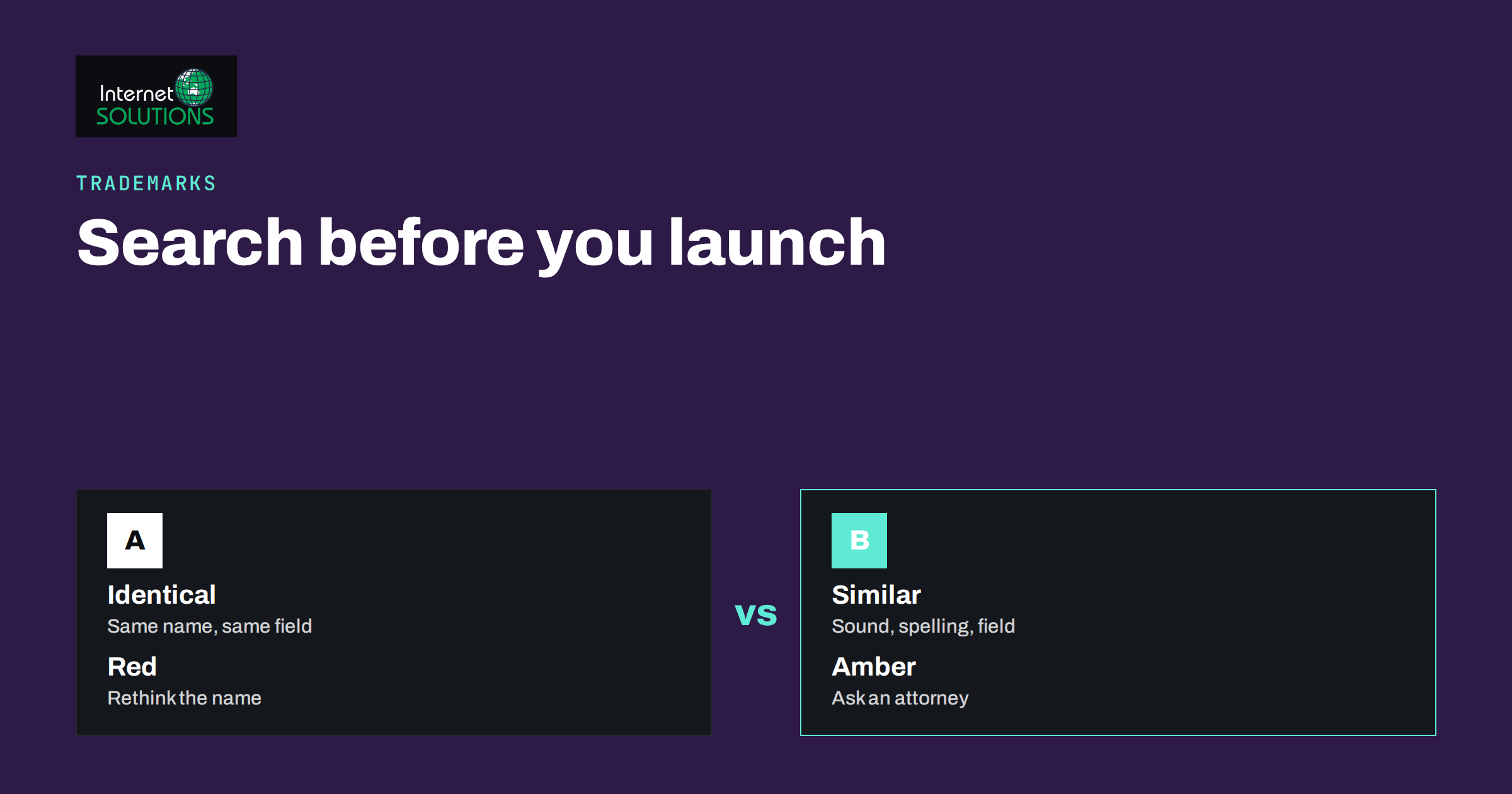
Sort what you find into three groups. Red results are identical or very similar marks for identical or closely related goods in a territory you need. These usually mean you should change the name. Amber results are similar marks in related fields, or marks with a shared element, where the outcome depends on details. These are the cases for an attorney’s opinion, because small differences in goods, markets and wording matter. Green results are marks that are different in appearance and meaning or that are clearly in unrelated fields.
Pay particular attention to prior marks that have been registered by competitors, marks that use the same distinctive word as yours, and marks that sound the same in another language of your target market. A name that is meaningless in English can be an ordinary, descriptive word in another language, which affects both conflicts and registrability. Also check whether the name itself is registrable. Descriptive, generic or deceptive names are often refused even if nobody else uses them.
Common Traps
- Assuming a free domain means a free name. Domains and trademarks are separate systems, and a registered domain gives no trademark rights. Our guide on domain names and trademarks explains the overlap.
- Checking only the home country. Your online shop may sell to people in countries where a conflicting mark exists.
- Searching only the exact spelling. Similar spellings and sounds are where most conflicts live.
- Ignoring pending applications. An application filed earlier than yours can take priority once it is registered.
- Overlooking logos. A device mark or a logo with a distinctive shape may conflict with yours even if the words differ.
- Relying on a company register. A registered company name does not give trademark protection, and a company with a different name can still own a conflicting mark.
- Treating the search as permanent. New applications appear every day, so repeat the check shortly before filing and consider a watch service. Our article on trademark monitoring describes how to keep watching.
When to Use an Attorney
A self-service search is a sensible first filter, and it can quickly eliminate names with obvious problems. It is not a legal opinion. Involve a trademark attorney when you intend to invest significantly in the name, when your search shows amber results, when you plan to file in several countries or when the sector is crowded. Professional searches use commercial databases that cover common-law use, phonetic algorithms and design codes, and an attorney can judge the likelihood of confusion under the rules that apply. Ask what the search covers, which territories and classes, how the results are presented and whether an opinion is included, and agree the price in advance.
If your plan includes several countries, ask also how a registration route such as the Madrid system or an EU trade mark would work, and compare an EU trade mark with national registrations. A trademarks specialist, such as our trademarks team, can run the search, explain the results and prepare the filing.
A Worked Example
A founder wants to launch a software tool for scheduling deliveries and has chosen the name “Routelo”. She searches the national register and TMview and finds no identical mark. A search with variations shows “Routello”, registered in a neighbouring country for logistics software, and “Rutelo”, a pending application for travel services. A quick web search also shows a small company using “Routelo” for hiking maps, without any registration.
She sorts the results. The logistics mark is red, because it covers closely related software in a market where she expects customers. The travel application is amber, because the field is related but different. The hiking maps company is amber for unregistered rights in a field that is somewhat different. She decides not to proceed with the name, rather than invest in a brand that may be challenged in the first year. A week later, she has a second candidate that passes the same process, with only a few amber results, and she asks an attorney to review those before filing.
The exercise cost a few hours, and it saved her from a name she would have had to change after launch.
Frequently Asked Questions
Is a free online search enough?
It is a good first filter, but not a complete clearance. Free databases may not include every territory, may not show unregistered use and cannot assess the likelihood of confusion. For a name you will invest in, consider a professional opinion.
How long does a clearance search take?
A basic self-service search takes a few hours. A professional search with an opinion usually takes a few days to a couple of weeks, depending on the number of territories and classes.
Does registering a company name clear the trademark?
No. A company register only prevents identical company names in that register. Trademark rights are separate, and another business may own a similar mark for similar goods.
What if I find a similar mark that is not in use?
It may still be valid, and in some countries a mark can be cancelled for non-use only after a certain period. The risk depends on local law, so ask an attorney before relying on it.
Do I need to search every country?
Search the countries where you sell, produce or plan to expand, and add those where copying is likely. You can start with a few and widen the search as the business grows.
Can I use a name while the application is pending?
Often yes, but you carry the risk that the application is refused or opposed. A search before launch reduces that risk, and monitoring after filing helps you react to objections.
The Bottom Line
A trademark clearance search checks whether a name is safe to use before you build a brand on it. Search identical and similar marks across registers, domains, marketplaces and social networks in every territory that matters to you, sort the results into red, amber and green, and keep a record. Use an attorney for the amber cases and for names you will invest in heavily, and repeat the check just before you file. A few hours of searching early is far cheaper than changing a name after launch.