

 English
 Lietuvių
 Latviešu
 Eesti
 Русский
 Polski
 Українська
 Deutsch
 Italiano
 Español
 Français
 Português
 Čeština
 Magyar
 Română
 Ελληνικά
 Türkçe
 日本語
 العربية
 हिन्दी
 Bahasa Indonesia
 Bahasa Melayu
 ไทย
 Tiếng Việt
 বাংলা
Training New Chat Operators: A First-Week Checklist for Talkmio Teams
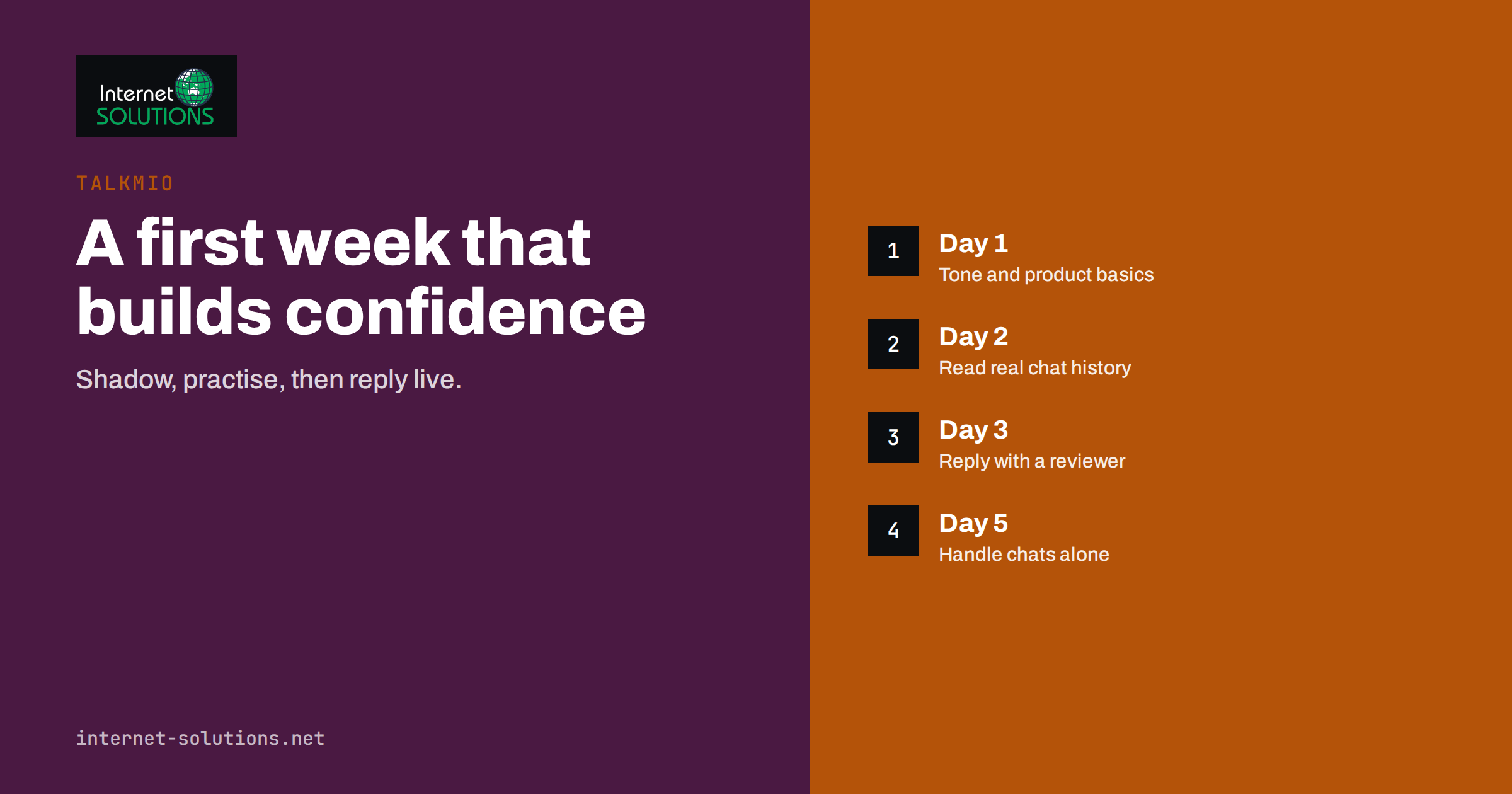
Training new chat operators well in the first week decides how customers experience your company for months afterwards. Chat is fast and public in its own way: every reply is written, saved and often read aloud by a customer to a colleague. A new operator who knows the product but not the tone, or the tone but not the limits, produces replies that confuse or irritate people. A new operator who has a clear plan becomes useful quickly and confident much sooner. This article gives a first-week checklist for teams that use Talkmio, covering what to teach, how to use the inbox and history to learn, how to shadow and review and how to measure progress.
It is written for owners and team leads who add a person to the chat team, whether that is a first hire or the tenth. Talkmio is an AI live chat and inbox for websites: Mio answers visitors first from your own content, and your team steps in from the web inbox when a person is needed. That means a new operator is not answering everything, but handling the conversations that matter most, so training should focus on judgement as much as on knowledge.
What a Good Operator Needs to Learn
Before planning days and hours, decide what “good” looks like. A new operator needs five things.
- Product and service knowledge. Enough to answer the common questions and to know where to find the rest.
- Tone of voice. How your company writes: warm or formal, short or detailed, with or without emoji.
- The tools. The inbox, quick replies, internal notes, assignments, tickets and the visitor information.
- Boundaries. What the operator may promise, which questions go to a manager and what must never be said or asked in chat.
- Handover rules. When and how to pass a case to another person, and how to write a handoff note that saves the next person time.
Write these as a one-page document before the new person arrives. Our article on live chat etiquette is a good base for the tone section.
Before Day One: Prepare the Ground
A calm first day starts with preparation.
- Create the account and set permissions. Give access only to what the role needs. Check the plan to make sure there is an operator seat available, as described in Talkmio plans explained.
- Prepare a short reading pack. Product overview, price list, policies on returns or bookings, the tone guide and ten examples of excellent replies from your own history.
- Prepare ten sample questions for practice, ranging from easy to awkward.
- Name a mentor. One experienced colleague who is available for questions and reviews replies.
- Tell the team. Everyone should know who is new and what the plan is, so that nobody expects full speed on day one.
The First-Week Plan
| Day | Focus | Activities | Done when |
|---|---|---|---|
| Day 1 | Orientation | Company, products, tone guide, tour of the inbox, read the knowledge Mio uses | Operator can describe the product in three sentences |
| Day 2 | Learning from history | Read forty real conversations, mark good and weak replies, learn the quick replies | Operator can name common questions and their answers |
| Day 3 | Practice with a reviewer | Draft replies to sample and live questions, mentor reviews before sending | Replies need few corrections |
| Day 4 | Live with supervision | Handle real chats with the mentor watching, practise handovers and tickets | Operator handles routine chats alone, asks for help on edge cases |
| Day 5 | Review and independence | Handle chats independently for a shift, review results with the lead, agree next steps | Operator and lead agree on a plan for week two |
Day 1 and 2: Knowledge and History
The fastest way to learn the tone and the questions is to read real conversations. Talkmio keeps the full history of each chat in the inbox, so a new operator can read how customers phrase questions, how Mio answered, where a person stepped in and how the case ended. Ask the operator to read forty conversations over the two days and to note three things in each: what the customer wanted, what answer solved it and what could have been better. Discuss the notes with the mentor.
Show the operator what Mio is taught. The knowledge base consists of the website content, the questions and answers you added and the documents you uploaded, and everything Mio says comes from there. Our article on the Talkmio knowledge base explains how to teach and test it. A new operator who knows what the assistant knows will recognise quickly when it hands over and why. Operators are often the first to spot gaps in the content, so give them a simple way to log them.
Day 3: Practice With a Reviewer
On the third day, the operator starts to write. A safe format is the drafting workshop: the mentor shares ten sample questions or recent real ones without personal details, and the operator writes the replies. The mentor reviews them against the tone guide, and both discuss differences. Three habits are worth building at this stage.
- Answer the question first, then add context. Customers read the first line.
- Use the customer’s words. Echoing their wording shows that the message was understood.
- Close the loop. End with the next step or a question that confirms the answer helped.
Introduce the tools that make a team faster: quick replies for repeated answers, internal notes to leave context for colleagues and assignments to claim a conversation. Our guide to the Talkmio inbox workflow describes these features and how teams use them. Remind the operator that quick replies are a starting point and should be personalised, since an obviously pasted answer feels cold.
Day 4: Live Chats With Support
On the fourth day, the operator handles real conversations while the mentor is available, either sitting beside them or watching the inbox. Start with routine questions, and let the mentor take the awkward ones, explaining why. Practise the handover: how to tell a customer that a colleague will take over, how to write an internal note so that the colleague does not need to ask again and how to turn a conversation into a ticket when it needs more time. Set clear rules for what the operator may decide alone, such as small goodwill gestures, and what must be approved, such as refunds or exceptions.
It is also a good moment to talk about staffing and response times. The article on live chat staffing and response times explains coverage and handoff rules, which help a new operator understand why fast first replies matter.
Day 5: Independence and Review
By the end of the week, the operator should handle a shift of routine chats alone, with a way to ask for help. Afterwards, review together. Look at a sample of ten conversations: what went well, what to improve, which questions were new. Check the numbers Talkmio provides, such as conversations per day, first-reply time and ratings, but use them to start a conversation and not to judge a new person against experts. Agree three goals for week two, for example reducing the time to first reply, learning two more product areas and writing three new quick replies.
Ask the operator for feedback on the training itself. They are the best source of information on which parts of the pack were unclear. Update the checklist after each new hire, so that the process improves.
Boundaries and Sensitive Topics
Every team has topics where improvisation is risky. Make the list explicit on day one and repeat it later.
- Prices and promises. Only from the published list or with approval.
- Medical, legal or financial advice. Not given in chat, unless your business is regulated and has defined rules.
- Personal data. Ask only for what is needed. Never ask for passwords or full payment card numbers in chat.
- Complaints and angry customers. Acknowledge, apologise for the experience without admitting fault until facts are known and escalate to the right person.
- Privacy and records. Chat records are personal data and should be handled under your privacy policy.
The general principles of good service are well described in reference works such as the overview of customer service, and the idea of response targets is explained in the article on service level agreements. The product overview of Talkmio lists the features that operators will use.
Week Two and Beyond
The first week gives a foundation, not a finished operator. Plan the next month so that learning continues without overloading the new person. In week two, add more complex topics, such as returns, special orders or technical questions, and let the operator take the lead on a few tickets from start to finish. In week three, ask the operator to write or improve three quick replies and to suggest two additions to the knowledge Mio uses, based on questions that came up. In week four, hold a review: look at ratings, sample a few conversations together and agree on the next skill to develop. Pair the operator with different colleagues for an hour each, since everyone has useful habits. Avoid long periods without feedback, because small bad habits set quickly. Over time, rotate responsibilities so that the new person also trains the next one, which is the best test of how well they understand the work.
A Worked Example
A small online furniture shop adds a second person to its chat team. The owner writes a one-page guide with the tone (“friendly, plain, short sentences”), the boundaries (no promises about delivery dates beyond the published ones, no custom prices without the owner) and ten sample questions. On day one, the new operator reads the product pages and the knowledge Mio uses. On day two, she reads forty conversations and marks three that she thinks are perfect, which the owner discusses with her.
On day three, she drafts replies to ten questions and receives corrections, mostly about opening with the answer. On day four, she handles live chats with the owner nearby, practises handing a delivery complaint to a colleague with a clear internal note and creates a ticket for a custom order. On day five, she works a shift alone. The owner reviews the conversations, notes that first-reply time is good and a few answers are too long, and agrees on goals for next week. The operator also finds that Mio lacks an answer about assembly instructions, and the owner adds one to the knowledge base.
Common Mistakes
- Throwing a new operator into live chats without any reading or practice.
- Teaching only product facts and not tone or boundaries.
- Relying on quick replies so much that every answer sounds pasted.
- Not explaining when and how to hand over a chat.
- Judging a new person by speed alone in the first week.
- Not asking the new operator what the training lacked.
- Forgetting to update the training pack after each hire.
Frequently Asked Questions
How long does it take for a new operator to become independent?
Many can handle routine chats alone after a week with a clear plan, but depth of knowledge and judgement on difficult cases usually take a few weeks more.
Should a new operator answer live chats on the first day?
It is better to start with reading and practice. Live chats with supervision come on the third or fourth day, once the operator knows the product and the tone.
How does the AI assistant affect training?
Mio answers many routine questions first, so operators handle the conversations that need a person. Training should therefore emphasise judgement, empathy and handovers.
What should I measure in the first weeks?
Look at first-reply time, the quality of sampled conversations, ratings and the number of questions that needed help. Use them to coach, not to rank.
Can operators use the mobile app?
Operators can answer chats from a phone as well as from the web inbox. Agree rules for out-of-hours use, so that nobody feels permanently on call.
How do I keep tone consistent across the team?
Keep a short tone guide with examples, share the best conversations and review samples together each month.
The Bottom Line
Training new chat operators works best as a simple, structured week: orientation and a tone guide on day one, reading real conversations on day two, drafting with a reviewer on day three, supervised live chats on day four and an independent shift with a review on day five. Teach the tools, the boundaries and the handover rules as carefully as the product, let new people learn from the history in the Talkmio inbox and review the results with kindness. A clear plan produces confident operators, and confident operators produce the replies that customers remember.