

 English
 Lietuvių
 Latviešu
 Eesti
 Русский
 Polski
 Українська
 Deutsch
 Italiano
 Español
 Français
 Português
 Čeština
 Magyar
 Română
 Ελληνικά
 Türkçe
 日本語
 العربية
 हिन्दी
 Bahasa Indonesia
 Bahasa Melayu
 ไทย
 Tiếng Việt
 বাংলা
Word Mark or Logo: What to Register First for a New Brand
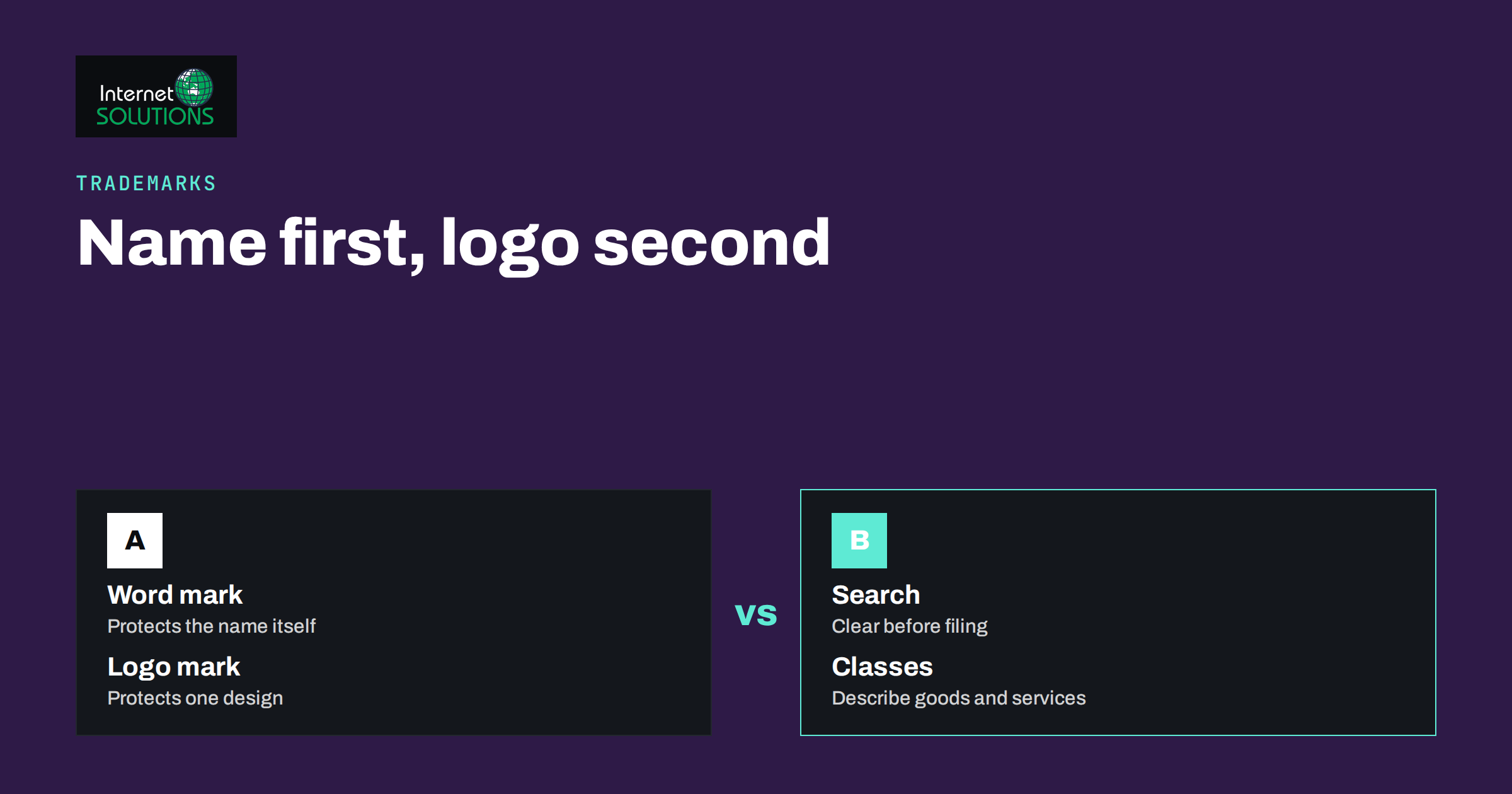
When a founder decides to protect a brand, one of the first practical questions is what to file: the name written in plain letters, the logo, or both. The choice looks like a minor technical detail, yet it decides the scope of the protection, the cost of the application and the amount of redesign work that can later be done without losing rights. A word mark protects the name itself. A logo mark, often called a figurative or design mark, protects a particular visual appearance. A combined mark protects a specific arrangement of words and graphics together. Each has strengths and limits, and for most new businesses there is a sensible order in which to file them.
This article explains the differences between word marks and logo marks, why the word mark usually comes first, when a logo registration is worth adding, how a combined filing behaves, what happens when you redesign, how the rules vary between registers and how to plan a small budget. It is general information and not legal advice, and trademark law differs by country, so check with a qualified attorney or the official register before you file.
The Three Basic Forms
Trademark offices use slightly different words, but the structure is similar everywhere.
| Form | Other names | What is protected | Typical example |
|---|---|---|---|
| Word mark | Standard character mark, plain word mark | The words or letters themselves, regardless of font, colour or size | The name “Greenfield Bakery” written in ordinary letters |
| Logo mark | Figurative mark, design mark, device mark | A graphic or stylised design as filed, with or without words, and sometimes with colours claimed | A leaf symbol used on its own |
| Combined mark | Composite mark, word and device mark | The words together with the graphic elements in the filed arrangement | The leaf symbol above the stylised name |
Registers also accept other forms, such as slogans, three-dimensional shapes, colours, sounds and patterns, but these are rarer for small businesses. The official guidance of offices such as the US Patent and Trademark Office and the UK Intellectual Property Office explains how each form is filed and examined in those countries.
Why the Word Mark Usually Comes First
For most businesses, the name is the most durable and most valuable part of the brand. Customers say it, search for it, write it in reviews and type it in a domain. A logo can be redrawn many times over the years, but a name tends to stay. A word mark in standard characters protects the name in any presentation. If you later change the typeface, the colours or the layout, the registration still covers it, because it was never tied to a specific look. In practice that gives broad protection against others who use the same or a confusingly similar name in different graphics.
- Breadth. A competitor cannot avoid a word mark by using a different font or colours.
- Durability. Brand refreshes do not require a new application for the name.
- Cost. In many registers, a word mark and a logo mark cost the same per class, so the word mark gives more coverage for the price.
- Searchability. Word marks are the easiest to find in clearance searches and monitoring, which also helps others avoid conflicts with you.
The word mark, however, is only possible if the name is registrable. Names that merely describe the goods, such as “Fresh Bread” for a bakery, are often refused or give narrow protection. Coined names, unusual combinations and arbitrary words are stronger. Our article on trademark clearance searches explains how to check a name for conflicts before filing, and our guide on what to register before you launch gives the wider checklist.
What a Logo Registration Adds
A logo mark protects the design as filed. It is useful when the symbol itself is a distinctive asset that customers recognise without the name, such as an icon on packaging, an app or a vehicle, and when you want to act against copies of the graphic. It can also be the only route when the words are too descriptive to register alone but the stylised combination is distinctive enough. The protection, though, is narrower. If the logo is registered in a particular design, a rival who uses a clearly different graphic with the same words may not infringe the logo registration, though they may infringe the word mark if there is one.
- Filed as it is used. The image you file should match what you actually use. Offices and courts may look at how the mark is used when they judge whether the registration is valid.
- Colour. Some registers allow you to file in black and white, which covers the design in any colour combination, while others allow colour claims that narrow the protection to specific colours. For most businesses, black and white gives broader protection.
- Quality of the file. A clear, high-resolution image, with no text outside the design, avoids examination problems.
- Elements that cannot be claimed. A common word inside a logo, a generic shape or a standard symbol may be disclaimed, which means you cannot claim exclusive rights to it alone.
Combined Marks: Convenient but Narrow
Many small businesses file their logo as it appears, with the name and the symbol together, because it feels like the complete brand. That is understandable and cheap, but it has a trade-off: the registration covers that combination, and the strength of protection for the words alone can be weaker than a pure word mark. If the words are dominant in the combined mark, courts and offices often compare the words first, so the protection can still be meaningful. If the graphic dominates, a rival who copies only the words may be harder to stop.
Because of this, the common recommendation is to file the word mark first, and the logo separately if the budget allows, instead of relying on one combined filing alone. If you can file only one thing, file the one that you expect to keep unchanged for the longest time and that gives the widest protection, which is usually the word mark.
Redesigns, Rebrands and Variations
Logos change more often than names. A new colour palette, a simplified symbol or a modern typeface may seem a small update, but a registered logo covers a specific image. Registers generally do not allow you to amend a registered mark in a way that materially changes it, so a substantial redesign normally requires a new application. A light refresh that keeps the distinctive character of the old mark may still be treated as the same mark in use, but the line is a legal judgment, not a design one.
- Plan for redesigns. If you expect a visual overhaul in the next year or two, delay the logo filing until the design stabilises, and file the word mark now.
- Keep the old mark alive while the new one is pending, and keep using the registered form as appropriate to preserve rights, as explained in our guide to trademark renewal and maintenance.
- Use the mark consistently. Adding words, rearranging elements or using the logo in many different versions can weaken your claim that the registered form is being used.
- Record changes of owner or name. If the company name changes, update the register so that the ownership trail remains clear.
Classes, Territories and Budget
The form of the mark is one decision, and two others interact with it: the classes of goods and services and the territories. Each class and each territory adds cost, and the budget usually decides the plan.
| Budget situation | Suggested first filing | Add later |
|---|---|---|
| Very limited, one home market | Word mark in the one or two classes that cover the core business | Logo once the design is stable and the business is earning |
| Moderate, one home market | Word mark in core classes plus the logo in the main class | More classes as products expand |
| Selling in several countries | Word mark through a regional or international route | Logo in markets where copying is a real risk |
| Strong visual brand, little name distinction | Logo and combined mark, with the word mark if registrable | Word mark variants as the brand grows |
Choosing the classes is a skill of its own, covered in our article on trademark classes, and choosing between a national and a regional registration is discussed in our guide to EU trade mark or national registration. For several countries at once, the Madrid System allows one international application based on a home filing, and the same form of mark must be used consistently across designations.
Practical Steps Before You File
- Decide what is stable. Which part of your brand will you keep for ten years? File that first.
- Search the name, and also look at logos in your field. The EU database TMview covers many registers and is a good starting point for similar marks.
- Check descriptiveness. Say the name aloud to a customer. If it simply describes what you sell, expect objections or narrow rights.
- Prepare a clean logo file in black and white and, separately, in colour, if you intend to use both.
- List goods and services accurately. A broad but truthful list is stronger than a vague one, and claiming things that you do not intend to offer can create problems later.
- Register the domain and social handles that match the name, as our article on domain names and trademarks explains.
- Ask an attorney to review the plan, especially for names you will invest in heavily or sell abroad.
A Worked Example
Two founders launch a small company that sells hand-made candles online under the invented name “Lumora”. They have a rough logo of a flame inside a circle, drawn by a friend, and they plan to hire a designer next year. Their budget allows one filing in their home market now. They search the register, find no similar marks in the candle class and decide to file “Lumora” as a word mark in the class for candles and in the class for online retail services.
A year later, a professional designer produces a refined symbol, and the founders add a logo filing in black and white for the candle class. They keep using the name with the logo as a pair in packaging, but the word mark ensures that their name is protected in any style. When a competitor opens a shop called “Lumora Lights” with a different graphic, the word mark gives them a clear basis for a letter, and they handle it with advice from an attorney. Had they filed only the first rough logo, the redesign would have left them without a registration at all.
Common Mistakes
- Filing only a combined logo and assuming that it protects the name in every form.
- Registering a logo that is about to be redesigned.
- Filing a descriptive name as a word mark and expecting strong protection.
- Claiming specific colours when black and white would cover more.
- Using different versions of the mark than the registered one.
- Copying a competitor’s style so closely that your own filing is opposed.
- Forgetting that each country and each class costs extra and needs planning.
- Assuming that a registration in one country applies in all.
Frequently Asked Questions
Should I register the name or the logo first?
For most businesses the name, as a word mark, because it is the most stable part of the brand and gives the broadest protection. Add the logo when the design is settled and its protection matters.
Does a logo registration protect my name?
Only partly. A combined mark protects the whole arrangement, and the words may carry weight in comparisons, but the protection is narrower than for a pure word mark.
What if I change my logo later?
A significant change normally needs a new application, while the word mark remains valid. Keep the old registration while you transition, and file the new design when it is final.
Can I file the logo in colour?
You can in some registers, but colour claims usually narrow the protection. Black and white filings generally cover the design in any colour, so many advisers prefer them unless colour is a key part of the brand.
Is a word mark case-sensitive?
A standard character word mark is generally not tied to capital letters, fonts or styles, which is part of its strength. The specifics follow the rules of each register.
Do I need an attorney?
You can file yourself in many countries, but a qualified attorney helps with searches, classes, objections and international plans. The cost is often small compared with the cost of a refused application or a forced rebrand.
The Bottom Line
Register the part of your brand that will last, which is usually the name as a word mark, and add the logo once the design is stable and worth defending. Search first, choose classes and territories that match your plans, use the mark exactly as registered and keep the registration in force. A little planning at the start gives wider protection for the same money and avoids paying twice when the design changes. To see which marks Internet Solutions holds itself, visit our trademarks page.