

 English
 Lietuvių
 Latviešu
 Eesti
Eesti Русский
 Polski
 Українська
 Deutsch
 Italiano
 Español
 Français
 Português
 Čeština
 Magyar
 Română
 Ελληνικά
 Türkçe
 日本語
日本語 العربية
 हिन्दी
 Bahasa Indonesia
 Bahasa Melayu
 ไทย
ไทย Tiếng Việt
 বাংলা
বাংলাLive Chat Etiquette: Writing Replies Customers Trust With Talkmio
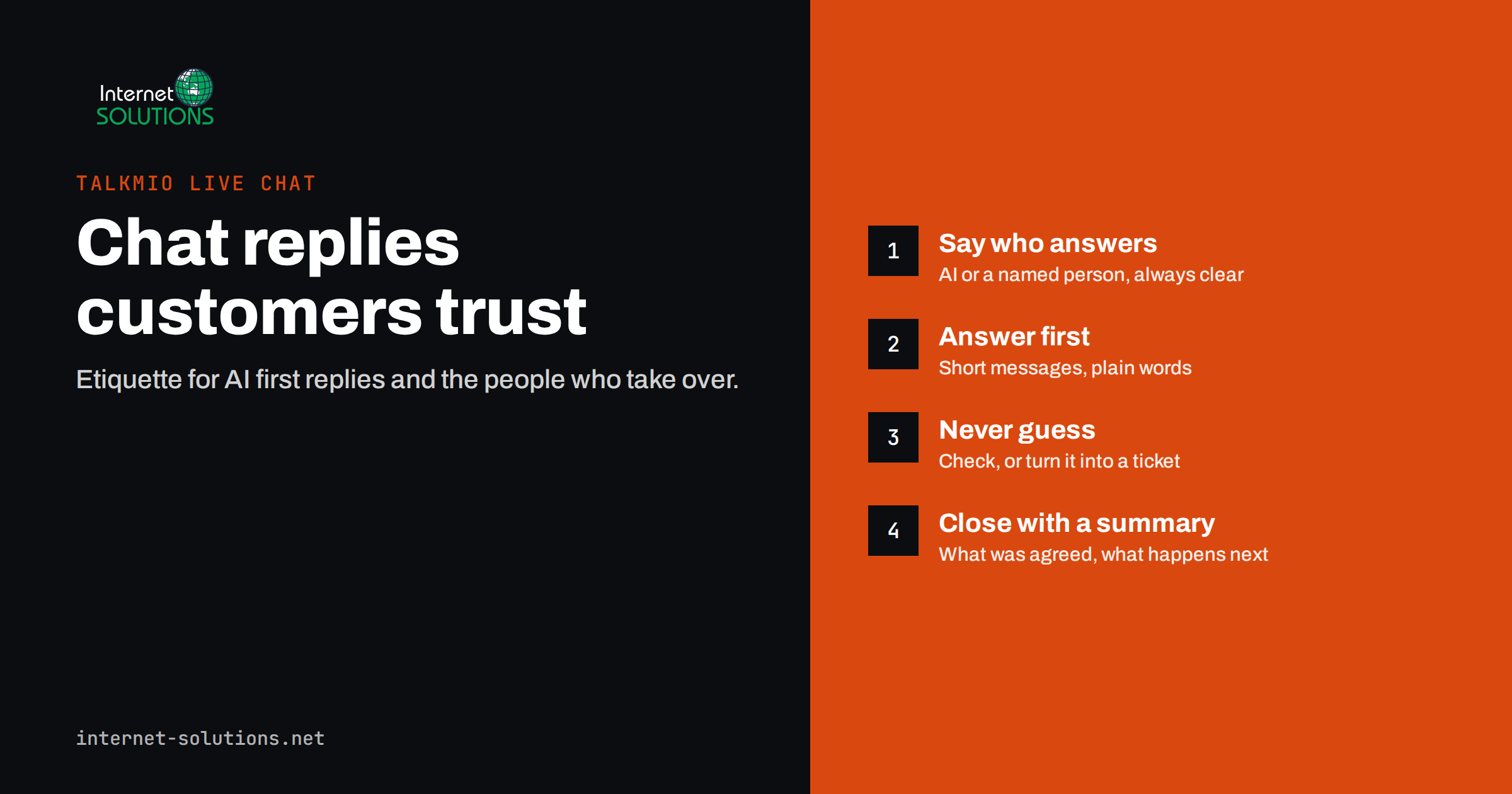
Live chat is the most personal channel most websites have. A visitor types a question and expects a person, or at least something that behaves like a helpful person, to answer within moments. That closeness is why chat converts so well, and also why a careless reply does more damage in chat than in any other channel. Live chat etiquette is the set of habits that make replies feel fast, clear and trustworthy, whether the answer comes from an agent or from an AI assistant working the first shift.
This guide covers the practical side of live chat etiquette: greetings, tone, response timing, handling questions you cannot answer, handing over between AI and people, and closing conversations well. It uses Talkmio, the AI live chat built by Internet Solutions, as the working example, but the principles apply to any chat tool your team uses.
Why Etiquette Matters More in Chat Than in Email
In email, customers expect a delay and a considered answer. In chat, they are usually still on the page, often in the middle of a decision: whether to buy, whether to book, whether to leave. The conversation happens in real time, in short messages, and the visitor judges the company by every one of them. Usability research by the Nielsen Norman Group, summarised in its guidelines for customer-service chat, found that users value speed, clarity about who they are talking to and answers that actually resolve the question over any amount of friendliness.
Good etiquette therefore is not about politeness formulas. It is about removing friction: making the visitor feel heard, telling them what happens next and getting them to an answer in as few messages as possible.
Opening the Conversation
Greet briefly and invite the question
A good opening is short and specific. “Hi, I’m Laura from the support team. What can I help you with?” works better than a paragraph about the company. If the chat was started proactively, for example on the pricing page, refer to the context: “Hi, comparing plans? I can help you pick the right one.”
Say who is answering
Visitors deserve to know whether they are talking to a person or an AI assistant. In Talkmio, Mio, the AI assistant, answers first from your website content, FAQ and documents, and your team can take over any conversation with its full history. Make that clear in the greeting or the widget, and when a person joins, have them introduce themselves by name. Honesty here builds trust; pretending an AI is a person, or leaving a person anonymous, erodes it.
Acknowledge before you investigate
If the answer needs checking, say so immediately: “Let me check the delivery options for Germany, one moment.” Silence of even a minute feels much longer in chat than in email, and a visitor who sees no reply may close the window.
Writing Replies People Can Scan
Chat messages are read on small windows, often on phones. The writing rules follow from that.
- One idea per message. Several short messages are easier to follow than one long block, but avoid sending ten one-word messages in a row.
- Answer first, explain second. “Yes, we ship to Norway. Delivery takes 3 to 5 working days.” is better than a paragraph that reaches the answer at the end.
- Use the customer’s words. If they ask about “the blue one”, do not switch to the internal product code without explanation.
- Plain language. Avoid jargon, internal abbreviations and legal-sounding phrases. The W3C’s writing tips for accessibility apply to chat as much as to web pages: short sentences, common words and clear instructions.
- Links with context. “Here is the size guide: [link]. The 42 fits a foot of about 27 cm.” rather than a bare link.
- Numbered steps for instructions. If the visitor needs to do three things, number them.
Tone: friendly, not scripted
Match the customer’s level of formality, within your brand’s limits. A relaxed question can get a relaxed answer; a complaint deserves a calm and serious one. Avoid overusing exclamation marks, emojis and stock phrases such as “I completely understand your frustration” repeated in every conversation. Customers recognise scripts quickly, and scripted empathy feels less sincere than none.
Response Times and Expectations
Speed is the core promise of chat. Two numbers matter: the time to the first reply and the time between replies during the conversation. Talkmio’s reports show first-reply time, how many conversations Mio solved alone, ratings and the busiest hours, which gives a team the data to set realistic targets.
| Situation | Good practice | What to avoid |
|---|---|---|
| New chat during staffed hours | AI or agent reply within seconds; human takeover quickly when needed | Leaving the visitor unanswered for minutes |
| Agent needs to check something | Say what you are checking and roughly how long it will take | Silent pauses with no explanation |
| Question needs a specialist | Explain the handover and pass the full context | Asking the customer to repeat everything |
| Answer will take hours or days | Convert to a ticket and confirm the email address | Promising “we’ll get back to you” without a way to do it |
| Visitor stops replying | One polite follow-up, then close with a summary | Repeated nudges or closing without a word |
| Outside working hours | AI answers what it can; the rest becomes a ticket with a clear expectation | A widget that looks online but nobody answers |
If your team struggles to meet these expectations, the problem is usually staffing and coverage rather than etiquette. Our guide to live chat staffing and response times covers how to plan hours and handoff rules.
When You Do Not Know the Answer
Every chat team eventually faces a question it cannot answer on the spot. How it handles that moment matters more than the hundreds of easy questions.
Never guess
A confident wrong answer about price, delivery, warranty or compatibility creates a real problem later, often a refund or a complaint. It is better to say “I want to give you the correct answer, so I’m checking with our logistics team” than to improvise. Talkmio’s Mio is built with the same rule: it answers from your content and hands off rather than inventing prices or policies.
Offer a path
If the answer cannot come within the chat, turn the conversation into a ticket. In Talkmio, customer emails and escalated questions become numbered tickets with threads, priorities and SLA, and replies go out as email. Tell the customer exactly that: “I’ve created ticket 1042 for this. You’ll get the answer by email, usually within one working day.”
Use internal notes, not the customer’s time
When colleagues need to discuss a case, do it in internal notes that the customer does not see, rather than asking the customer to wait while the team debates in public.
Handing Over Between AI and People
Many teams now let an AI assistant handle the first reply and routine questions, with people taking over for complex or sensitive cases. The handover is where etiquette often breaks down.
- Announce the handover. “I’m passing you to Tomas from our sales team, who can help with a custom quote.”
- Carry the context. The agent should read the full history before writing, so the customer never has to repeat the question. Talkmio shows the full conversation and visitor details, such as country, current page and past conversations, to the agent who takes over.
- Introduce yourself as a person. The first human message should make clear that someone new has joined.
- Do not contradict silently. If the AI’s earlier answer was incomplete, say so openly and correct it. Then fix the source content so the same gap does not appear again.
Languages and Tools That Help
Visitors often write in their own language. Talkmio’s Mio replies in more than 30 languages, and agents get instant translation, AI-suggested replies, quick replies and internal notes. These tools save time, but etiquette still applies to how they are used.
- Quick replies should be starting points. Adjust each one to the actual question, or the conversation will sound like a form letter.
- Suggested replies need a human check before sending, especially for anything involving money, deadlines or promises.
- Translation works best with short, simple sentences. Avoid idioms and jokes that do not survive translation.
Review transcripts regularly to see where replies were unclear or slow. Our article on what chat transcripts reveal about your website shows how to turn those reviews into fixes for the site as well as the team.
Handling Difficult Conversations
Angry or frustrated customers test etiquette most. A few principles keep these conversations productive.
- Acknowledge the specific problem, not the feeling in general: “Your order was due on Tuesday and still hasn’t arrived” shows you have read the message.
- Stay factual. Explain what you can see and what you will do next.
- Do not argue about blame in the chat. Solve the problem first; investigate internally later.
- Know your limits. Rudeness toward staff does not need to be tolerated. Have a clear, polite closing line for abusive conversations, and a rule for when to end them.
- Escalate early when the issue involves refunds, legal questions or data protection, rather than improvising.
Closing the Conversation Well
The end of a chat is what the customer remembers. Summarise what was agreed, confirm the next step and ask whether anything else is needed. “So: I’ve changed the delivery address to the office, and the parcel ships tomorrow. Anything else I can help with?” If the tool asks for a rating, let it do so after the summary, not in place of it. Closing a chat without a word, or while the visitor is still typing, undoes much of the goodwill built during the conversation.
For teams setting up chat for the first time, our Talkmio page explains how it fits alongside the rest of your website and support tools.
Turning Etiquette Into a Team Standard
Etiquette only works when the whole team follows it, including new staff and the AI assistant’s source content. Write a one-page chat standard that covers the greeting, how agents introduce themselves, the maximum silent pause, the rule against guessing, when to create a ticket and the closing summary. Add five or six real example conversations, one good and one weak for each common situation, because examples teach faster than rules. Review a small sample of transcripts every week as a team, focusing on what could be clearer rather than on blame. When the same question keeps reaching agents, update the website content or the knowledge base Mio learns from, so the next visitor gets the answer immediately.
Frequently Asked Questions
What is live chat etiquette?
Live chat etiquette is the set of habits that make chat replies fast, clear and trustworthy: a short greeting, honest information about who is answering, plain language, no guessing, smooth handovers and a clear summary at the end.
How quickly should a live chat reply?
The first reply should come within seconds, which is where an AI assistant helps. During the conversation, keep gaps short, and if you need time to check something, say so and estimate how long it will take.
Should I tell customers they are talking to an AI?
Yes. Being clear about whether a person or an AI assistant is answering builds trust and sets the right expectations, especially when a person later takes over the conversation.
Are emojis acceptable in business chat?
Occasionally, if they fit your brand and the customer’s tone. Avoid them in complaints, payment issues or any serious conversation, and never let them replace a clear answer.
What should an agent do when they do not know the answer?
Say that you are checking, never guess, and if the answer cannot come during the chat, convert the conversation into a ticket with a clear promise about when and how the customer will hear back.
How can we keep canned replies from sounding robotic?
Use quick replies as drafts rather than final messages. Adjust each one to the customer’s actual question, use their words and remove anything that does not apply.
The Bottom Line
Live chat etiquette comes down to respect for the visitor’s time and trust. Greet briefly, say who is answering, reply fast, write short answers first and explanations second, never guess, hand over with full context, and close with a clear summary. Tools such as Talkmio’s AI first replies, translation, suggested replies and tickets make good etiquette easier to deliver at scale, but they work best when the team agrees on these habits and reviews real conversations to keep improving them.