

 English
 Lietuvių
 Latviešu
 Eesti
 Русский
 Polski
 Українська
 Deutsch
 Italiano
 Español
 Français
 Português
 Čeština
 Magyar
 Română
 Ελληνικά
 Türkçe
 日本語
 العربية
 हिन्दी
 Bahasa Indonesia
 Bahasa Melayu
 ไทย
 Tiếng Việt
 বাংলা
Brand vs Non-Brand Campaigns in Google Ads: Protect and Measure
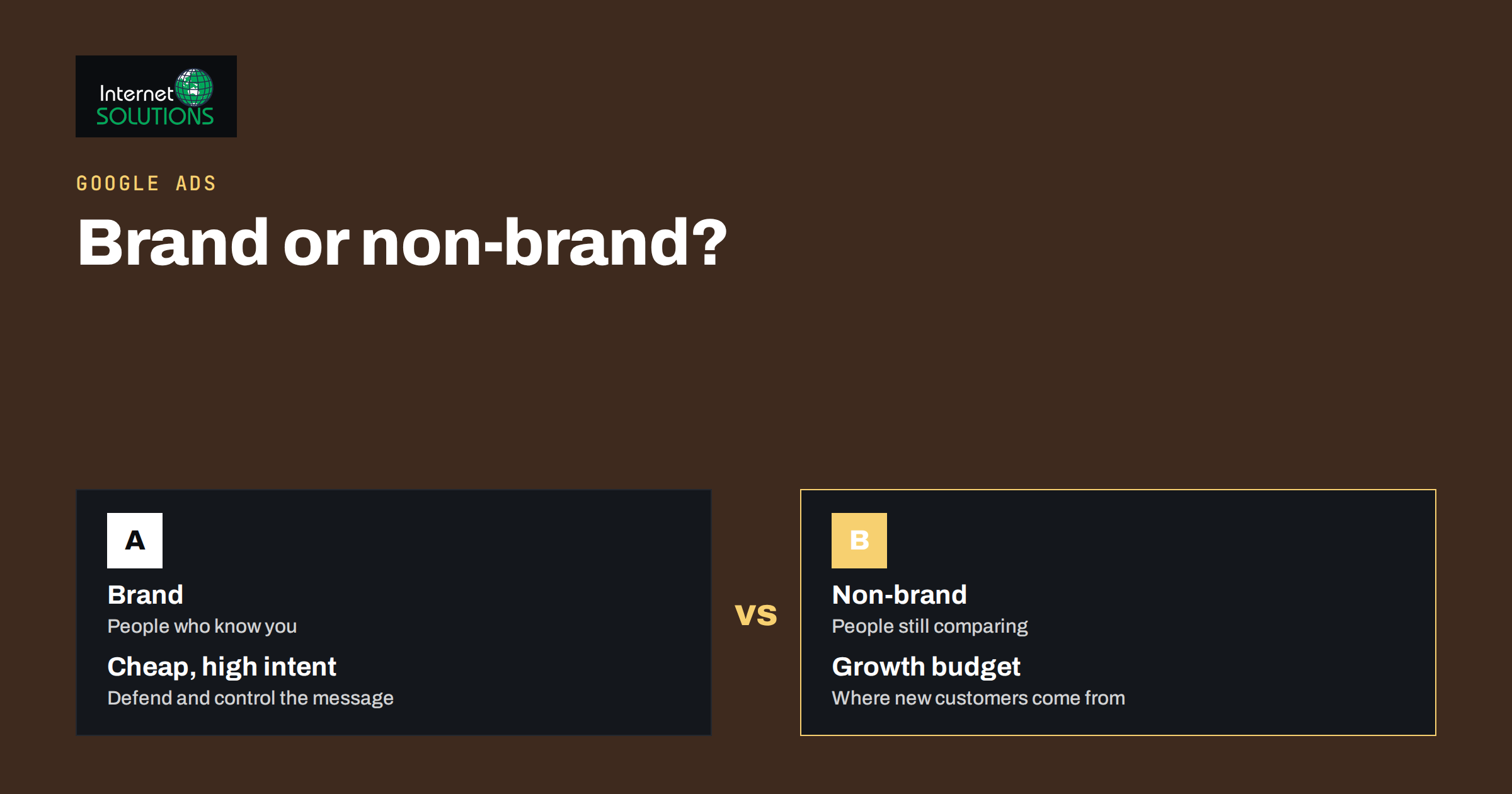
Brand campaigns in Google Ads target people who search for your company by name, while non-brand campaigns target people who search for what you sell without knowing who you are. The two behave so differently that mixing them in one campaign is one of the most common reasons an account looks healthier than it really is. Brand searches convert cheaply and often, so they pull the blended numbers up and hide how weak the prospecting campaigns may be. Separating them gives you honest reporting, a clearer budget and a deliberate decision about whether to bid on your own name at all.
This guide explains what counts as brand traffic, why it deserves its own campaign, whether you should pay for clicks you might get free, how to handle competitors who bid on your name, and how to measure the real effect. It applies to service businesses, online stores and software companies alike, and it assumes you already run, or are about to run, Search campaigns.
What Counts as Brand Traffic
A brand search contains your company name, a product or service name you own, a distinctive domain, or a common misspelling of any of these. Someone typing your company name plus “contact” or “login” is brand traffic. So is someone typing your product’s name plus “pricing”. These people already know you. They are usually further along the decision path, which is why they click more, convert more and cost less per sale.
Non-brand traffic is everything else: generic terms such as a service plus a city, a product category, a problem description or a question. These searchers are comparing options, and many of them have never heard of you. Winning them is the real growth work of paid search, and it is almost always more expensive per conversion than brand.
A third group sits in between: competitor searches. Someone searching for a rival’s name is not your brand traffic, and bidding on those terms is a separate, optional strategy with its own rules. Keep it out of both of the other groups.
Why Brand and Non-Brand Need Separate Campaigns
Honest reporting
Imagine an account with a blended cost per lead of 20. Brand might be running at 4 and non-brand at 45. The blended figure suggests everything works fine, while the campaigns that bring new customers are quietly losing money. When you split them, each number means something and you can set a sensible target for each.
Different budgets and bids
Brand demand is limited by how many people search your name, so budget needs are small and predictable. Non-brand demand is limited mostly by your budget and bids. Putting both in one campaign lets the cheap brand clicks use up budget and creates a false sense of efficiency. Separate campaigns let you set a modest, protected budget for brand and a growth budget for non-brand.
Different messages
Brand ads should reinforce what the searcher already believes and make the next step easy: the official site, a clear call to action, key offers and contact details. Non-brand ads must introduce you, explain the benefit and justify the click. Different copy and landing pages belong in different ad groups. Our overview of Google Ads account structure and naming shows how to lay this out so it stays manageable as the account grows.
Different automation signals
Smart bidding learns from conversions. If brand conversions are mixed in with non-brand ones, the system may favour the easy brand queries because they produce results quickly, and starve the prospecting terms that bring in new business. Separate campaigns give each bidding strategy a cleaner signal.
Should You Bid on Your Own Brand?
This is the question that sparks the most debate. If your website already appears first in the organic results for your name, why pay for the same click? The honest answer is that it depends on four factors.
Competition on your name
If nobody else bids on your brand terms, paid and organic results compete for the same click, and many of those clicks would have reached you anyway. Cost is low and the incremental value is small, but the cost is also low. If competitors do bid on your name, a competitor’s ad can sit above your organic result and capture some of your own demand. Defending the name then has clear value.
What the result page looks like
On a brand search, a paid ad takes space that organic results would otherwise occupy and pushes competitors lower. With extensions such as sitelinks, calls and locations, a single ad can lead the searcher straight to the page they want, which an organic listing may not do. For businesses with several distinct services, that precision often justifies the spend.
Control of the message
Organic listings are shaped by the search engine. An ad lets you control the headline, promote a current offer, state opening hours or send people to a specific landing page. If a promotion or notice must be visible to everyone who searches your name, an ad is the dependable way to do it.
Measured incrementality
The only reliable answer is a test. Pause brand ads for a period, or run them on a split of locations, and compare total conversions from brand searches across paid and organic. Many businesses find that most of the paid brand conversions would have happened anyway. Others find that a noticeable share disappears, usually when competitors are active. Test, then decide with numbers rather than opinion.
Brand and Non-Brand Compared
| Aspect | Brand campaign | Non-brand campaign | Competitor campaign |
|---|---|---|---|
| Searcher intent | Already knows you | Comparing options, may not know you | Looking for a rival |
| Typical cost per conversion | Lowest | Highest of the core groups | Often high |
| Main purpose | Defend demand and control the message | Find new customers | Win some comparison traffic |
| Budget behaviour | Small, capped by search volume | Scales with bids and budget | Test with a small cap |
| Landing page | Home page or the exact page named | Page matched to the search topic | Honest comparison page, if any |
| Main risk | Paying for clicks you would get free | Wasted spend on broad terms | Policy issues and low quality score |
Building the Brand Campaign
Keep the brand campaign tight. Use exact and phrase match for your name, your main product and service names, your domain and common misspellings. Group them logically: company name in one ad group, individual products or services in others, support or login terms in a separate group if you do not want to advertise on them. Our guide to keyword match types and negative keywords explains why precise match types matter here.
Write ads that confirm the visitor is in the right place. Lead with the name, state the main benefit or current offer, and include sitelinks to the pages people usually want. Add call and location assets if phone calls or visits matter. Landing pages should be the page the search implies: someone searching for a product name should reach that product, not a generic home page.
Set a modest budget, a bidding approach that favours a high impression share, and a goal of being visible rather than being cheap. Monitor impression share for the brand campaign; if it is low on your own name, you are leaving room for others.
Keeping Brand Terms Out of Non-Brand Campaigns
This is the step most accounts skip, and it is the main reason blended results mislead. Broad match, dynamic ad groups and Performance Max can all serve ads on brand searches unless you stop them. Add your brand terms as negative keywords at the campaign level in every non-brand campaign, using the guidance in Google’s negative keywords help page. Check the search terms report regularly to see which campaigns are catching brand queries; our weekly search terms review routine is designed for this kind of check.
For automated campaign types, use the brand exclusion or brand list controls the platform provides where they are available, and verify with reports instead of assuming the setting works. After any change, compare the search terms in non-brand campaigns for a few weeks and watch whether non-brand conversion volume drops. A drop is not a failure: it shows how much of the earlier performance was really brand demand in disguise.
Competitors Bidding on Your Name
Competitors are generally allowed to bid on your brand name as a keyword, but the rules on using your trademark inside ad text are stricter, and they vary by region and by the platform’s current policy. Review Google’s trademark policy page for how complaints and exceptions work. If a competitor uses your trademark in the text of their ads, you can file a complaint with the platform, and a registered mark makes that process more straightforward. This is one more reason to protect your name early; see our guide to trademarks and brand protection for what to register before you launch.
For a competitor who only bids on the keyword, the practical response is competitive: appear above them with a strong brand ad and good extensions. Your quality score on your own name is normally excellent, which means you can usually win the position at a low cost. Watch the auction insights report to see who is entering the auction and how often they appear above you.
Measuring What the Split Reveals
Once brand and non-brand are separate, build a small monthly table for each: spend, clicks, conversions, cost per conversion, conversion value if you track it, and impression share. Then review four questions.
- What is the non-brand cost per conversion, and is it acceptable against the value of a customer?
- Is brand volume growing? Rising branded searches often follow offline marketing, PR, social posting or good organic content, and they are a useful measure of awareness.
- What is the brand impression share, and who is taking the rest?
- Would total conversions fall if brand ads stopped? Answer with a test, not a guess.
Be careful with conversion tracking when brand traffic is high. A visitor who first met you through a non-brand ad or a social post and later searched your name will be credited to the brand click in last-click reporting. That is how brand campaigns look better than they are, and how prospecting campaigns look worse. Our article on conversion tracking that holds up explains how to set up measurement so you are not misled, and attribution views that include assisted conversions give a fairer picture.
A Simple Setup Checklist
- Create a separate brand campaign with its own budget and its own name in the account.
- Use exact and phrase match for brand terms, misspellings and product names.
- Add brand terms as campaign-level negatives in every non-brand campaign.
- Write brand ads that lead with the name, the main benefit and current offers, with sitelinks and call or location assets where relevant.
- Send each brand search to the page it implies.
- Track brand and non-brand results separately, and report them separately to stakeholders.
- Run an incrementality test before deciding to cut brand spend, and recheck after competitors change.
- Review the search terms and auction insights monthly.
If you would like a second pair of eyes on an account that mixes the two, our Google Ads service starts with exactly this kind of structural review, because everything else in the account depends on the numbers being read correctly.
Frequently Asked Questions
Should I run ads on my own company name?
It depends on competition and on what you gain. If competitors bid on your name, or you want control over the message, sitelinks and landing page, it usually pays. If nobody competes and your organic listing is strong, test pausing brand ads before deciding.
Why do brand campaigns look so profitable?
The searchers already know you, so they click and convert more often at a lower cost. Last-click reporting also credits brand searches for sales that earlier channels started, which inflates their apparent value.
How do I stop non-brand campaigns from serving on brand searches?
Add your brand terms as negative keywords at campaign level, use the platform’s brand exclusion controls in automated campaigns where they exist, and check the search terms report to confirm the setting works.
Can a competitor bid on my brand name?
Competitors can generally bid on your name as a keyword, but using your trademark in their ad text is restricted by policy and varies by region. A registered trademark makes a complaint easier.
Is a separate brand campaign worth it for a small budget?
Yes. Even with a small budget, a separate campaign keeps cheap brand clicks from hiding the cost of finding new customers, and it lets you control brand spend independently.
How often should I review brand campaigns?
Check impression share and auction insights monthly, and review search terms for both brand and non-brand campaigns weekly or fortnightly. Run an incrementality test at least once a year or when the competitive picture changes.
The Bottom Line
Separating brand from non-brand turns a flattering blended average into two honest sets of numbers. Give brand its own small, protected campaign with tight keywords and message-led ads, block brand terms in every non-brand campaign, and measure incrementality before deciding whether to pay for clicks you might otherwise get free. Where competitors are active, defending your own name is cheap insurance. Where they are not, test and let the data decide. Either way, the account becomes easier to read, easier to budget and far harder to fool.