

 English
 Lietuvių
 Latviešu
 Eesti
 Русский
 Polski
 Українська
 Deutsch
 Italiano
 Español
 Français
 Português
 Čeština
 Magyar
 Română
 Ελληνικά
 Türkçe
 日本語
 العربية
 हिन्दी
 Bahasa Indonesia
 Bahasa Melayu
 ไทย
 Tiếng Việt
 বাংলা
Black Friday Marketing Plan for Small Business: Offers, Email, Ads
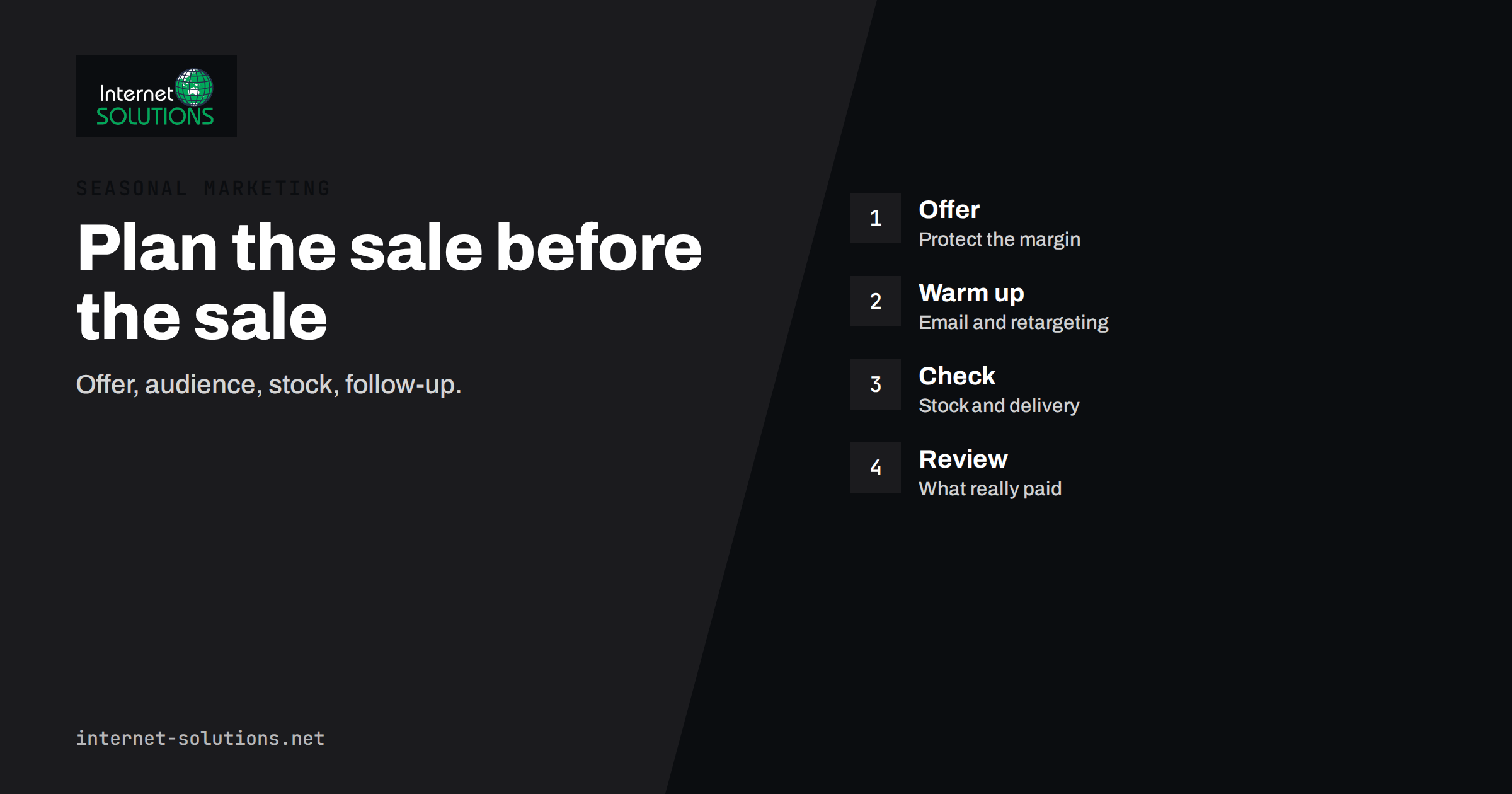
A Black Friday marketing plan decides whether the busiest shopping weekend of the year helps your business or just cuts your margin. In 2026, Black Friday falls on 27 November, the day after the American Thanksgiving holiday, and Cyber Monday follows on 30 November. Small businesses cannot match the discounts of giant retailers, and they should not try. What they can do is choose one clear offer, prepare their audience early, make sure stock and delivery hold up and use the weekend to win customers who come back in the spring.
This guide gives a plan you can start today, with roughly four weeks to go. It covers choosing offers that protect margin, building your email list and ad audiences before the rush, preparing the website and logistics, staying within consumer pricing rules and reviewing the results afterwards. It is written for online shops, but service businesses can adapt most steps to gift vouchers and packages.
Decide What You Want From the Weekend
Start with the goal, because it changes the offer. A business can aim for revenue, new customers, stock clearance or list growth, and each calls for a different approach. Write the goal in one sentence with a number, such as “two hundred new first-time buyers and a profit of at least X”. A plan with no number cannot be judged afterwards.
- Revenue and profit. Offer a small, targeted discount on best sellers with healthy margins.
- New customers. Make an attractive entry offer, and plan the follow-up emails that bring them back.
- Clearance. Use the weekend for end-of-line and overstock items, clearly labelled.
- List growth. Collect sign-ups before the weekend with early access to the offer.
Choose Offers That Protect Margin
The danger of Black Friday is selling a lot at a loss. Before announcing any offer, calculate the margin after discount, payment fees, shipping, returns and advertising. Many small businesses do better with a structured offer than with a blanket percentage off.
| Offer type | Good for | Margin effect | Watch out for |
|---|---|---|---|
| Percentage off selected products | Best sellers with strong margin | Controlled, predictable | Do not apply to loss leaders by mistake |
| Bundle or set price | Raising average order value | Often better than a straight discount | Stock must match bundle components |
| Gift with purchase above a threshold | Lifting basket size | Cost is the gift, not the whole price | Gift stock and clear terms |
| Free shipping above a threshold | Shops with high shipping friction | Shipping cost is the exposure | Set the threshold above your average order |
| Early access for subscribers | List growth, loyal buyers | Limited and targeted | Prepare the list in time |
| Gift vouchers | Services and shops with spare capacity | Cash in advance, redemption later | Set validity and terms clearly |
Follow Consumer Pricing Rules
Pricing claims are regulated, and Black Friday is when regulators pay attention. In the European Union, when you announce a price reduction, you must generally show the lowest price you applied in the previous 30 days as the reference price. Rules differ by country and can include further details, so check the guidance of your national consumer authority. Do not inflate the price before the sale to create a fake discount, since that can bring fines and reputational damage.
- State the original price accurately and the end date of the offer.
- Describe limits honestly, such as “while stock lasts” with a real stock figure behind it.
- Keep the usual right of withdrawal and return information visible.
- Check that discount codes and automatic discounts do not stack in unintended ways.
The European Commission’s pages on consumer protection law describe the main framework, and your national authority will publish details for your country.
Build the Audience Before the Weekend
The best Black Friday results come from people who already know you. Use the weeks before to grow the groups you can reach cheaply: email subscribers, social followers and recent visitors. A short “early access” signup page, promoted through your site, social posts and a banner, gives you permission-based contacts who expect your offer.
- Week 4: announce early access. Add a signup form on the home page and in the cart.
- Week 3: send a teaser email with one clear message. Show what is coming without revealing every price.
- Week 2: prepare ad audiences from site visitors, past buyers and subscribers. Test creatives at a low budget.
- Week 1: confirm stock, update product pages and send a reminder with the dates.
- Weekend: launch, monitor, respond and adjust.
- Week after: thank buyers, handle delivery questions and send a follow-up offer.
A content schedule makes this easier to run; our guide to a small business content calendar shows how to lay out weeks of posts quickly.
Email: The Highest-Return Channel
For most small shops, email delivers the best return on Black Friday because the audience already knows the brand and sending costs little. Plan a short sequence rather than one message: an early-access announcement, the launch message, a mid-weekend reminder for those who have not opened or bought, and a last-chance message on the final day. Segment the list so that past buyers, recent subscribers and inactive contacts get different messages; see our guide to segmenting your email list. Pay particular attention to deliverability: a surge of sends from a rarely used domain can land in spam. Warm up with regular sends in the weeks before.
Abandoned cart and browse reminders are worth enabling before the weekend; they often recover sales with no extra ad spend. We describe them in email automation flows that earn their keep.
Ads: Retarget First, Prospect Second
Advertising costs usually rise during Black Friday because many advertisers compete for the same audiences. A cautious approach spends first on people who are most likely to buy: visitors in the last thirty days, cart abandoners, past customers and engaged followers. Prospecting to cold audiences can be tested on a small scale, but a limited budget stretches further on retargeting. If you sell products, a catalog-based format that shows the exact items people viewed is a strong choice, as explained in our guide to dynamic product ads.
- Start campaigns early enough to leave the learning phase before the weekend.
- Set daily budget caps, and raise them only when the return is proven.
- Refresh creatives; frequency rises quickly in a short, intense period.
- Check that conversion tracking works before spending.
Prepare the Website and Operations
A sale is won or lost on practical details. Test the site speed under load, check the checkout on a phone, confirm that discount codes work and make sure payment methods are active. Review shipping cut-off dates for Christmas and publish them. Prepare customer support for more questions: update the FAQ, set up quick replies and consider extra cover for the weekend. Stock must be accurate, or overselling will turn a good weekend into a service problem.
Delivery carriers are busy at this time of year, so give realistic delivery estimates and consider a buffer. If your team is small, decide who is on duty and when, so that messages are answered within a reasonable time.
A Worked Example
A shop that sells running shoes and accessories has a list of four thousand subscribers and modest ad budgets. Instead of a sitewide discount, the owner chooses three actions: ten percent off a selected range of last season’s shoes, a free pair of socks with orders above a set amount and early access for subscribers one day ahead. The sale prices respect the thirty-day rule, and the product pages show the previous lowest price.
In the three weeks before, the shop adds a signup banner for early access and sends two teaser emails. Retargeting ads target recent visitors and cart abandoners at a modest daily budget. On launch day, the email goes to subscribers first; public launch follows the next morning. Abandoned cart emails run automatically, and a quick-reply list covers the ten most common questions. After the weekend, the owner reviews revenue, margin, new customers and returns, and sends a thank-you offer to first-time buyers for January. The profit is lower than the headline revenue suggested, but the shop adds more than six hundred first-time customers.
A Weekend Operations Checklist
Many sales are lost not to weak offers but to avoidable operational problems. Use this checklist for the days around the sale and assign a named person to every item.
- Before launch. Place a test order with every payment method and a discount code, on both desktop and phone. Confirm that stock numbers are right and that shipping rules and taxes calculate correctly.
- Site health. Check page speed with the heaviest pages, such as the home page and the sale category, and ask your host about expected traffic limits.
- Support cover. Update the FAQ with delivery cut-off dates and return terms for gifts. Prepare replies for the ten likely questions. Decide who answers messages on each day, and until what time.
- Monitoring. Watch orders, the conversion rate and ad spend several times a day. A broken checkout step is visible in the numbers within hours.
- Stock control. Set a rule for what happens when an item sells out: hide it, show a waiting list or offer a substitute. Do not keep selling what you cannot ship.
- Packing and dispatch. Prepare packaging in advance, agree carrier pickups and plan extra hands for packing days.
- Message discipline. Send fewer, clearer emails. A mistake in an offer email is hard to take back, so have a second person check prices and links before each send.
Write down what happened as the weekend goes on: problems, questions, unexpected best sellers. These notes make the review meeting much more useful and become the starting point for next year’s plan.
Common Mistakes
- Offering a deep discount on products with thin margins.
- Raising prices beforehand to make a discount look larger.
- Starting promotion in the last week, with no audience prepared.
- Testing the checkout and tracking only after launch.
- Overselling stock or giving unrealistic delivery promises.
- Sending to the full list with the same message every time.
- Forgetting the follow-up that turns bargain hunters into repeat customers.
For historical background on the day and how it spread beyond the United States, see the Black Friday overview.
Plan the Day After
Decide before the weekend what happens on Tuesday: who handles returns, who thanks customers and when the first follow-up email goes out.
Frequently Asked Questions
When is Black Friday in 2026?
Black Friday is on Friday 27 November 2026, the day after the American Thanksgiving holiday. Cyber Monday follows on Monday 30 November.
Do small businesses need to join Black Friday at all?
No. If the margin is thin or capacity is limited, a targeted offer to existing customers or no sale at all can be wiser. Join only if you have a clear goal and a plan.
How big should the discount be?
Big enough to be noticed and small enough to stay profitable after fees, shipping and returns. Bundles, gifts and early access often protect margins better than a large percentage off everything.
What are the rules for showing the original price?
In the EU, a price reduction announcement generally has to show the lowest price from the previous 30 days. Rules vary by country, so check your national consumer authority.
Should I spend more on ads during Black Friday?
Costs often rise, so start with retargeting audiences that already know you, set budget caps and raise spending only where results are proven.
What should I do after the weekend?
Thank buyers, handle delivery questions, review profit and new customers, and send a follow-up offer. The goal is to turn first-time buyers into repeat customers.
The Bottom Line
A good Black Friday marketing plan is built backwards from a clear goal. Choose offers that protect margin, follow the pricing rules, build your audience through early access and teasers, favour email and retargeting over expensive cold prospecting, and make sure the site, stock and support can handle the weekend. Review profit, new customers and returns afterwards, and use the follow-up weeks to make the first purchase the start of a relationship rather than a one-off bargain.