

 English
 Lietuvių
 Latviešu
 Eesti
Eesti Русский
 Polski
 Українська
 Deutsch
 Italiano
 Español
 Français
 Português
 Čeština
 Magyar
 Română
 Ελληνικά
 Türkçe
 日本語
日本語 العربية
 हिन्दी
 Bahasa Indonesia
 Bahasa Melayu
 ไทย
ไทย Tiếng Việt
 বাংলা
বাংলাFacebook Ads Lookalike Audiences: Choosing Seeds That Actually Work
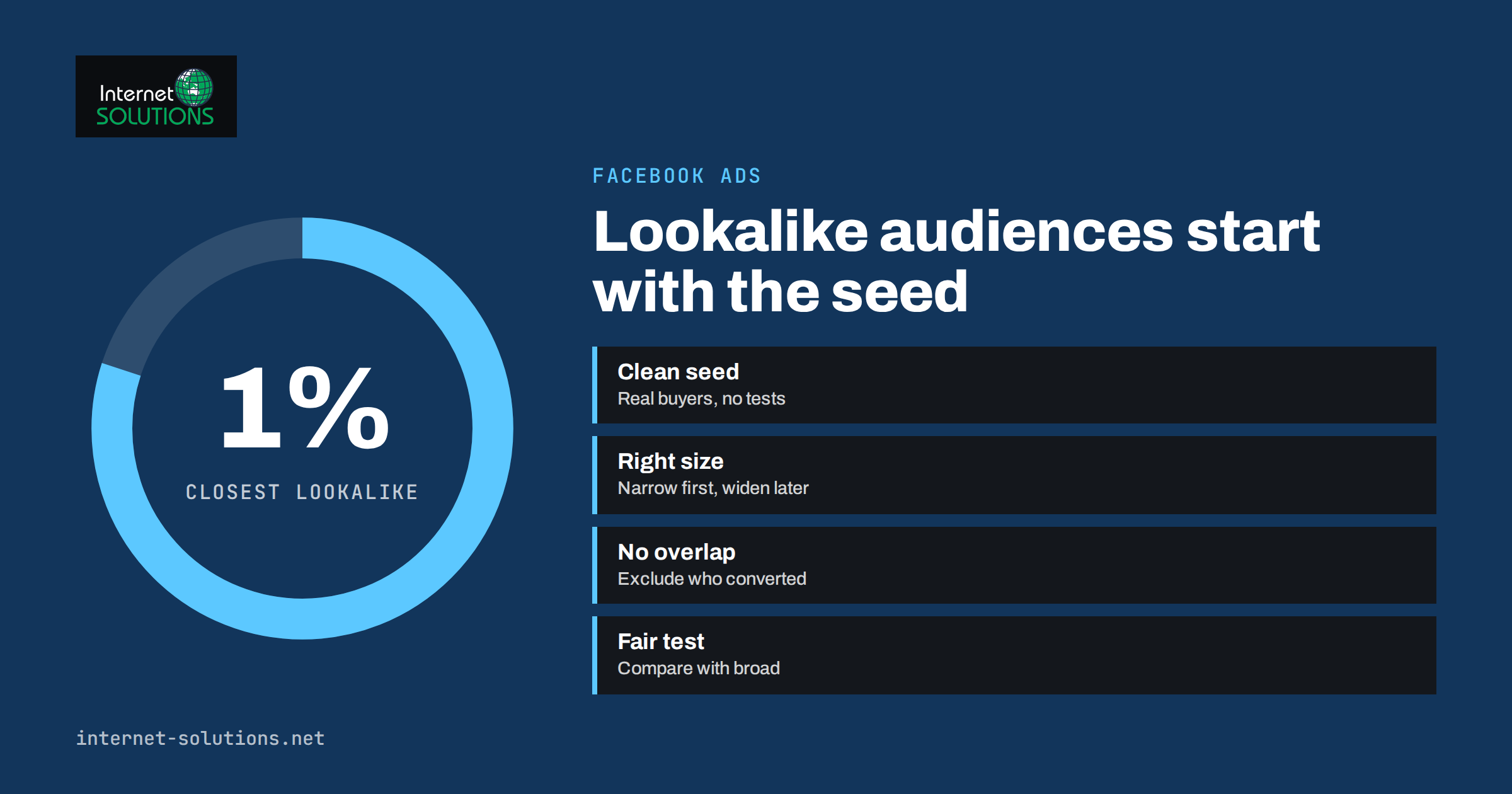
Facebook lookalike audiences promise something every advertiser wants: a way to reach new people who resemble your best customers. In practice the results vary enormously between accounts, and the difference is rarely the lookalike setting itself. It is the quality of the list you feed in, known as the seed. A lookalike built from the wrong seed finds more of the wrong people, quickly and at scale, and the account looks “broken” when the real problem is the input.
This guide explains how lookalike audiences work in plain language, how to choose and clean a seed, how broad the audience should be, how to avoid overlap and wasted spend, and how to test the result properly. It is written for owners and marketers who run Meta campaigns themselves or brief an agency, and it complements our Facebook Ads service page. Meta changes its interface and defaults often, so treat the menu names below as a guide and confirm current options in Ads Manager and in Meta’s help centre description of lookalike audiences.
What a Lookalike Audience Is, and What It Is Not
A lookalike audience is a group of people Meta selects because they share patterns with the people in your source audience. You choose a country and a size, and the system ranks everyone in that country by similarity to your seed. You do not see a list of names, and you cannot tell which individuals were included. What you get is a targeting option that you attach to an ad set.
It is important to be clear about what a lookalike does not do. It does not understand your product the way you do. It does not know which customers were profitable, which asked for refunds or which were a poor fit, unless your seed already reflects those differences. It also does not remove the need for good creative and a good landing page. A lookalike improves who sees the ad; it does not improve what the ad says or what happens after the click.
The Seed Decides Almost Everything
If you remember one idea from this article, make it this one: the seed is the brief you give the algorithm. A seed of 3,000 people who bought once on a deep discount teaches the system to find discount hunters. A seed of 800 customers who bought at full price and came back within 90 days teaches it to find loyal buyers. Both seeds are “customers”, yet they produce very different audiences.
Before building anything, decide what a valuable person looks like for your business. For a store, it might be repeat buyers or high-basket orders. For a B2B company, it might be qualified leads that became paying accounts rather than every form submission. For a subscription service, it might be users who stayed past the trial. Once you have that definition, find the data that represents it.
Seed Options and When to Use Each
You can build a seed from several kinds of sources. The table summarizes the usual options and their trade-offs.
| Seed source | Strength | Weakness | Best used when |
|---|---|---|---|
| Customer list (email, phone) with value | Reflects real buyers; can be weighted by value | Needs clean data and a lawful basis for use | You have a CRM with purchase history |
| Website purchasers or qualified leads via the pixel and events | Updates automatically as people convert | Depends on correct tracking | Tracking is reliable and volume is steady |
| High-value visitors (long sessions, key pages) | Large and available early | Interest is not the same as purchase | Conversions are too few for a purchase seed |
| Page, video or Instagram engagers | Quick to build | Often rewards entertaining content over buying intent | Early awareness stage, treated as a test |
| App or offline events | Captures channels outside the website | Needs integration work | Sales happen in store or in an app |
As a rule, prefer seeds that sit close to revenue. A smaller, cleaner seed of real purchasers is usually better than a large seed of casual visitors. If you only have engagement data today, use it for a first test, but plan to replace it as soon as you collect real conversion data.
How Big Should the Seed Be?
Meta publishes minimum requirements for source audiences and its guidance has changed over time, so check the current figure before you start. In general, a seed needs a minimum number of people from one country to be accepted, and a larger seed gives the system more signal. Many advertisers aim for a seed in the low thousands, with quality ranking above quantity.
When the seed is small, resist the temptation to pad it with weaker signals. Adding every newsletter subscriber to a seed of 400 buyers dilutes the very pattern you want the system to learn. Instead, keep the purchaser seed pure and build a second, separate lookalike from the broader group, so that you can compare the two cleanly later.
Clean the Seed Before You Upload It
A few hours of preparation prevents weeks of poor delivery. Clean the data with the following steps.
- Remove test and internal records. Staff addresses, test orders and fake sign-ups teach the system nothing useful.
- Remove refunds and chargebacks. People who asked for their money back are not the customers you want more of.
- Deduplicate. Merge repeated emails and phone numbers so that heavy buyers are not counted several times by accident.
- Keep formats consistent. Use standard phone formats with country codes and lowercase emails without spaces, so that more rows match to accounts.
- Use a recent window. A seed built from the last 6 to 12 months usually reflects your current offer better than one that includes customers from several product generations ago.
- Add value if you can. If your list includes lifetime value, you can use value-based options, which weight high-value customers more heavily. Check that the option is available for your objective.
Privacy, Consent and Customer Lists
Uploading a customer list is a processing of personal data. In the European Union and the United Kingdom you need a lawful basis for sharing customer data with an advertising platform, and you should reflect this in your privacy notice and consent practices. Customer lists are typically hashed before upload, but hashing does not remove your obligations. Ask your legal adviser or data protection officer what is appropriate for your business, and read the overview of EU data protection rules. If you are not sure that you can use a list, build the seed from pixel-based audiences instead, with a cookie consent setup that respects visitor choices.
Choosing Audience Size and Location
Lookalike size is expressed as a percentage of the population of the chosen country. A narrow audience, such as the closest 1 percent, is the most similar to the seed but also the smallest. Wider audiences include more people who are less similar. The right choice depends on your budget and market.
- Large countries and generous budgets: start with the closest 1 percent and test wider ranges once performance is stable.
- Small countries: a 1 percent audience can be very small. Reaching only a few tens of thousands of people leads to quick frequency build-up, so test a wider range earlier.
- Multiple countries: create a separate lookalike for each country instead of one combined audience, because the system matches within a country and buying behaviour differs by market.
- Language: if your site and ads are in one language, make sure the target location does not include large groups who cannot read it.
Expect trade-offs. A narrower audience can give a better conversion rate but a higher cost per thousand impressions and faster fatigue. A wider one gives more room to scale at a slightly lower relevance. Run both for the same budget and let the data decide.
Avoid Overlap and Exclude the Right People
Two common mistakes inflate costs. The first is overlapping audiences in the same campaign. If an ad set aimed at a 1 percent lookalike and another aimed at a 3 percent lookalike include largely the same people, you compete against yourself in the auction. Meta provides an audience overlap view in its tools; use it, or build wider audiences with the narrower ones excluded.
The second mistake is targeting people who have already converted. Exclude recent purchasers, current customers and existing leads from prospecting ad sets so that your budget is spent on new people. Keep those groups for a separate retargeting or upsell campaign, as described in our guide to retargeting funnels.
A Simple Test Plan That Gives a Fair Answer
Lookalikes are easy to misjudge because small tests are noisy. A structured plan helps.
- Define one question. For example: does a lookalike of purchasers beat a lookalike of high-value visitors at the same cost target?
- Change one thing. Keep creative, placements, optimization event and budget the same between ad sets. Only the audience differs.
- Give it time and spend. Allow enough days for delivery to leave the learning phase. Our article on the learning phase explains why early numbers swing.
- Judge by cost per qualified result. Cost per click and click-through rate are not enough. Compare cost per purchase or cost per qualified lead.
- Keep a broad control. Add an ad set with broad targeting and no lookalike. Increasingly, automated audience options perform well in some accounts, and you want to know whether the lookalike truly earns its place.
Document the result and refresh the winner every few months. As you gain customers, rebuild the seed so that the audience follows the business instead of describing it as it was a year ago.
Lookalikes, Broad Targeting and Automation
Meta has moved towards automated audience selection in many campaign types, where your audience inputs act as suggestions rather than strict limits. That does not make a good seed worthless. It means the seed matters in a different way: it is a signal about who you want, and the system may expand beyond it when it expects better results. Where you are able to apply stricter limits, compare both approaches. Where you cannot, spend your effort on what you still control, namely the quality of conversion tracking, the clarity of the offer and the creative. Our guide to creative testing on a small budget shows a practical way to do this.
Common Lookalike Mistakes
- Seeding with everyone who ever visited. Casual traffic produces casual lookalikes.
- Never refreshing the seed. A static list of last year’s customers describes the past.
- Judging results after two days. Early numbers are noise, especially with small budgets.
- Using weak events as the optimization goal. If you optimize for page views, you will get page views.
- Ignoring the landing page. A great audience still leaves without buying if the page is slow or confusing.
- Combining countries in one audience. It hides which markets actually perform.
If you would like help reviewing your Meta account structure, pixel setup and audiences, you can contact us.
Frequently Asked Questions
What is a good seed for a Facebook lookalike audience?
The best seed is a clean list of people who represent real business value, such as repeat purchasers, high-value customers or qualified leads that became customers. Choose the group closest to revenue that is still large enough to meet Meta’s current minimum.
How large should a lookalike audience be?
Start narrow, such as the closest 1 percent, in large markets and test wider ranges as you scale. In small countries the narrowest option may be too small, so test a wider one earlier and watch frequency.
Do lookalike audiences still work after Meta’s automation changes?
They can, but their role has changed. In some campaign setups your audience acts as a suggestion rather than a limit. Keep a broad or automated control in your tests to see whether the lookalike adds value in your account.
Can I use my email list to build a lookalike audience?
Yes, if you have a lawful basis to use the data and you describe it in your privacy notice. Clean and deduplicate the list first. If you are unsure, ask your legal adviser or build the seed from website events instead.
How long should I wait before judging a lookalike audience?
Allow the ad set to leave the learning phase and gather a meaningful number of results, usually at least a week, and compare cost per qualified result against a control. Judging after a couple of days is unreliable.
Should I exclude existing customers from lookalike campaigns?
Usually yes, for prospecting. Exclude recent purchasers and current customers so that spend goes to new people, and reach existing customers through a separate retargeting or upsell campaign.
The Bottom Line
A Facebook lookalike audience is only as good as the seed behind it. Define what a valuable customer is, choose the source closest to revenue, clean it carefully and respect privacy rules when you upload a list. Pick an audience size that matches your market, avoid overlap, exclude people who have already converted and test against a broad control for long enough to get a fair answer. Refresh the seed as your customer base grows, and remember that targeting is only one part of the system: tracking, creative and landing pages decide how much of the audience quality turns into sales.