

 English
 Lietuvių
 Latviešu
 Eesti
Eesti Русский
 Polski
 Українська
 Deutsch
 Italiano
 Español
 Français
 Português
 Čeština
 Magyar
 Română
 Ελληνικά
 Türkçe
 日本語
日本語 العربية
 हिन्दी
 Bahasa Indonesia
 Bahasa Melayu
 ไทย
ไทย Tiếng Việt
 বাংলা
বাংলাLead Magnets and Signup Forms: Growing an Email List the Right Way
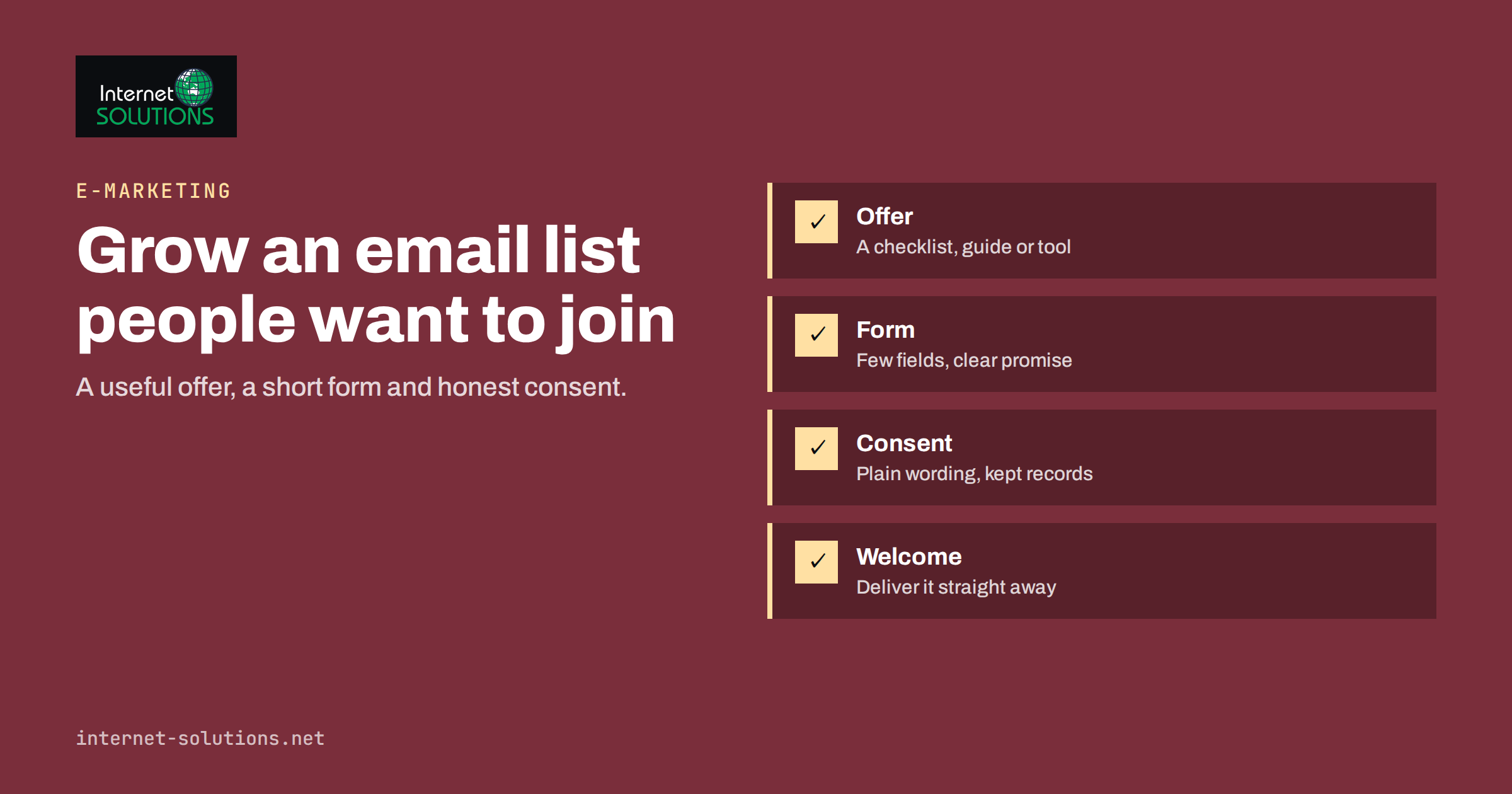
An email list, fed by good lead magnets, is one of the few marketing assets you own. Social platforms change their rules and reach, search rankings move, and ad costs rise, but a list of people who asked to hear from you stays with you. It is also easy to build badly: a pop-up that annoys visitors, a form that asks for too much, a prize draw that fills the list with people who never wanted your emails. The result is a large list with low opens, many complaints and poor deliverability.
Growing a list the right way means giving people a clear reason to subscribe, making signing up simple, collecting consent properly and welcoming new subscribers so that they stay. This guide covers the offer (the lead magnet), the form, the placement, the legal basics and the first emails. It is written for small businesses, agencies and publishers, and it works alongside our introduction to email marketing fundamentals.
Why People Subscribe
People give an email address when they expect something worth more than the interruption. That value can be information, a tool, a discount, early access or simply a regular newsletter they like. A vague promise such as “subscribe to our newsletter” gives no reason to act. A specific one does: “Get the monthly checklist we use to review client websites” or “Receive a short email each Friday with new offers from local suppliers”.
The offer you make at the signup point is called a lead magnet. It is the exchange you propose: an email address for something useful. A good lead magnet is related to what you sell, solves a small real problem quickly and attracts the kind of people who could become customers. A poor one attracts anyone, including people who only want a free item.
Lead Magnet Ideas That Work
The best lead magnets are narrow and practical. They give a quick win and show your expertise. Common formats include:
- Checklists and templates. A website launch checklist, a monthly SEO review template or a content calendar spreadsheet. They are easy to use and easy to produce.
- Short guides. A concise PDF that answers one question, such as “How to choose a hosting plan”.
- Calculators and tools. A budget estimator, an ROI calculator or a simple audit form. Tools can attract high-quality leads because they solve a specific problem.
- Discounts and offers. Useful for online stores, though they often attract bargain hunters. Combine them with a clear explanation of what else subscribers will receive.
- Email courses. A short series sent over several days that teaches a skill. This also builds the habit of opening your emails.
- Early access and member content. New products, events or articles before the public sees them.
- Webinars and workshops. A live or recorded session with registration.
- A good newsletter. If you publish regularly and the content is genuinely useful, the newsletter itself is the lead magnet. Say what it contains and how often it arrives.
Choose the format by asking what your best customers wanted to know before they bought. Your sales and support conversations probably answer this. The questions people ask again and again are the best starting points.
Match the Offer to the Audience
| Business type | Strong lead magnet | Why it works |
|---|---|---|
| Local service business | Seasonal maintenance checklist, price guide, quick quote request | Solves an immediate need and signals trust |
| Online store | First-order offer, size or buying guide, restock alerts | Links directly to a purchase and uses real interest |
| B2B or SaaS | Template, benchmark report, product trial with onboarding emails | Attracts decision makers with a defined problem |
| Agency or consultant | Audit checklist, report template, short training | Demonstrates method and gives a reason to talk |
| Publisher or blogger | Weekly digest, exclusive articles | Builds a regular reading habit |
If a lead magnet attracts many subscribers who never buy, it may be too general. Make the next version closer to the actual problem your product or service solves.
Design a Short, Honest Signup Form
Every extra field lowers the number of people who finish. For a newsletter, an email address is enough. Add a first name only if you will use it. Ask for more details later, once people have had reason to trust you, using progressive questions in emails or on a preference page. If you need qualifying information, such as company size, ask it only for offers that require it, such as a demo.
- Write a clear headline that states the benefit, not the action: “Get the website launch checklist” is better than “Subscribe”.
- Add one line of detail: what people will receive and how often.
- Use a specific button label, such as “Send me the checklist”.
- Show a short privacy note with a link to your policy.
- Keep the form visually simple and large enough for phone use.
- Confirm success clearly, with a thank-you message that says what happens next, whether that is a download or a confirmation email.
Make sure the form works with the keyboard and screen readers, has labels for its fields and shows understandable error messages. Accessible forms convert better for everyone.
Where to Place Signup Forms
Place the offer where interested people are already reading. Possible locations include:
- Inside relevant articles. A checklist offer at the end of a guide on the same topic usually converts better than a generic sidebar box.
- A dedicated landing page. Useful for paid traffic and social posts, with one message and one form.
- The footer. Always present and not intrusive, although it converts modestly.
- The checkout or order confirmation, as an optional box, for customers who agree to hear from you.
- Live chat. After a helpful conversation, offer to send a guide or updates by email, with the person’s agreement.
- Pop-ups and slide-ins. They can work, but they annoy when they appear instantly or cover content on phones. If you use them, delay them, trigger them by scroll or exit intent, limit how often they appear and make them easy to close.
Test placements one at a time, as in our guide to email A/B testing, and judge them by the quality of the subscribers they bring, not only the number.
Consent and the Law
The legal rules depend on where your subscribers live, and this article is not legal advice. Several principles are shared by most modern privacy regimes, including the European Union’s GDPR. Consent should be freely given, specific, informed and unambiguous. In practice, that means:
- No pre-ticked boxes. The person must take a positive action.
- Say what they are signing up for. If the checkbox is for marketing emails, say so, and do not bundle it with other terms.
- Keep a record of when and how each person subscribed, which form they used and what text they saw.
- Make unsubscribing as easy as subscribing, with a working link in every email.
- Do not add people without their agreement, for example from business cards or purchased lists.
The text of the regulation is available for reference: see the GDPR article on the conditions for consent, and the guidance of the UK regulator on direct marketing. For website-wide privacy practices, such as cookie banners and policies, see our guide to cookie consent and GDPR compliance.
Single or Double Opt-In
With single opt-in, a person is added as soon as they submit the form. With double opt-in, they receive a confirmation email and are added only after clicking the link. Single opt-in produces more subscribers but also more mistyped addresses, bots and addresses entered by other people. Double opt-in produces a smaller, cleaner list, gives stronger proof of consent and protects your sending reputation. In many European countries, double opt-in is the common practice.
If you choose double opt-in, make the confirmation email arrive within seconds, write a clear subject line, explain what the click does and deliver the lead magnet right after confirmation. Check that confirmation emails are authenticated properly, as explained in our guide to SPF, DKIM and DMARC, because otherwise they may land in spam and the person is lost.
Welcome New Subscribers Properly
The first email is the most opened email you will ever send. Use it well.
- Send it immediately, while the person still remembers signing up.
- Deliver what you promised, with a clear link to the checklist or guide.
- Repeat what to expect: topics and frequency.
- Introduce yourself briefly, in plain language and a human tone.
- Ask for one small action, such as replying with a question, which also helps inbox placement.
- Follow with a short sequence, for example three or four emails over two weeks that offer your best content and a gentle next step.
Our guide to email automation flows shows how to build a welcome series and what to include in each message.
Measure the Quality of Growth
Subscriber count alone can mislead. Track several figures together.
- Conversion rate of each form, meaning visitors who subscribe.
- Confirmation rate, if you use double opt-in.
- Open and click rates of the welcome series, which reveal early engagement.
- Unsubscribe and complaint rates in the first weeks, an indicator that the offer and the content do not match.
- Revenue or leads per subscriber source, which shows which lead magnets bring customers and not just addresses.
Open rates have become less reliable on some mail clients because of privacy features, so rely more on clicks, replies and conversions, as explained in our article on email marketing metrics after Apple Mail Privacy Protection.
Keep the List Healthy
Growth is only half the task. A list needs maintenance: remove invalid addresses, handle bounces, and re-engage or retire subscribers who stopped reading. Doing so protects deliverability and keeps your reports honest. Our guide to email list hygiene describes the routine.
Mistakes That Damage a List
- Buying or scraping addresses. It breaks consent rules, brings spam traps and ruins reputation.
- Offering a prize unrelated to your business. You attract people who want the prize, not your service.
- Hiding the frequency or topic. Surprise leads to complaints.
- Collecting too much data upfront. It reduces sign-ups and increases risk.
- Ignoring mobile. A form that is hard to use on a phone loses most visitors.
- Not following up. A lead magnet without a welcome sequence wastes the moment of highest interest.
If you want help with the forms, the site and the email setup as a single project, our e-marketing team can plan the offer, build the pages and connect the sending domain correctly.
Frequently Asked Questions
What is a lead magnet?
A lead magnet is something useful you offer in exchange for an email address, such as a checklist, template, guide, tool, discount or a good newsletter. It should be relevant to what you sell and solve a small real problem quickly.
How many fields should a signup form have?
As few as possible. For a newsletter, an email address is enough. Add a first name only if you will use it, and collect other information later through emails or a preference page.
Do I need double opt-in?
It is not required everywhere, but it gives cleaner data and stronger proof of consent, and it is common practice in many European countries. It reduces fake and mistyped addresses at the cost of slightly fewer confirmed subscribers.
Can I add customers to my newsletter automatically?
Generally not without their agreement. Offer an optional checkbox at checkout or in the account area, and keep a record of the consent. Rules vary by country, so check the requirements for your market.
Are pop-ups bad for email list growth?
They can work well when used with restraint. Delay them, trigger them by scroll or exit intent, limit how often they appear and make them easy to close, especially on phones. Judge them by subscriber quality, not only volume.
How often should I email new subscribers?
Send a welcome email at once and a short series over the first two weeks, then move to the frequency you promised. Consistency matters more than a particular number, and people should always know what to expect.
The Bottom Line
Growing an email list the right way depends on a clear exchange: a specific, useful lead magnet in return for an address, offered in a short, honest form at moments when readers are interested. Collect consent plainly, keep records, consider double opt-in, and welcome every new subscriber with the promised content and a short sequence. Measure the quality of growth through engagement and customers, not just the count, and keep the list clean over time. A smaller list of people who wanted to join will always outperform a larger one built on tricks.