

 English
 Lietuvių
 Latviešu
 Eesti
Eesti Русский
 Polski
 Українська
 Deutsch
 Italiano
 Español
 Français
 Português
 Čeština
 Magyar
 Română
 Ελληνικά
 Türkçe
 日本語
日本語 العربية
 हिन्दी
 Bahasa Indonesia
 Bahasa Melayu
 ไทย
ไทย Tiếng Việt
 বাংলা
বাংলাOnboarding a New Website With PostRSS, Talkmio and Ask Mio AI: A 30-Day Rollout Plan
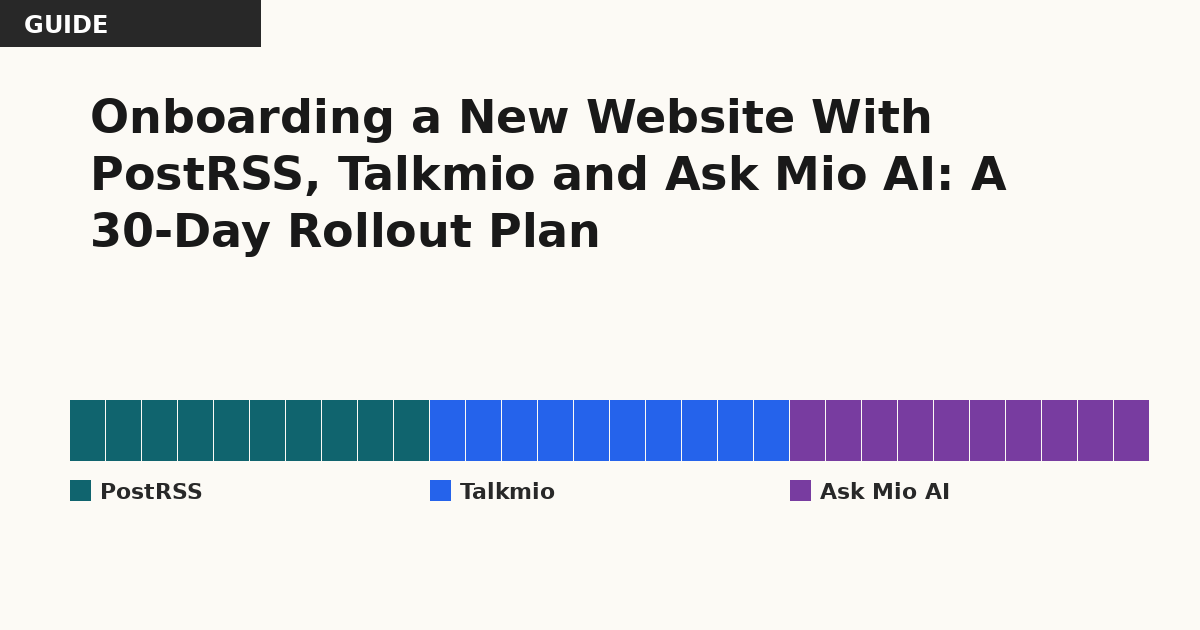
Launching PostRSS, Talkmio and Ask Mio AI together on a new website in a single afternoon is possible, and it’s usually a mistake. Each tool depends on decisions that are easier to make well with a little runway — a content distribution rhythm, a chat escalation policy, a set of answers an AI assistant can actually trust — and rushing all three live at once tends to produce a launch that looks complete on day one and needs quiet, embarrassing fixes for weeks afterward. A staged 30-day rollout gets the same three tools live, but in an order and pace that lets each one be configured properly before the next one starts leaning on it.
Why Sequencing Matters More Than Speed
The three tools aren’t independent of each other in practice, even though they can each run standalone. Ask Mio AI answers questions more reliably when it has real support conversations and a real content library to draw context from — both of which barely exist on day one of a new site. Talkmio’s escalation rules work better once there’s a sense of actual traffic patterns and common visitor questions, which don’t show up until the site has been live and distributing content for a while. And PostRSS’s distribution schedule is what generates the traffic and content history the other two tools benefit from having. Turning all three on simultaneously means each one launches into a vacuum the others were meant to help fill. This isn’t unique to marketing and support software — the same logic underlies why change-management frameworks like ADKAR treat organizational rollouts as a sequence of stages rather than a single switch-flip moment: awareness and readiness have to exist before adoption can, and adoption has to be real before reinforcement makes sense. A tool rollout follows the same shape even at a much smaller scale.
Week One: Content Distribution First
The first week focuses entirely on PostRSS: connecting the site’s RSS feed, mapping it to the intended distribution channels, and confirming that a handful of test posts render correctly on each connected platform before trusting the automation with real content. This week also includes writing and publishing the first few pieces of genuinely useful content the site will lean on later — not filler, since these early posts become part of what Ask Mio AI eventually draws from when answering visitor questions. By the end of week one, the goal is a working, verified distribution pipeline and a small but real content foundation, not yet any live chat or AI assistant.
Week Two: Live Chat, Configured Before It’s Public
Talkmio goes live internally in week two, but not necessarily visible to every visitor from day one. This week is for setting up the actual escalation rules — which questions get an automated response, which require a human, what happens outside business hours — and testing them against the kind of questions the first week’s traffic and content actually generated, rather than guessing at what visitors will ask. Team messaging integration (so new chats surface where the team is already watching) gets configured now too, since chasing a missed chat notification in week three, after the widget is already public, is a worse time to discover the integration wasn’t set up correctly.
Week Three: Ask Mio AI, Trained on What Actually Exists
By week three, there’s real content from PostRSS-distributed posts and a small library of real chat transcripts from Talkmio — both of which make Ask Mio AI’s training meaningfully better than it would have been on day one, when there was nothing to train on except generic product pages. This week focuses on building the knowledge base from what’s accumulated so far, defining the handoff threshold to Talkmio for questions the assistant shouldn’t try to answer alone, and running a soft launch — visible to a portion of traffic, or internally only — before opening it up fully.
Week Four: Integration, Measurement, and the First Real Review
The final week connects the pieces that benefit from working together rather than in isolation: Ask Mio AI’s handoffs flowing into the same channels Talkmio already notifies, qualified leads from either tool reaching whatever CRM or record-keeping system the business uses, and a first pass at reviewing what each tool has actually produced over the month — which posts got the most distribution traction, which chat questions came up often enough to deserve a permanent knowledge base entry, which AI conversations needed a human handoff and why. This review is what turns the rollout from “three tools are now live” into “three tools are now tuned to this specific business,” and it’s worth repeating monthly afterward rather than treating it as a one-time launch task.
| Week | Primary focus | What “done” looks like |
|---|---|---|
| 1 | PostRSS distribution + initial content | Verified feed-to-channel pipeline, first real posts published |
| 2 | Talkmio setup and internal testing | Escalation rules and team notifications configured and tested |
| 3 | Ask Mio AI knowledge base and soft launch | Assistant trained on real content and transcripts, handoff threshold set |
| 4 | Cross-tool integration and first review | Leads and handoffs flowing into one place, first performance review done |
What Happens When a Business Skips the Sequencing
The most common failure pattern isn’t a technical one — all three tools generally work as designed regardless of launch order. It’s that an AI assistant turned on before there’s any real content or chat history gives thin, generic answers that erode visitor trust in the assistant before it’s had a chance to actually get good, and a live chat widget turned on before escalation rules are configured leads to either unanswered chats piling up or an overwhelmed team fielding questions with no clear process for who handles what. Both problems are fully fixable after the fact, but fixing a bad first impression costs more attention and goodwill than building the sequence correctly the first time would have.
Adjusting the Timeline for an Existing Website
A site that already has an established content archive and traffic history doesn’t need the full month — Ask Mio AI’s knowledge base can be built from existing content immediately rather than waiting for week three’s freshly generated material, and Talkmio’s escalation rules can be informed by historical support tickets or existing contact-form patterns rather than a fresh week of observation. The underlying principle stays the same regardless of how compressed the timeline gets: distribution and content first, chat second, AI assistant third, integration and review last — because each later stage genuinely depends on data the earlier stages produce, not because of any fixed calendar requirement.
Treating the Assistant’s First Weeks as an Onboarding Experience, Not Just a Feature Launch
It’s easy to think about turning on Ask Mio AI as flipping a technical switch, but from a visitor’s perspective it’s closer to being introduced to a new part of the website they haven’t used before — and general research on software onboarding consistently finds that a first impression formed during initial, low-context use is disproportionately hard to undo later, even after the underlying product genuinely improves. That’s a strong argument for the soft-launch approach in week three rather than exposing every visitor to the assistant’s least-informed version of itself. A visitor who tries the assistant once, gets a thin answer, and quietly stops trying it again is a harder problem to fix than one who simply hasn’t encountered it yet.
Documenting the Rollout as It Happens
A short, running log of what changed each week — which escalation rule got adjusted, which knowledge base gap got noticed and filled, which distribution channel underperformed and why — turns the month into something a team can actually learn from afterward, rather than a blur of settings changes nobody can reconstruct later. This log is also what makes the week-four review genuinely useful rather than a vague impression exercise: specific changes tied to specific weeks make it possible to say with some confidence which adjustment actually caused which improvement, instead of guessing after the fact.
FAQ
Can all three tools be launched at the same time instead of staggered?
Technically yes, but each tool performs better with a foundation the earlier stages provide — content for the AI assistant to reference, chat history to inform escalation rules. A simultaneous launch usually means fixing configuration gaps after the fact rather than avoiding them.
What if the business already has years of existing content and support history?
The 30-day timeline compresses significantly. Ask Mio AI can be trained on the existing archive right away, and Talkmio’s rules can draw on historical support patterns instead of waiting to observe new ones — the sequence still matters, but each stage takes less time.
Does the AI assistant need to wait a full three weeks before going live?
Not necessarily in a hard sense — a soft launch to a limited audience earlier is reasonable if there’s already some content to draw from. The key is having a real knowledge base and a defined handoff threshold before opening it to full traffic, whatever week that happens to land in.
Who should own this rollout internally?
One person or a small team should own the sequencing and the week-four review, even if different people configure each individual tool, since the value of the staged approach comes from the tools being deliberately connected at the end, not just individually switched on.
How is success measured at the end of the 30 days?
Through the specific metrics each tool produces — distribution reach and engagement from PostRSS, response time and resolution rate from Talkmio, and qualified handoffs from Ask Mio AI — reviewed together rather than in isolation, since the point of the rollout is how well they work as one system, not just individually.
Should the review at the end of week four be repeated later?
Yes. Treating it as a recurring monthly or quarterly check, rather than a one-time launch task, is what keeps the three tools tuned to how the business and its visitors actually behave as both evolve over time.
The Bottom Line
PostRSS, Talkmio and Ask Mio AI each work better when the one before it has had a chance to produce real content and real conversation history first — distribution builds the foundation, chat learns from real questions, and the AI assistant trains on what actually exists rather than a placeholder. A staged rollout takes a few weeks longer than switching everything on at once, and it consistently avoids the thin-answer, missed-chat problems that come from skipping straight to a simultaneous launch.