

 English
 Lietuvių
 Latviešu
 Eesti
 Русский
 Polski
 Українська
 Deutsch
 Italiano
 Español
 Français
 Português
 Čeština
 Magyar
 Română
 Ελληνικά
 Türkçe
 日本語
 العربية
 हिन्दी
 Bahasa Indonesia
 Bahasa Melayu
 ไทย
 Tiếng Việt
 বাংলা
Trademark Assignment and Licensing: Selling or Sharing a Mark Safely
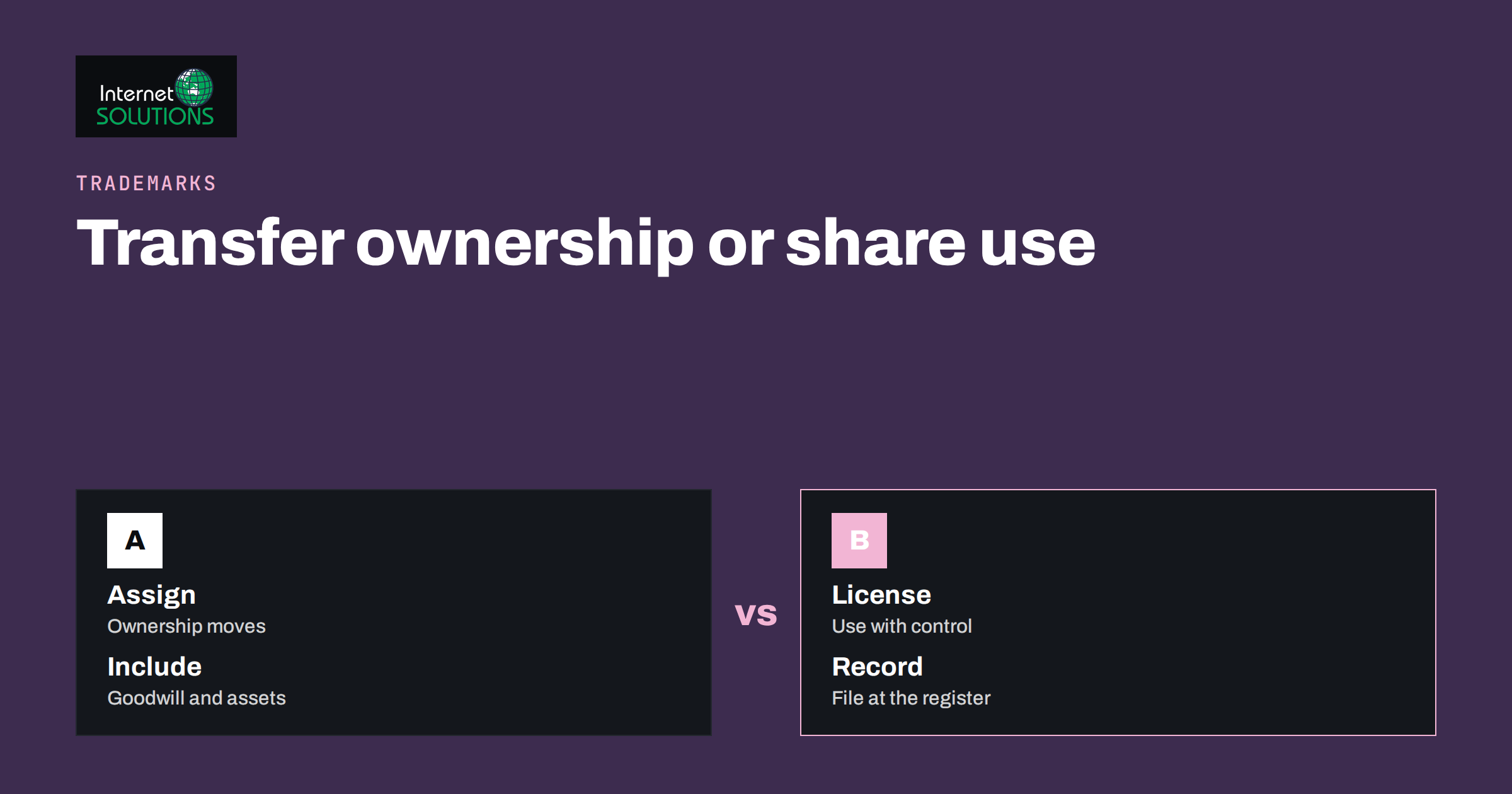
Trademark assignment and licensing are the two ways a registered brand can be used by someone other than its owner. An assignment transfers ownership of the mark, for example when a company is sold or a founder moves the brand into a new company. A licence leaves ownership with the owner and lets another party use the mark under agreed conditions, as happens with franchises, distributors and partner brands. Both are common, and both go wrong in predictable ways when they are handled informally.
This guide explains the difference, what a safe assignment includes, how to write a licence that protects the brand, and which records and filings keep everything valid. It is general information and not legal advice. Trademark law varies between countries, and the consequences of a mistake can include losing the mark, so involve a qualified trademark attorney for any real transaction.
Assignment and Licence: The Basic Difference
Think of a trademark as property that also carries a promise to customers about quality and origin. An assignment moves the property. After it, the new owner controls the mark, can enforce it and can license it to others; the former owner no longer has rights unless a licence back is agreed. A licence only grants permission. The owner keeps the property, and in return must make sure that licensed use does not mislead customers or lower quality.
| Question | Assignment | Licence |
|---|---|---|
| Who owns the mark afterwards? | The buyer or new holder | The original owner |
| Typical situations | Sale of a business, restructuring, transfer to a new company | Franchising, distribution, co-branding, group companies |
| Can it be undone? | Only by another transfer | By ending or not renewing the licence |
| Quality control | Passes to the new owner | Remains with the owner, who must exercise it |
| Filing at the register | Usually recorded so that the new owner is shown | Often recorded, depending on country and need |
Choosing the wrong instrument is a common mistake. A seller who wants to keep the brand but let a distributor use it needs a licence, not an assignment. A buyer who wants to control the brand needs an assignment, not just permission to use it.
Before Any Transfer: Check What You Actually Own
An assignment is only as good as the rights being assigned. Before signing, verify the status of every mark involved. Confirm the owner named on the register, the countries and classes covered, the renewal dates and whether any claims are pending. Check for earlier licences, security interests or disputes that might follow the mark to a new owner. If the brand was never registered, the rights may be limited to those arising from use, and it may be better to register before assignment. Our guide to company name versus trademark explains why a business registration does not give you brand protection.
Check also the underlying name and logo. A logo may involve design copyright owned by a designer, and the assignment should cover it or the buyer may find that they own the registration but not the artwork. The domain names, social media accounts and similar brand assets should be listed in the deal, because buyers often assume they are included. Review the choice between word mark and logo to understand exactly what is protected.
What a Safe Assignment Includes
An assignment document does not need to be long, but it must be precise. The main elements are these.
- The parties, with full legal names and addresses.
- The marks, identified by registration or application numbers, countries and classes, and a description of unregistered rights if they are included.
- The goodwill. In many legal systems, a mark must be transferred together with the goodwill of the business it represents; an assignment of the bare mark can be challenged as invalid. The document should say that goodwill is included, and the deal should be real.
- The consideration, meaning the price or other value exchanged.
- Warranties, such as that the assignor is the owner, has not granted conflicting rights and knows of no disputes.
- Effective date and, where relevant, rights to sue for past infringements.
- Related assets, such as domain names, social accounts, artwork files and brand guidelines.
- Further assurance, a promise to sign any additional documents needed to complete registration of the transfer.
- Signatures, following the formalities required locally.
After signing, record the assignment with each relevant trademark office. Until the register shows the new owner, enforcing the mark, renewing it and licensing it can all be complicated. The offices publish guidance on how to record transfers; for an overview of the system, see the World Intellectual Property Organization’s trademark pages and the US Patent and Trademark Office for United States marks. Keep copies of all filings and receipts.
Licensing: Keeping Control of the Brand
A licence lets others benefit from your brand, and the key legal point is control. If the owner lets others use the mark with no supervision, the mark can lose its meaning as an indicator of origin, and in the worst cases it can become vulnerable to cancellation. A good licence therefore combines permission with quality control.
- Define the licensed mark and use. Say exactly which marks, which goods or services, which territory and which channels are covered.
- Choose exclusive or non-exclusive. An exclusive licence means that even the owner may be barred from using the mark in that scope; a non-exclusive licence allows other licensees.
- Set quality standards. Describe specifications, approval of samples, brand guidelines, inspection rights and what happens if standards are not met.
- Control presentation. Require correct use of the mark, notices and logo files, and approval of new materials.
- Set fees. Royalties, minimum payments, reporting and audit rights.
- Limit sub-licensing. Allow it only with written consent.
- Decide who enforces. The licensee should report infringements, and the owner should decide whether to take action.
- Plan the end. Term, renewal, termination reasons, and what happens to stock, materials, domains and goodwill at the end.
A licence should also state that all goodwill from the licensee’s use benefits the owner, that the licensee cannot register the mark or confusingly similar names, and that it will stop using the mark at the end. Our article on trademark renewal, proof of use and licensing explains how licensed use can count as use by the owner when control is properly exercised.
Group Companies, Franchises and Partners
Many small businesses encounter licensing without realising it. A founder may own the trademark personally while the company operates the business; a group may hold brands in a separate company that licenses them to operating subsidiaries; a franchisor licenses a system, including the mark, to franchisees. Each arrangement benefits from a written licence, even between related parties, because it documents who owns the brand and on what terms others use it. Without paperwork, a dispute between founders, a sale of the company or an insolvency can create uncertainty about who actually owns the mark.
Partners and distributors need particular care. Give them clear brand guidelines and approval rules for materials, and be specific about whether they may register domain names or social accounts that contain your mark. Many disputes arise because a distributor registered the brand in its own name in a local market. Registering your mark in the markets where you trade, and monitoring for conflicting filings, reduces this risk; see trademark monitoring and infringement response.
A Worked Scenario
Consider a founder who built a small brand of workshop tools and registered the word mark in her own name. She later forms a company to run the business and an investor wants to buy a stake. The company has been using the brand for two years with no paperwork. To clean this up, she can either assign the mark to the company, or keep it personally and grant the company a written licence. Assignment gives the investor a simple story: the company owns what it sells under. A licence keeps the founder in control, but the investor will want to understand its term, its royalty and what happens if she leaves.
Whichever route is chosen, the steps are the same: check the register, agree the document, record it and update the company’s records. If she chooses assignment, the document should cover the goodwill built up by the company’s use, the logo artwork and the domain name. If she chooses a licence, it should include quality control and a clear end. Doing this before the investment avoids a rushed fix during due diligence, when every question can delay the deal.
Common Pitfalls
- Assigning without checking the register. The seller may not be the recorded owner, or the registration may have lapsed.
- Forgetting related assets. Domains and social accounts are often left behind and later become bargaining chips.
- Informal group use. Related companies use the mark without a licence, which blurs ownership and complicates later sales.
- No quality control. A licence that lets anyone use the mark in any way weakens the brand.
- Missing deadlines. A transfer that is not recorded may cause missed renewal notices that still go to the old owner.
- Ignoring local law. Rules on goodwill, formalities and recording differ between countries, so a document that works in one place may fail in another.
It also pays to think about price and tax early. The value of a trademark depends on how long it has been used, the strength of the brand and the territories covered, and the tax treatment of a transfer or of royalty payments varies by country. Ask your accountant to review the structure before signing, and keep evidence of use, such as sales records and marketing materials, because it supports both valuation and later enforcement.
Practical Checklist for a Deal
Whether you are selling, buying or licensing, a short checklist keeps the process orderly.
- List every mark, registration number, country and class, and check them on the official registers.
- Identify related assets: logos, artwork, domains, social accounts and brand files.
- Check for existing licences, liens and disputes.
- Decide whether you need an assignment or a licence, and who will control quality.
- Have a trademark attorney draft or review the document.
- Sign with the proper formalities and record the transaction at each register.
- Update your brand guidelines, website and business records.
- Diarise renewal deadlines and licence review dates.
If you are still deciding what to register in the first place, our trademarks service page explains how we help businesses prepare and protect their brands before they are shared or sold.
Frequently Asked Questions
Can I sell a trademark without selling the business?
In many countries a mark must be transferred with its associated goodwill, so a bare transfer can be challenged. Take legal advice on how to structure the sale in the countries concerned.
Do I have to record a trademark assignment?
It is strongly advisable. Recording at the register shows the new owner, supports enforcement and renewal, and protects against later conflicting transfers. Rules differ by country.
What is quality control in a licence?
It is the owner’s right and duty to make sure that licensed goods or services meet agreed standards, so that the mark continues to mean the same thing to customers.
Is a verbal permission to use my brand enough?
It is risky. A written licence with terms, quality control and an end date protects both sides and gives evidence if there is a dispute.
Can a licensee register my trademark?
It should not. A licence should forbid the licensee from registering the mark or similar names, and the owner should monitor registers for such attempts.
What happens to the licence if the owner sells the mark?
It depends on the terms and local law. A licence can state that it binds successors, which gives the licensee more security; check this point before signing.
The Bottom Line
Use an assignment when ownership should move, and a licence when only use should be shared. Verify the rights first, document the transfer with goodwill, related assets and warranties, and record it at the registers. For licences, define scope, set and enforce quality standards, limit sub-licensing and plan the end. Put everything in writing and have a trademark attorney review it, so that your brand stays valid, valuable and under your control.