

 English
 Lietuvių
 Latviešu
 Eesti
 Русский
 Polski
 Українська
 Deutsch
 Italiano
 Español
 Français
 Português
 Čeština
 Magyar
 Română
 Ελληνικά
 Türkçe
 日本語
 العربية
 हिन्दी
 Bahasa Indonesia
 Bahasa Melayu
 ไทย
 Tiếng Việt
 বাংলা
Trademark Classes Explained: How to Describe Your Goods and Services
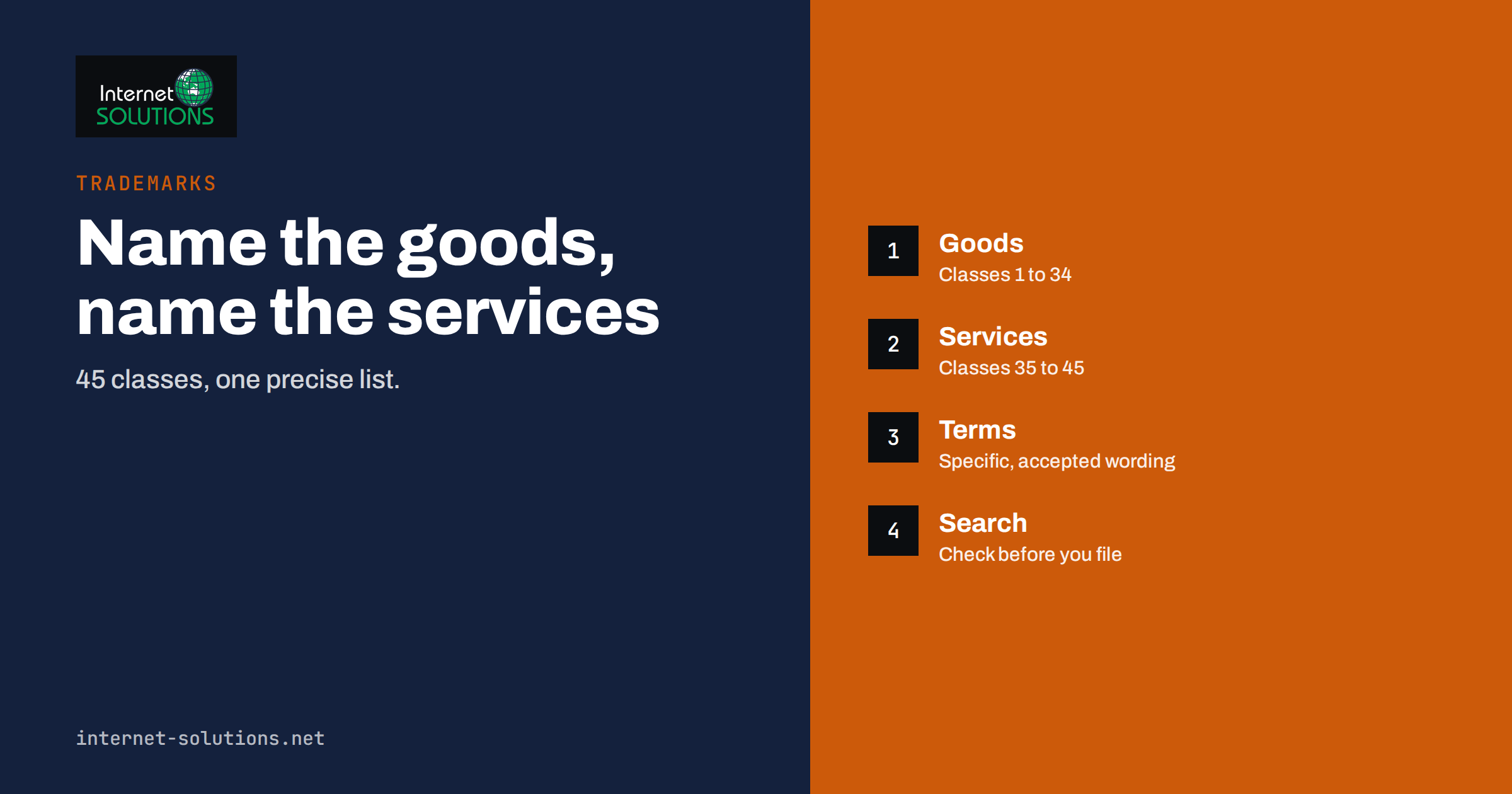
Trademark classes decide what your registration actually protects, and many applicants choose them in a hurry. When you file a trademark application, you do not only provide a name or a logo. You also list the goods and services for which you want to use it, and each item on that list belongs to a numbered class. A mark registered in the wrong class, or with a vague list, can leave you with a certificate that looks impressive but does not cover the thing you sell. This guide explains how the classification works, how to write a list of goods and services that fits your business, and how to avoid the mistakes that cost money later.
It is general information for business owners, not legal advice. Rules, fees and examination practice differ between offices, so check the current guidance of the office where you file, and consider asking a trade mark attorney for anything that matters to your brand.
What Trademark Classes Are
Almost all trademark offices in the world use the same system to sort goods and services: the Nice Classification, maintained by the World Intellectual Property Organization. It has 45 classes. Classes 1 to 34 cover goods, such as chemicals, clothing, software on a disc, food and drinks. Classes 35 to 45 cover services, such as advertising and business management, telecommunications, education, software as a service and legal services.
The purpose of classes is practical. They let an office examine applications in an orderly way, let applicants search for conflicts, and let you tell at a glance which area of trade a registration belongs to. Two businesses can own similar names in different fields without conflict, as long as customers are unlikely to confuse them. The classes are a tool for describing the field; the real question for a dispute is always whether the goods and services are similar and the marks are confusingly alike.
The classification is revised regularly, and offices accept the edition in force at the date of filing. Because lists are checked against it, use the terms that appear in the current database, or terms the office is known to accept, rather than inventing wording.
Why the Choice of Class Matters
A registration gives you exclusive rights for the goods and services you listed, plus protection against confusingly similar ones. It does not give you a general right to the name everywhere. That has three practical consequences.
- Gaps in coverage. If you registered your brand for clothing but start selling bags and shoes, you may have no registration for those goods. You may still have arguments based on similarity, but they are weaker than a registration that names the product.
- Cost. Most offices charge a base fee that includes one class, and further classes cost more. Adding a class during the application is usually cheaper than filing again later, but adding classes after filing is generally not allowed, so you must decide before you apply.
- Vulnerability. In many countries, a mark that is not used for some of its registered goods and services for a period, often five years, can be challenged for non-use. Claiming everything you can imagine is therefore not a safe strategy.
The sweet spot is to cover what you sell today, what you have a genuine plan to sell soon, and the closest neighbours that a competitor could use to trade on your reputation.
The Classes Small Businesses Use Most
Most small and growing businesses file in a handful of classes. The table shows common ones with typical examples. It is a simplified guide, not a substitute for the official headings.
| Class | Covers | Typical examples |
|---|---|---|
| 9 | Scientific and electronic apparatus; software | Downloadable apps, recorded software, computers, smart devices |
| 16 | Paper goods and printed matter | Books, brochures, stationery, packaging paper |
| 25 | Clothing, footwear, headgear | T-shirts, hoodies, shoes, caps |
| 35 | Advertising and business services | Online retail services, marketing, business consulting |
| 36 | Insurance, finance, real estate | Payment services, financial consulting, property management |
| 38 | Telecommunications | Chat services, online forums, transmission of messages |
| 41 | Education and entertainment | Courses, training, events, publishing online |
| 42 | Technology and scientific services | Software as a service, web design, hosting, IT consulting |
| 43 | Food and accommodation services | Restaurants, cafes, catering, hotels |
| 45 | Legal and security services | Legal services, licensing, personal services |
A software company, for instance, might consider class 9 for downloadable software and mobile apps, class 42 for the same functionality delivered online as a service, and class 35 if it also runs an online marketplace. The same product may need more than one class because the law treats a downloadable program and a hosted service as different things.
Goods Versus Services: Where Confusion Starts
The split between goods and services is where applicants most often go wrong. A few rules of thumb help.
- Selling things is not the same as retail services. If you make shoes, class 25 protects the shoes. If you run a shop that sells other people’s products as well as your own, class 35 can cover the retail service. Many offices expect the retail wording to say what kind of goods you retail.
- Making something for others is a service. A print shop prints for customers, which is a service in class 40, while the printed brochures themselves fall in class 16.
- Software has two faces. Software you download or install is a good in class 9. Software you use through a browser and do not install is a service in class 42. Apps often need both.
- Information and publications. A blog, newsletter or course is usually an educational or publishing service in class 41, while a printed or downloadable book is a good in class 16 or class 9.
- Consulting is a service. Business advice falls in class 35, technical advice in class 42 and legal advice in class 45, depending on the field.
When two classes seem to fit, read the official headings of both, then look at how similar businesses were classified in the public register of the office. Searching for a competitor’s mark and reading its list is one of the best free sources of guidance.
Writing the List of Goods and Services
The wording of the list matters as much as the class number. Offices usually distinguish between two ways of writing it.
Class headings
Each class has a short heading that summarises its field. Using a heading is quick and cheap, but practice varies. Some offices treat a heading as covering everything in the class, others only the literal meaning of the words, and some require more precise wording. A heading that sounds broad may protect less than you expect.
Specific terms
A list of specific terms, such as “downloadable mobile applications for managing appointments”, is clearer for both the examiner and any future opponent. It is also easier to defend, because you can show use for each item. Offices maintain databases of accepted terms, and the European Union Intellectual Property Office offers a free classification tool built on a shared database that many offices recognise. Terms taken from such databases are usually accepted without questions.
Whichever method you choose, follow these habits:
- Describe the real product or service in plain words first, then match it to accepted terms.
- Avoid words that are vague, such as “services” on its own, or marketing slogans in place of descriptions.
- Include the neighbouring goods that a customer could expect you to offer next.
- Do not add goods you have no intention of offering, since non-use can weaken the registration.
- Keep a record of why each item is there, so a future decision about renewal or licensing is easier.
How Many Classes Do You Need?
There is no single answer, but a method works well. List your offer in three groups: what you sell now, what you will launch in the next two or three years, and what a competitor could sell under a similar name to ride on yours. Map each group to classes and rank them by importance and by cost. Your core classes should be the ones where you already trade or will trade very soon.
A small online shop that sells its own branded clothing and runs an online store might file in class 25 for the clothing and class 35 for the retail service. A local training company might need class 41 only. A software startup that offers an app and a hosted service would consider classes 9, 42 and perhaps 35 or 38. A restaurant would look at class 43, plus class 30 or 32 if it plans to sell packaged sauces or drinks under the same name.
Think also about where you will trade. A national registration protects you in one country. A European Union trade mark covers the member states with one application, and the international system lets you extend a basic registration to other countries. Each route has its own fees and rules, so classes and territories should be planned together. Our guide to choosing between an EU trade mark and a national registration covers that decision.
A Worked Example
Imagine a founder who is launching a brand called “Brightpath” for a scheduling app for physiotherapists, with a companion blog and printed appointment cards for clinics. A sensible first draft of the classes might look like this.
- Class 9: downloadable software and mobile applications for scheduling appointments in the health sector.
- Class 42: providing online non-downloadable software for scheduling and managing appointments; hosting of web-based scheduling tools.
- Class 41: providing online publications, namely articles and guides in the field of clinic management.
- Class 16: printed appointment cards and stationery, if the founder genuinely plans to sell them.
The founder then asks whether every class is worth the cost. The app and the hosted service are the core of the business, so classes 9 and 42 stay. The blog supports the brand but does not generate revenue on its own, so class 41 may be postponed or covered by a modest wording. The appointment cards are a side idea, so class 16 may wait. A short list that is well written and used is stronger than a long list that is half imaginary.
Checking for Conflicts Before You File
Classes also matter when you search. A conflict is judged by similarity of goods and services as well as of marks, so search in your own classes and the related ones. Look in the registers of the offices where you plan to trade, and also in the international databases that gather several of them. Search for the exact name, similar spellings, phonetic variants and translations, because confusion can arise when marks sound alike or mean the same.
A clean search does not guarantee approval, because examiners and opponents may see conflicts you missed. It does reduce surprises. If the search finds a similar mark in a distant class, you may be fine; if it finds one in the same field, think about changing the name before you invest in branding. A single afternoon of searching costs far less than a rebrand after launch.
Use a short checklist when you search:
- Identical mark in your classes.
- Similar marks in your classes, including spelling and sound variations.
- Identical and similar marks in related classes, such as 9 and 42 for software.
- Company names and domain names with the same wording.
- The marks of well-known brands that could be diluted by yours.
Common Mistakes With Classes
| Mistake | Why it hurts | Better approach |
|---|---|---|
| Filing in one class only because it is cheapest | Leaves your real offer unprotected | Cover core goods and services, even if it costs more |
| Copying a long list from a big company | Pays for items you will not use; invites non-use challenges | Write a list that matches your plan |
| Using only a class heading | The scope may be narrower than you assume | Use specific terms from accepted databases |
| Choosing a class by guessing | The office may object, delaying the application | Read official headings and look at similar registrations |
| Forgetting to renew or to prove use | The registration can lapse or be attacked | Keep evidence of use and a renewal calendar |
| Filing the logo only | Protects the picture but not the name in other fonts | Consider the word mark and the logo separately |
After Registration: Keep the Protection Alive
Registration is the start of the work, not the end. Use the mark for the goods and services you listed, keep dated examples such as packaging, invoices, screenshots and advertisements, and mark your brand consistently. Renew on time, because most offices run on fixed periods, commonly ten years. If your business changes, review the list: adding new goods usually means a new application, because the old one cannot be widened.
It also pays to watch for others who file similar marks. Many offices publish new applications for a period during which you may oppose them, which is cheaper than court action afterwards. Our article on trademark monitoring, watch services and responding to infringement explains how that works in practice.
For a broader look at what to protect and when, read what to register before you launch. For a real example of what a registered mark looks like, you can see the details of the marks owned by Internet Solutions, UAB on the trademarks page, including the office, registration date and number.
Frequently Asked Questions
How many trademark classes are there?
The Nice Classification has 45 classes: 34 for goods and 11 for services. Every application must assign each good or service to its class.
Can I register one mark in several classes?
Yes. One application can usually cover several classes, and the fee generally grows with the number of classes. You decide the classes before filing because most offices do not allow classes to be added to a pending application.
Does a registration in one class stop others from using my name in a different class?
Not automatically. Protection covers your listed goods and services and those similar to them. Where goods are unrelated, others may be able to use a similar name, unless your mark is famous or the use would take unfair advantage of it.
Should I use the class heading or specific terms?
Specific terms are usually clearer and safer. Class headings are quicker, but offices handle them differently, and a heading may protect less than its broad wording suggests. Terms taken from the office’s accepted database are the most reliable.
Which class covers a website or an online shop?
A website as such is not a class. What you provide through it is: online retail services fall in class 35, hosted software in class 42, online education in class 41, and so on. Choose the class by the service your customers receive.
Do I need a lawyer to choose classes?
You can file without one in many offices, and the official tools help. A trade mark attorney is worth the fee when the brand is central to your business, when you plan to trade abroad or when a search shows similar marks.
The Bottom Line
Trademark classes turn a name into a precise protected right, so treat them as part of the brand strategy rather than a form field. Describe what you really sell, map it to the right goods and service classes, write specific terms, search for conflicts in your classes and the neighbouring ones, and keep evidence of use. A short, accurate list that follows your business will protect you better than a long list nobody can defend.