

 English
 Lietuvių
 Latviešu
 Eesti
 Русский
 Polski
 Українська
 Deutsch
 Italiano
 Español
 Français
 Português
 Čeština
 Magyar
 Română
 Ελληνικά
 Türkçe
 日本語
 العربية
 हिन्दी
 Bahasa Indonesia
 Bahasa Melayu
 ไทย
 Tiếng Việt
 বাংলা
Trademark Monitoring: Watch Services, Oppositions, Infringement
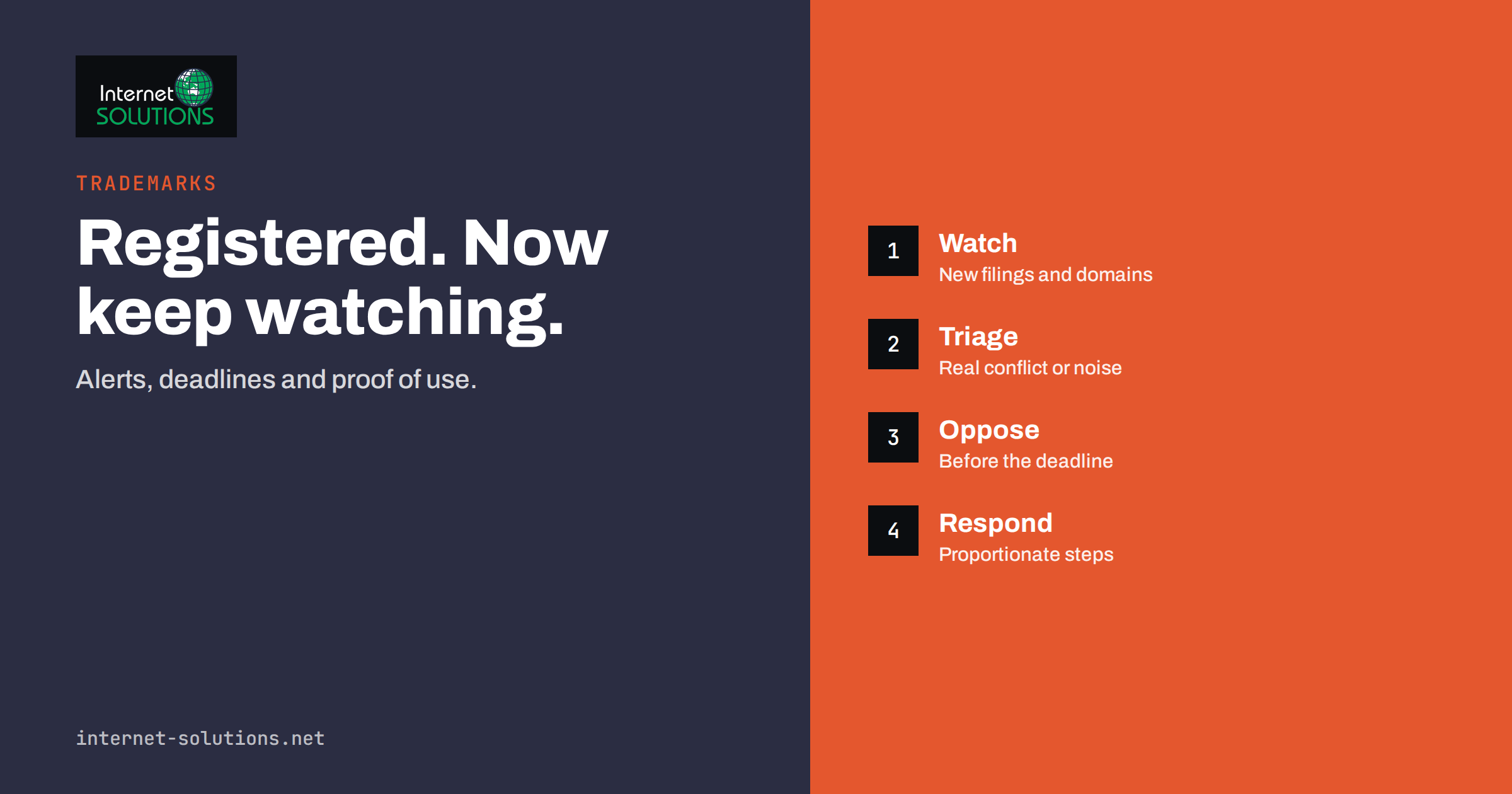
Trademark monitoring is the part of brand protection that begins after the certificate arrives. Registering a name or logo gives you rights, but nobody enforces them for you. Other businesses file applications for similar names, competitors adopt confusing logos, sellers on marketplaces use your brand to sell copies, and domain names that imitate yours appear at any time. If you do not look, you will find out late, usually when a customer is confused or a rival has already built a reputation around a name that sounds like yours.
This guide explains how to watch for conflicting marks, what the different kinds of monitoring cover, how an opposition works in general terms, how to respond when someone uses your brand without permission, and how to build a simple routine that fits a small company. It is general information for business owners, not legal advice. Trademark law differs between countries and the facts of each case matter, so involve a qualified trademark attorney for decisions that carry risk.
Why Registration Alone Is Not Enough
A registered trademark is a right that you must defend. Several practical reasons explain why watching matters.
- Deadlines are short. When a competing application is published, the period in which you can object is limited, often a few months. After it ends, your options become narrower, slower and more expensive.
- Delay weakens your position. If you know about a similar mark and do nothing for years, the other side may argue that you accepted the situation.
- Dilution harms the brand. A name that many unrelated businesses use in similar ways loses its power to identify you.
- Customers pay the price. Confusing look-alikes lead to misdirected complaints, lost sales and damage to your reputation for something you did not do.
- Online copying is fast. Fake shops, imitation social accounts and misleading advertisements can appear within hours.
If you have not yet decided what to register or where, start with our guides on what to register before you launch and on choosing between an EU trade mark and national registration. Monitoring follows from those choices: you watch the territories and classes in which you hold, or plan to hold, rights.
What Can Be Monitored
| Area | What you look for | Typical tools | How often |
|---|---|---|---|
| New trademark applications | Identical or similar names and logos in your classes and territories | Official databases, paid watch services, an attorney’s docket | Monthly, or whenever bulletins are published |
| Domain names | New registrations containing your brand or common misspellings | Domain monitoring services, registrar alerts | Weekly to monthly |
| Marketplaces and online shops | Listings using your brand or copying your products | Search alerts, brand protection programmes of marketplaces | Weekly |
| Social media | Impersonating accounts, fake pages, misuse of logos | Searches, platform reporting tools | Weekly |
| Search results and ads | Competitors bidding on your name, misleading advertisements | Regular searches, ad transparency tools | Weekly |
| Company names | New businesses registered with a name close to yours | Company register alerts | Monthly |
| Your own marks | Renewal dates, ownership details, use requirements | A register of your portfolio | Quarterly |
Not every business needs all of these. A local service company may care mostly about its national register and its domain names. An online brand that sells across borders should add marketplaces and the territories in which it trades.
Watching the Registers
Trademark offices publish new applications so that people with earlier rights can object. This is the most important stage to catch. There are three common ways to monitor it.
- Do it yourself with free databases. Official registers and shared search tools let you search by name, class and similarity. The EU Intellectual Property Office operates a search tool called TMview that combines data from many offices, and the World Intellectual Property Organization offers a global brand database. Details are available on the EUIPO website and the WIPO trademark pages. Searching manually every month is feasible if you have one or two marks.
- Subscribe to a watch service. Commercial services run your terms against new filings and send alerts. Good services cover similar spellings, phonetic matches and translations, not just identical words, and let you choose territories and classes. Compare coverage, the way similarity is judged, the frequency of reports and the price.
- Ask your attorney. Many trademark firms offer watching as a service and will also advise on each alert. This costs more but saves the work of deciding which alerts matter.
Whichever route you take, define what you want to catch. Include your exact name, logo elements, common misspellings, translations and phonetic variants. Choose the classes of goods and services where you operate, plus closely related ones. A rival who files in a neighbouring class may still create confusion.
Triaging an Alert: Is This a Real Problem?
Most alerts are false alarms. A systematic first assessment saves money. For each hit, ask these questions.
- How similar are the marks? Compare appearance, sound and meaning. A shared common word, such as “solutions”, is weak. A distinctive coined word is strong.
- How related are the goods or services? Identical marks for unrelated products usually pose less risk than similar marks for similar products.
- Which territory? A filing in a country where you do not trade and do not plan to may not matter.
- Who is the applicant? A well-known competitor deserves more attention than an unrelated individual. Consider whether the filing looks like a bad-faith attempt to block you or to sell you the name.
- What do your rights cover? Check the date, scope and territory of your own registration. Earlier rights are what give you the basis to object.
- What is the cost against the benefit? An opposition has a fee and legal time. Weigh it against the damage you expect.
Record each alert and your decision in a simple log, including the date, the other mark, your assessment and the deadline. When a deadline is near, ask the attorney early, not on the last day.
Oppositions in Outline
An opposition is a formal objection filed with the trademark office against a published application. The general pattern in many systems, including the EU system, is that there is a limited period after publication, commonly three months, in which a person with earlier rights can oppose. The opposing party must state the earlier right, the grounds and the goods and services involved, and pay the fee. The office then examines the case, often after giving the parties time to talk. Many disputes end in a settlement: the applicant narrows the list of goods, changes the sign or withdraws the application.
Points worth knowing:
- The period varies. Offices have different rules and some allow extensions. Check the office concerned and note the exact date when the period ends.
- Earlier rights matter. Registered marks are the usual basis, but in some systems unregistered rights or well-known marks can also support an opposition.
- Proof of use may be requested. If your registration is older than a certain age, the applicant can ask you to show that you have genuinely used the mark. Keep dated evidence such as invoices, packaging, advertisements and screenshots.
- Coexistence agreements. Sometimes the best outcome is a written agreement that limits how each party uses its mark, which avoids the cost of a contest.
- Outcome is not guaranteed. The office decides on the likelihood of confusion, and reasonable people can differ.
An attorney will normally prepare the filing, but you will need to supply facts and evidence. Gathering them in advance, in a folder, shortens the process.
Responding to Unauthorised Use
When someone is already using your brand, the options range from gentle to formal. Choose the lightest step that is likely to work.
- Gather evidence. Take dated screenshots, save web addresses, record who is selling what and keep copies of advertisements and invoices. Do not rely on a page staying online.
- Check your rights and theirs. Confirm that your registration covers the goods, services and territory involved. Consider whether the use might be legitimate, for example a reseller correctly describing your genuine products, or a business using its own surname.
- Use platform tools. Marketplaces, social networks and hosting companies have notice procedures for counterfeit goods, impersonation and brand misuse. These are often the fastest route, and they need little more than proof of your registration and a clear description of the problem.
- Send a friendly contact first when appropriate. An honest small business may not know. A polite message identifying your mark and asking for a change can resolve the matter at once.
- Send a formal letter. A cease-and-desist letter, ideally drafted by an attorney, sets out your rights, describes the use and asks for specific action by a stated date. It is a serious document, so avoid threatening more than you are ready to do.
- Escalate where needed. Options include domain name dispute procedures, complaints to authorities for counterfeits, and court action. These have costs and risks, so decide with advice.
Take care to remain accurate and proportionate. Sending aggressive demands to someone who has done nothing wrong can lead to a counterclaim and embarrassment. When in doubt, ask for professional advice before sending anything.
Online-Specific Problems
Many brand conflicts today happen on the web rather than in the register.
- Look-alike domains. Register your most obvious variations and the country domains you use, and set up alerts for new domains containing your name. Keep your own domains secure; our guide to domain name management explains renewals and registrar locks.
- Impersonating accounts. Claim your name on the main social platforms, even those you do not use, and report fakes through each platform’s process.
- Advertising on your name. Competitors may bid on your brand as a keyword. Rules differ by platform and country, and bidding itself is often permitted, but misleading ad text is not. Monitor the search results for your name regularly.
- Fake shops and phishing. Copies of your site used to defraud customers are both a trademark and a security matter. Report them to the host and registrar, and warn customers using your own channels. See also our guide on phishing awareness.
- Review manipulation. Fake reviews that mention your brand should be reported with evidence.
A Simple Monitoring Routine for a Small Company
- Make a register of your marks. For each one, list the number, owner, territories, classes, filing and renewal dates and any use evidence.
- Define your watch terms. Exact name, close variants, logo description, translations.
- Choose the tools. Free database searches monthly, or a paid watch service if risk and budget justify it.
- Set a monthly slot. Fifteen minutes to check alerts, domains, marketplaces and social accounts.
- Log and decide. Record each finding and one of four outcomes: ignore, watch, contact or escalate.
- Keep evidence ready. A folder of dated proof of use and brand materials.
- Review yearly. Check renewals, new products and new markets, and update classes and territories accordingly.
For an example of the details worth recording for each mark, such as owner, status, registration date, number and office, see how the registrations of Internet Solutions are presented on our trademarks page.
Frequently Asked Questions
Do I need a paid trademark watch service?
Not always. For one or two marks in a single country, regular searches of the free official databases may be enough. A paid service makes sense for valuable brands, several territories or a history of conflicts.
How long do I have to object to a conflicting application?
It depends on the office. In the EU system the period is commonly three months from publication, but you must confirm the exact date for the office concerned and act well before it ends.
What if the other mark is only similar, not identical?
Similarity can still cause confusion. The assessment looks at appearance, sound, meaning and how related the goods or services are. A professional opinion is worth having when the commercial stakes are high.
Can I stop a competitor from bidding on my brand name in search ads?
Often not simply because of bidding, since rules vary by platform and country. You can usually act against misleading ad text or confusing use of your logo, and you should monitor your brand results regularly.
Should I send a cease-and-desist letter myself?
You can, but a poorly worded letter can backfire. For anything beyond an obvious copy, have an attorney review or write it, and start with platform complaint tools or a friendly message when the other party seems unaware.
What evidence should I keep?
Dated proof of genuine use of your mark, such as invoices, packaging, advertisements and website captures, plus screenshots of any problem uses. Store them in an organised folder from the start.
The Bottom Line
A trademark is only as strong as your willingness to look after it. Keep a register of your marks, watch the official databases and the online places where brands are copied, and give each alert a quick, structured assessment. Know the deadlines for opposing applications, collect evidence of use before you need it and respond to unauthorised use in proportion, starting with platform tools and friendly contact. Use a specialist attorney for formal steps. A modest monthly routine protects the value that your registration represents.