

 English
 Lietuvių
 Latviešu
 Eesti
 Русский
 Polski
 Українська
 Deutsch
 Italiano
 Español
 Français
 Português
 Čeština
 Magyar
 Română
 Ελληνικά
 Türkçe
 日本語
 العربية
 हिन्दी
 Bahasa Indonesia
 Bahasa Melayu
 ไทย
 Tiếng Việt
 বাংলা
Trademark Registration Timeline and Costs: What to Expect at Each Step
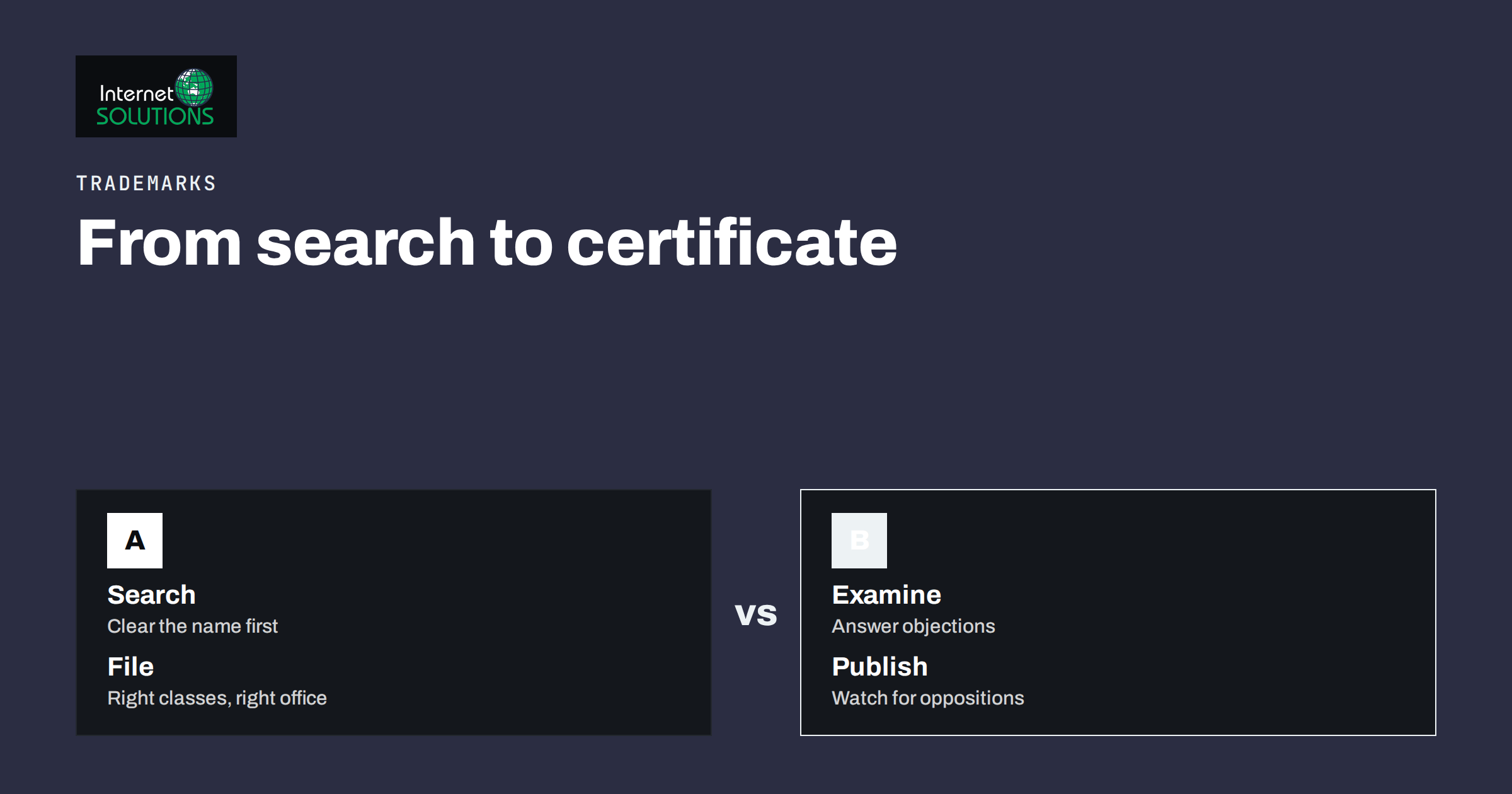
The trademark registration timeline is the question almost every founder asks after choosing a name: how long will it take, and what will it cost? The honest answer is that it depends on the office, the type of mark, the classes you choose and whether anyone objects, but the path itself is quite similar almost everywhere. A trademark application moves through preparation and search, filing, formal and substantive examination, publication with a window for oppositions and finally registration. Each stage has its own typical delays and its own costs, and knowing them in advance lets you plan a launch, set a budget and avoid expensive surprises.
This guide explains each step in plain language, which factors lengthen or shorten the process, how costs add up and what to do while you wait. It gives general information and not legal advice, and it does not quote fees or durations as facts, because they vary by office and change over time. Always check the current fee schedule and processing information on the website of the office where you file, and consider asking a qualified trademark attorney for anything beyond a simple case.
The Big Picture: Five Stages
Whether you file with a national office, with a regional one such as the European Union Intellectual Property Office or through the international system, the same five stages appear.
- Preparation and search. You choose the mark, decide what it will cover and check that it is free to use and register.
- Filing. You submit the application with the mark, the owner’s details, the goods and services and the fee.
- Examination. The office checks formal requirements and, in many systems, whether the mark can be registered at all, for instance whether it is distinctive and not misleading.
- Publication and opposition. The application is published, and third parties with earlier rights may object within a set period.
- Registration. If there are no obstacles, the mark is registered, and you receive a certificate. Maintenance and renewal follow.
Our guide to trademarks and brand protection explains what to register before you launch, and the trademark services page describes how we can help.
Stage 1: Preparation and Search
This stage often takes the least time and saves the most money. Before filing, you should decide three things: the exact form of the mark, whether to protect the word, the logo or both, and where you need protection. Our article on word mark or logo explains the choice. Then check that the name is available. A clearance search looks for identical and similar marks in the register for the same or related goods and services, and for conflicts that a register search does not show, such as unregistered use. The article on trademark clearance search explains how to do this.
Time here ranges from a day for a quick check to weeks for a careful professional search. Cost ranges from nothing for a self-made search to professional fees for a full report. Skipping the stage is a common false economy: a conflict discovered after you have printed packaging and registered a domain costs far more than a search.
Stage 2: Filing the Application
Filing is mostly a matter of accuracy. The application normally requires the applicant’s name and address, a representation of the mark, a list of goods and services, a classification and payment of the official fee. Most offices accept online filings, and some give a filing receipt and date within a day. The filing date matters, because in many systems it sets your priority against later applicants.
The list of goods and services is where mistakes cost most. Classes divide goods and services into groups, and the fee often depends on how many classes you choose. Describing your business too narrowly leaves gaps, while claiming things you will never use can invite objections and, in some systems, weaken the registration if the mark is not used. Our guide to trademark classes explains how to describe them well. If you are filing in your home country first and plan to expand, remember that under the Paris Convention you usually have six months from the first filing to file abroad and claim the earlier date as priority.
Stage 3: Examination
After filing, the office examines the application. Two kinds of check are common.
- Formal examination. The office checks that the application is complete, the fee is paid and the goods and services are described properly. Missing information leads to a request for correction with a deadline.
- Substantive examination. In many systems, the office also examines whether the mark can be registered: whether it is distinctive, descriptive or deceptive, whether it contains protected symbols and, in some countries, whether it conflicts with earlier registered marks.
This is often the stage with the greatest variation in duration, because it depends on the office’s workload and on whether there are objections. If the examiner raises an issue, you will receive a notice and a period to respond, with arguments, an amended list or evidence of distinctiveness. Responding well, and on time, is important, since missed deadlines can cause the application to lapse. Each round adds weeks or months. Where the office searches for earlier marks, a conflicting earlier registration can also lead to refusal or negotiation.
Stage 4: Publication and Opposition
If the application passes examination, it is published so that others can see it. In the European Union, for example, there is a period of three months after publication in which owners of earlier rights may file an opposition. Other offices have similar windows, which differ in length. If nobody opposes, the process moves to registration. If someone does, the proceedings can take months or years, with a possibility of negotiation, a coexistence agreement, limiting the goods and services or withdrawing.
You cannot control whether someone opposes, but a clearance search reduces the risk, and a calm, professional response helps if it happens. Our guide to trademark monitoring, oppositions and infringement response explains the process from both sides. The opposition period also applies in reverse: once you own a mark, watching new publications lets you object to confusingly similar applications by others.
Stage 5: Registration, Renewal and Upkeep
When the opposition period ends without objections, the office registers the mark and issues a certificate. Rights usually last for ten years from the filing or registration date, depending on the system, and can be renewed for further periods. Some countries require proof of use after a certain period, and a registered mark that is not used can be challenged. Keep a record of the renewal date, and read the rules where you are registered. Our article on trademark renewal and maintenance explains deadlines, proof of use and licensing.
What Shapes the Timeline
| Factor | Effect on time | What you can do |
|---|---|---|
| Choice of office | Each office has its own processing times | Check current figures on the office’s website |
| Clear, distinctive mark | Fewer objections, shorter examination | Avoid descriptive or generic names |
| Precise list of goods and services | Fewer correction requests | Use the office’s standard terms where possible |
| Earlier similar marks | Refusals, negotiation, oppositions | Search before filing |
| Objections from the examiner | Adds weeks or months per round | Respond fully and on time |
| Opposition by a third party | Can add months or years | Seek advice, consider coexistence |
| Number of countries | Several parallel timelines | Plan priorities and a budget by market |
| Accuracy of your application | Delays from errors and missing documents | Check every field before filing |
How Costs Add Up
Costs have several parts, and the official fee is often only one of them.
- Search and clearance. Free self-checks, or professional reports at a price.
- Official filing fee. Usually depends on the office and the number of classes. Check the current fee schedule, since amounts change.
- Professional fees. If you use an attorney or agent, there are fees for filing, responding to objections, handling oppositions and renewals. Ask for a clear quote, including what is not included.
- Responses to office actions and oppositions. The unpredictable part of the budget. Allow a contingency.
- Foreign filings. Each country has its own fees and often requires a local representative. The international system can reduce effort; see our guide to the Madrid Protocol, and the article on EU trade mark or national registration for regional choices.
- Renewal fees at the end of each protection period.
- Monitoring services if you choose to watch for conflicting applications.
The official sources are the best guide. The European Union Intellectual Property Office and the World Intellectual Property Organization publish fee information, forms and guidance, and national offices do the same for their countries.
What to Do While You Wait
An application takes time, and the business cannot pause. Some sensible habits help.
- Use the mark consistently, and keep evidence of use such as dated invoices, packaging and web pages.
- Use the right symbols. Do not use the registered symbol before registration. The letters TM can signal a claim in many countries, but check local rules.
- Secure the domain and social handles that match the name. Our guide to domain names and trademarks explains the link between the two.
- Keep all notices and deadlines in one calendar. Offices send letters or emails with response periods that cannot be missed.
- Do not make large irreversible investments in the brand until the main risks, such as conflicts, have passed, unless the cost of a change is acceptable.
- Keep your correspondence address current so that notices reach you.
A Worked Example
A founder is launching a skincare brand with a distinctive invented name and a simple logo. She checks the register, finds no identical or similar marks for cosmetics and decides to file the word mark first, in the main class for cosmetics, in her home country, with a plan to extend abroad within six months using the priority right. She prepares the list of goods carefully, files online and receives the filing date the same day.
The office examines the application and requests a small correction to the wording of one product, which she sends within the deadline. The mark is published, and she sets a calendar reminder for the end of the opposition period. During the wait, she keeps dated records of sales and packaging, registers the domain and plans the first export markets with an attorney. When the window ends without objections, the mark is registered. She then files the logo as a second application once the design is final, and marks the renewal date in her calendar.
Common Mistakes
- Filing without a search and discovering a conflict later.
- Describing the goods and services too narrowly or too broadly.
- Missing a deadline to respond to the office.
- Forgetting the priority period when expanding abroad.
- Assuming that the quoted official fee is the total cost.
- Printing large quantities of packaging before the main risks pass.
- Letting renewal dates and use requirements slip.
Frequently Asked Questions
How long does trademark registration usually take?
It depends on the office and on whether there are objections or oppositions. A straightforward application can take several months, and a contested one much longer. Check the processing information of your office.
Can I use the name while the application is pending?
Generally yes, but you do so at your own risk until the mark is registered, and use of a mark that conflicts with another’s rights can lead to claims. A prior search lowers the risk.
What happens if someone opposes my application?
The office starts an opposition procedure. Outcomes include negotiation, limiting the goods and services, a coexistence agreement, withdrawal or a decision. Seek advice, since deadlines are strict.
Do I need an attorney?
Not always, and simple cases are filed by owners themselves. An attorney helps with searches, difficult objections, oppositions and multi-country strategy, and in some countries a local representative is required.
How much does registration cost?
It depends on the office, the number of classes and whether you use professional help. Consult the official fee schedule and ask for a written quote that lists all expected costs.
When does protection start?
Rights in many systems arise from registration, with the filing date often giving priority. Check the rules where you file, as the details differ between countries.
The Bottom Line
The trademark registration timeline follows five stages: preparation and search, filing, examination, publication with a window for oppositions and registration. Time and cost depend on the office, the clarity of the mark, the precision of your goods and services and whether anyone objects, so use the official sources for current figures. Search before you file, describe your business carefully, answer every notice on time, keep evidence of use and plan renewals and foreign filings early. Treat the wait as part of the plan, not a pause, and the registration will arrive with fewer surprises.