

 English
 Lietuvių
 Latviešu
 Eesti
Eesti Русский
 Polski
 Українська
 Deutsch
 Italiano
 Español
 Français
 Português
 Čeština
 Magyar
 Română
 Ελληνικά
 Türkçe
 日本語
日本語 العربية
 हिन्दी
 Bahasa Indonesia
 Bahasa Melayu
 ไทย
ไทย Tiếng Việt
 বাংলা
বাংলাFacebook Ads Budgets: Campaign Budget vs Ad Set Budget Explained
Facebook ads budget settings look simple: pick an amount, choose daily or lifetime, publish. In practice, where you set the budget changes how Meta spends your money. You can set it once at the campaign level and let Meta distribute it across ad sets, or set a separate budget for each ad set and keep that distribution under your own control. The choice affects how fairly you can test audiences and creatives, how quickly campaigns exit the learning phase and how smoothly you can scale. Many small advertisers switch between the two without understanding the trade-offs, and lose money in the process.
This guide explains how campaign budgets and ad set budgets work on Facebook and Instagram, when each one makes sense, how daily and lifetime budgets behave, and how to scale spend without resetting performance. It is written for business owners and marketers who manage their own Meta ads or want to understand what their agency is doing.
Two Places to Set a Budget
A Meta ads campaign has three levels: the campaign, which defines the objective; ad sets, which define audience, placements, schedule and optimisation; and ads, which contain the creative. Budgets can live at either of the first two levels.
Campaign Budget (Advantage+ Campaign Budget)
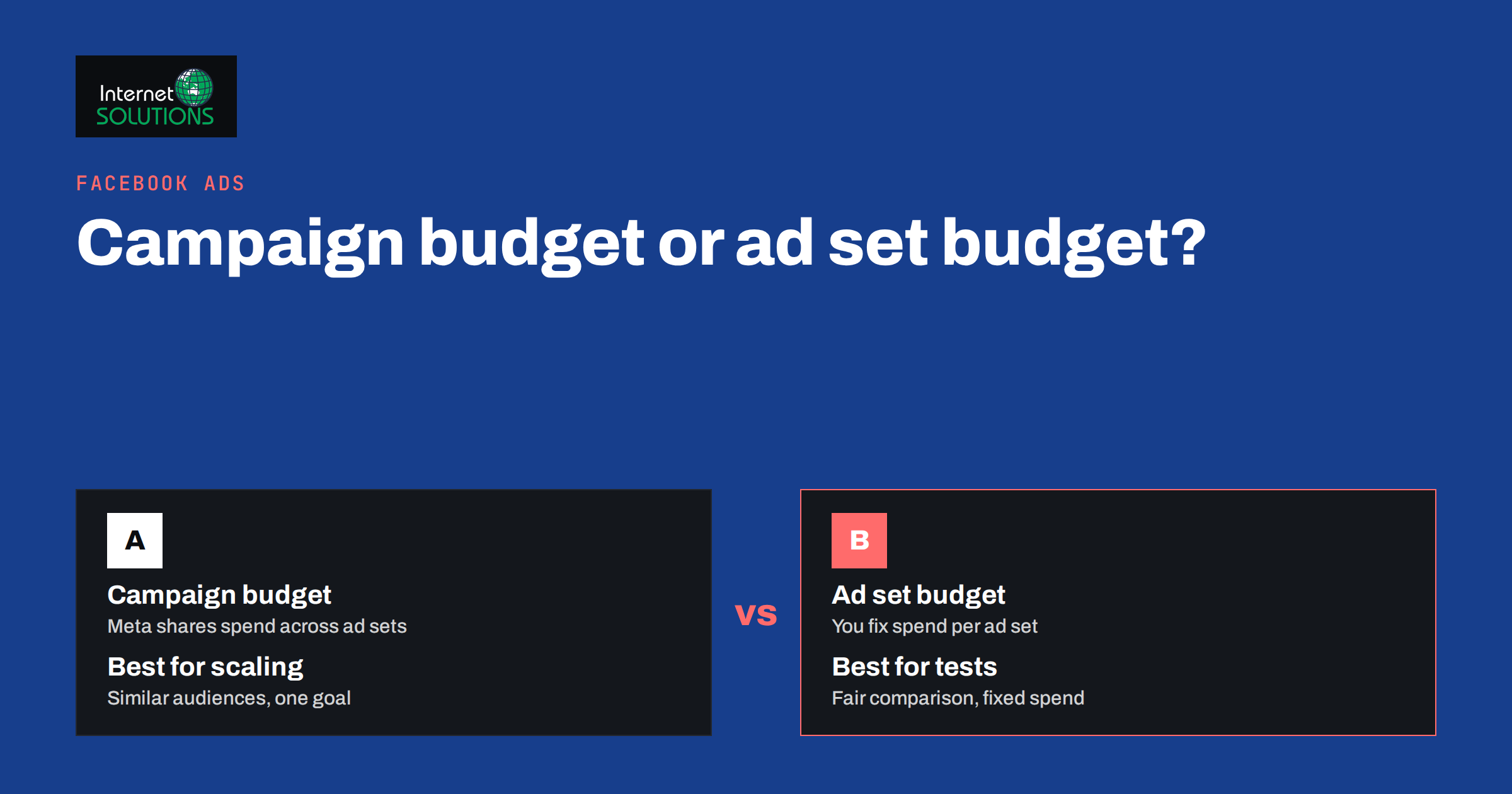
With a campaign budget, you set one amount for the whole campaign. Meta then distributes spend across the ad sets in real time, sending more money to the ad sets it expects to deliver the best results for your chosen objective. The feature was long known as campaign budget optimisation, or CBO, and Meta now calls it Advantage+ campaign budget.
You can still influence distribution by setting minimum or maximum spending limits on individual ad sets, but the default behaviour is that Meta decides.
Ad Set Budget
With ad set budgets, sometimes called ABO, each ad set receives its own fixed budget. Meta optimises delivery within each ad set, but it does not move money between them. If one audience performs better than another, it is up to you to shift budget manually.
How the Two Approaches Compare
| Aspect | Campaign budget | Ad set budget |
|---|---|---|
| Who distributes spend | Meta, across ad sets, in real time | You, per ad set |
| Best use | Scaling proven setups with similar ad sets | Testing audiences, offers or markets fairly |
| Control | Lower, influenced by optional spending limits | High, every ad set spends its own budget |
| Management effort | Lower once running | Higher, budgets need manual rebalancing |
| Risk | Some ad sets may receive almost no spend | Weak ad sets keep spending until you act |
| Learning phase | One budget feeds all ad sets | Each ad set needs enough budget to learn |
Neither option is always better. They solve different problems, and many well-run accounts use both: ad set budgets for structured tests, campaign budgets for the campaigns that scale what the tests proved.
When to Use a Campaign Budget
A campaign budget works well when the ad sets inside the campaign are genuinely comparable and you care about the overall result, not about each ad set individually. Typical cases:
- Scaling a proven setup. You know which audiences and creatives work and want Meta to find the cheapest results among them.
- Broad and lookalike audiences of similar size. Meta can shift spend towards the one that is cheaper on a given day.
- Limited time for management. Meta rebalances budget continuously, often faster than a person checking once a day.
- Retargeting funnels with clear stages, where minimum spend limits keep each stage alive. Our article on Facebook ads retargeting funnels describes how to structure those stages.
The main drawback is uneven delivery. Meta often concentrates spend on one or two ad sets early, based on initial signals, and the others barely run. That is fine when you want the best overall result, but it makes a campaign budget a poor tool for learning which audience is actually better.
When to Use Ad Set Budgets
Ad set budgets are the right choice when a fair comparison matters more than short-term efficiency:
- Testing audiences. Each audience receives the same spend, so differences in cost per result reflect the audience, not the algorithm’s early preference.
- Testing offers or landing pages where each ad set represents one variant.
- Different markets or regions with their own business targets, such as a fixed budget per country.
- Small or very different audiences, for example a small retargeting audience next to a large prospecting audience, where a campaign budget would starve the smaller one.
For creative testing specifically, keep the audience fixed and vary only the creative, so results are easy to read. Our guide to Facebook ads creative testing on a small budget explains how to structure those tests.
Daily or Lifetime Budget
Independently of the level, you choose between a daily and a lifetime budget.
- Daily budget sets the average amount to spend per day. Meta explains in its help pages on daily budgets that actual spend can be higher on days with better opportunities and lower on others, while staying within a weekly limit based on the daily amount. Daily budgets suit always-on campaigns.
- Lifetime budget sets the total amount for a campaign or ad set with a fixed end date. Meta paces spend over the whole period. Lifetime budgets are required if you want to run ads only on certain days or hours, and they suit promotions, launches and events.
For most small businesses, a daily budget on always-on campaigns plus lifetime budgets for time-limited promotions is a simple and effective combination.
The Learning Phase and Why Budget Size Matters
When an ad set starts or changes significantly, Meta’s delivery system goes through a learning phase while it explores who responds best. Meta indicates that an ad set generally needs around 50 optimisation events within a week after the last significant edit to exit this phase. Until then, results are less stable and usually more expensive.
This has direct consequences for budget decisions:
- Budget per ad set must be realistic. If your cost per purchase is 30 euros, an ad set spending 10 euros a day will rarely reach enough conversions to exit learning. Either increase the budget, consolidate ad sets or optimise for an event that happens more often, such as adding to cart.
- Fewer ad sets learn faster. Splitting a small budget across many narrow ad sets leaves each one stuck in learning. Consolidating is often the single biggest improvement in small accounts.
- Big edits restart learning. Large budget changes, new creatives, targeting changes and optimisation event changes can all send an ad set back into learning.
Scaling Without Resetting Performance
When a campaign works, the temptation is to double or triple the budget overnight. Large jumps often push the ad set back into learning and raise costs. Safer approaches:
- Increase gradually. A common rule of thumb is to raise budgets in moderate steps, for example around 20 percent, and wait a few days between increases to see how costs respond.
- Scale horizontally. Duplicate a winning ad set to a new, similar audience or a new market, rather than pushing one ad set ever higher.
- Move winners into a campaign budget. After ad set tests identify the best audiences and creatives, combine them in a campaign with a campaign budget and let Meta distribute spend.
- Refresh creative before fatigue. Rising frequency and falling click-through rates signal that the audience has seen the ads too often. New creative often does more for scale than more budget.
- Watch business metrics, not only platform metrics. Confirm that sales in your shop or CRM grow in proportion to spend.
Automated campaign types such as Advantage+ shopping campaigns take this further and handle much of the distribution automatically; our article on Meta Advantage+ shopping campaigns discusses how much control that involves.
Common Budget Mistakes
Most budget problems we see in audits of small Meta ads accounts come from a handful of habits:
- Too many ad sets for the budget. Ten ad sets sharing a small daily budget means none of them collects enough data. Fewer, broader ad sets usually perform better.
- Daily tinkering. Changing budgets every day because of one good or bad day keeps campaigns in permanent learning. Judge performance over at least several days.
- Comparing ad sets inside a campaign budget. If Meta gave one ad set most of the spend, its results are not comparable with an ad set that barely ran. Use ad set budgets for comparisons.
- Optimising for an event that rarely happens. If the account records only a few purchases per week, optimising for purchases leaves the algorithm with too little data. Optimise for an earlier event until volume grows.
- Ignoring overlap. Several ad sets targeting overlapping audiences compete with each other in the auction and raise costs. Check audience overlap before launching parallel ad sets.
- No link to real outcomes. Budget decisions based only on in-platform results can be misleading if tracking is incomplete. Make sure conversions are measured reliably on your website as well.
- Forgetting minimum spend on retargeting. In a campaign budget, small retargeting ad sets may receive nothing. Give them their own campaign or a minimum spending limit.
Setting the Total Budget in the First Place
Before deciding where the budget lives, decide how much the account can spend. Start from the business side: what a customer is worth to you, what you can afford to pay to acquire one, and how many customers you want per month. Multiply the acceptable cost per customer by the target number of customers to get a starting monthly budget, then check whether that budget gives each ad set enough volume to learn. If it does not, reduce the number of ad sets or start with an earlier conversion event. Revisit the figure monthly using real results from your shop or CRM rather than estimates.
A Simple Budget Structure for Small Accounts
For businesses spending a modest monthly amount on Meta ads, a structure like this works well:
- One prospecting campaign with a campaign budget and two or three broad or lookalike ad sets.
- One retargeting campaign with an ad set budget, so the small audience always receives spend.
- One testing campaign with ad set budgets, used for a few weeks at a time to try new audiences or offers, with a fixed share of total spend such as 10 to 20 percent.
Review results weekly, move proven elements from testing into prospecting, and avoid touching budgets every day. If you would like professional help, our Facebook ads service agrees the campaign goal, defines the audience, prepares the ads and adjusts audience, ads or budget when the numbers call for it.
Frequently Asked Questions
Is CBO the same as Advantage+ campaign budget?
Yes. Campaign budget optimisation was renamed Advantage+ campaign budget by Meta. It means one budget at the campaign level, distributed across ad sets by Meta.
Can I switch an existing campaign from ad set budgets to a campaign budget?
Meta allows switching in many cases, but it is a significant change that can affect delivery. It is often cleaner to create a new campaign with the winning ad sets.
Why does one ad set get almost all the budget?
With a campaign budget, Meta sends money where it predicts the best results. Use minimum spending limits if each ad set must receive some spend, or switch to ad set budgets for testing.
What daily budget do I need per ad set?
Enough to reach roughly 50 optimisation events per week. Divide that target by your expected cost per result to estimate the weekly budget needed.
Should I use a lifetime budget for always-on campaigns?
Usually not. Lifetime budgets need an end date and suit fixed promotions. Daily budgets are simpler for campaigns that run continuously.
How often should I change budgets?
As rarely as possible. Make moderate changes, then give the system a few days to adjust before judging the result.
The Bottom Line
Where you set your Facebook ads budget decides who controls the spend. Use ad set budgets when you need fair tests of audiences, offers or markets, and campaign budgets when you want Meta to find the best results among proven, comparable ad sets. Give each ad set enough budget to exit the learning phase, consolidate rather than fragment small budgets, scale in moderate steps and refresh creative before fatigue sets in. A simple structure with prospecting, retargeting and a separate testing campaign keeps both control and efficiency. If you want help setting up or reviewing your Meta ads, contact our team.