

 English
 Lietuvių
 Latviešu
 Eesti
Eesti Русский
 Polski
 Українська
 Deutsch
 Italiano
 Español
 Français
 Português
 Čeština
 Magyar
 Română
 Ελληνικά
 Türkçe
 日本語
日本語 العربية
 हिन्दी
 Bahasa Indonesia
 Bahasa Melayu
 ไทย
ไทย Tiếng Việt
 বাংলা
বাংলাGoogle Ads Account Structure: Campaigns, Ad Groups and Naming
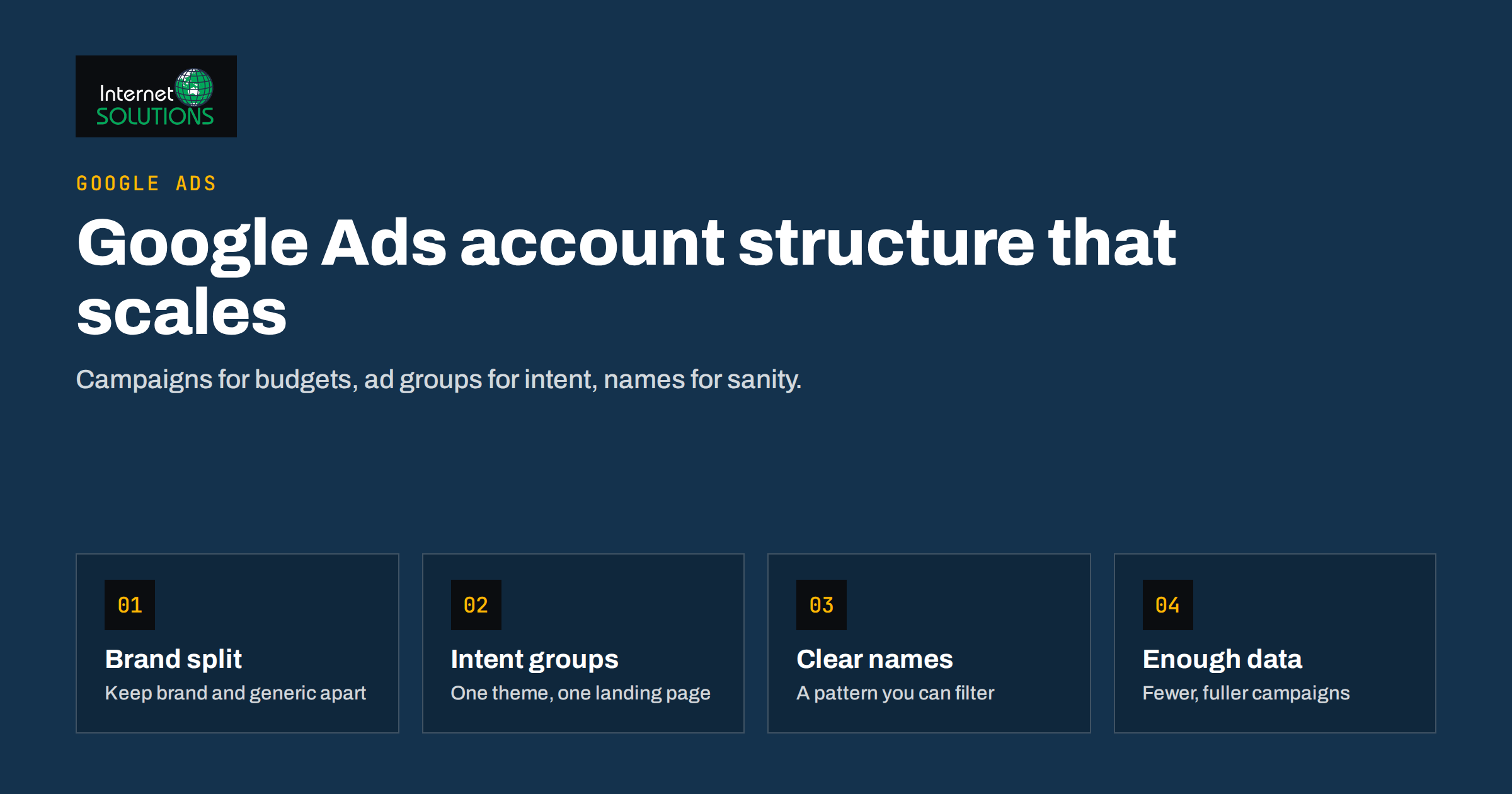
A well-planned Google Ads account structure decides how much control you have over your money, how clearly you can read your results and how easily the account grows without turning into a mess. Most struggling accounts do not fail because of one bad keyword. They fail because everything is mixed together: brand and non-brand searches share a budget, unrelated products sit in one ad group, and nobody can tell which campaign actually produces enquiries.
This guide explains how the Google Ads hierarchy works, what belongs at each level, how to split campaigns so that budgets and bids do what you intend, how to organise ad groups around search intent and how to name everything so that the account stays readable a year from now. It is written for business owners and marketers who run their own account or who want to review the work of an agency. If you would rather hand the work over, our Google Ads service starts with exactly this kind of structural review.
How the Google Ads Hierarchy Works
Every account has the same basic layers. Understanding which setting lives at which layer is the foundation of every structural decision, because a setting can only be controlled at the level where it exists.
- Account: billing, users, conversion actions, account-wide linking to Google Analytics and similar tools, and shared libraries such as negative keyword lists.
- Campaign: the daily budget, the bidding strategy, locations, languages, ad schedule, networks and devices. A campaign is also where you choose the campaign type, for example Search, Shopping, Performance Max or Display.
- Ad group: a set of closely related keywords (in Search campaigns) together with the ads written for them. The ad group is where relevance is created.
- Ads and keywords: the headlines, descriptions and landing page the visitor sees, plus the search terms you want to match.
The practical consequence is simple. If two things need different budgets, bids, locations or schedules, they must be in different campaigns. If two things only need different messages, they can live in different ad groups inside the same campaign.
Start With Business Goals, Not With Keywords
Before opening the platform, write down what the account is supposed to deliver. A local plumber wants phone calls from three towns. An online shop wants purchases at a profitable return on ad spend. A software company wants trial sign-ups at a target cost. These goals decide which conversion actions you track, which campaign types make sense and how many campaigns the budget can realistically support.
A useful rule is to work backwards from the budget. A campaign needs enough daily budget and enough conversions for automated bidding to learn. If you have a small monthly budget, ten small campaigns will each starve. Three focused campaigns will give you more data per campaign and clearer decisions. Our guide on how much to budget for Google Ads shows how to size the spend before you design the structure.
Check that conversions are measured first
Structure is useless without measurement. Confirm that the conversion actions that matter, such as form submissions, calls or purchases, are tracked and marked as primary goals for bidding. Secondary actions like page views or scroll depth should not drive bidding. If tracking is not yet reliable, fix it before restructuring; conversion tracking that holds up explains how.
Splitting Campaigns: The Decisions That Matter
Campaigns are where you separate things that need different control. The following splits are the ones that most often pay off.
Brand versus non-brand searches
People who search for your company name already know you. They convert at a much higher rate and at a lower cost than people searching for a generic service. If both kinds of search share a campaign, the cheap brand conversions hide how poorly the generic keywords perform, and the budget gets consumed by whichever converts easily. Keep brand terms in their own campaign with its own modest budget, and judge the non-brand campaign on its own numbers.
Different products, services or margins
If one service earns three times the profit of another, they should not compete for one budget. Separate campaigns let you give the profitable service the budget and a more aggressive bidding target. For shops with large catalogues, structuring Shopping campaigns follows the same principle: group products by margin and performance, not by whatever the product feed happens to contain.
Different locations or languages
Locations, languages and ad schedules are campaign settings. A business that serves two countries with different currencies or phone numbers needs a campaign for each. Mixing them forces one set of settings on both markets.
Different campaign types
Search, Shopping, Performance Max, Display and Video behave differently and report differently. Keep each type in its own campaign so that you can compare like with like. If you use Performance Max alongside Search, read what Performance Max automates and what you still control before deciding how the two share budget and traffic.
Different bidding strategies
If one group of keywords has enough conversion history to use a target cost per acquisition and another group is new and needs manual or maximise-clicks bidding, they belong in separate campaigns, because the bidding strategy is a campaign-level setting. The trade-offs are explained in Google Ads bidding strategies.
Building Ad Groups Around Search Intent
Inside a campaign, ad groups exist to make ads and landing pages relevant to what the searcher wanted. A common beginner mistake is to put every keyword into one ad group and write generic ads for all of them. The searcher looking for “emergency boiler repair” then sees an ad about “heating services”, which is less likely to be clicked and tends to earn a lower Quality Score.
Group by theme, not by single keyword
Years ago, advisers recommended one keyword per ad group. Since Google began matching keywords to close variants, such strict splitting adds management work without much benefit. A better rule is to build ad groups around one theme or intent, with roughly five to twenty closely related keywords, and a single landing page that answers that intent. If you cannot write one headline that fits every keyword in the group, the group is too broad.
Match the landing page to the ad group
Each ad group should send visitors to the page that best answers its theme, not to the homepage. If a landing page has to serve three intents, either split the page or split the ad groups. Landing pages for paid traffic lists what to fix first.
Write ads for the group
Responsive search ads accept up to 15 headlines and 4 descriptions, which Google combines automatically. Use that space for different angles of the same theme, for example price, speed, guarantee and location, rather than 15 rewordings of the same sentence. The practical details are covered in writing responsive search ad headlines.
Control match types and negatives
Match types decide how broadly each keyword matches searches. Keep tightly themed ad groups on phrase and exact match where precision matters, and add negative keywords at the right level: account-level lists for terms you never want, campaign-level negatives to keep the brand campaign and the generic campaign from overlapping, and ad-group negatives to steer a search to the best-fitting group. Our explanation of keyword match types and negative keywords goes into the detail.
A Practical Example: A Local Service Business
Consider a company that installs and repairs heating systems in one region. A clean starting structure could look like this:
| Campaign | Purpose | Example ad groups |
|---|---|---|
| Search | Brand | Region | Capture people who search for the company name | Company name, Company name reviews |
| Search | Repair | Region | Urgent, high-intent repair enquiries | Boiler repair, Emergency heating repair, Heat pump repair |
| Search | Installation | Region | Planned, higher-value installations | Boiler installation, Heat pump installation, Underfloor heating |
| Search | Maintenance | Region | Service contracts and annual checks | Boiler service, Maintenance plans |
Repair enquiries are urgent and often come at odd hours, so that campaign might run with a call extension and a longer schedule. Installations are planned purchases with a longer decision time, so that campaign might use a different budget and a different conversion goal. None of this would be possible if everything sat in one campaign.
Naming Conventions That Keep the Account Readable
Names look like a cosmetic detail until you manage fifteen campaigns and need to filter reports quickly. Choose a pattern and use it everywhere. A common pattern is: network or type, goal, product or theme, location. For example, “Search | Repair | Heat pumps | Region”. For ad groups, use the theme itself, such as “Heat pump repair”. For shared lists, use a prefix like “NEG |” for negative keyword lists.
- Use the same separators and word order in every name, so that sorting and filtering works.
- Avoid dates in names unless the campaign is genuinely temporary, such as a seasonal promotion.
- Keep names short enough to read in reports without truncation.
- Use labels for cross-cutting groupings, such as “Seasonal” or “Test”, that do not fit the name.
Budgets, Bidding and How Structure Affects Learning
Automated bidding works best when each campaign has enough data. As a general guideline, a campaign that uses conversion-based bidding needs a steady flow of conversions each month, and fragmenting a small budget across many campaigns slows learning and makes performance swing from week to week. Consolidate when volumes are low, split when you have clear evidence that two areas need different targets.
Budgets are set per campaign, so put the priority campaigns first. If one campaign repeatedly runs out of budget early in the day while another spends only half of its allowance, move budget towards the one with stronger returns. Google Ads Help explains the basics in managing your spend in Google Ads.
Avoid constant restructuring
Every large structural change resets some of the learning the system has built. Plan changes in batches, record what you changed and when, and then give the account a few weeks before judging the result. Small, frequent edits make it impossible to tell what caused a change.
Common Account Structure Mistakes
- One campaign for everything. Budgets, bids and reports are blended, so nothing can be optimised separately.
- Too many tiny campaigns. Each one gets too little data to learn from, and management time explodes.
- Brand and non-brand together. Cheap brand conversions hide weak generic performance.
- Ad groups with unrelated keywords. Generic ads lower relevance and Quality Score, which is described in Google’s overview of Quality Score.
- The same keyword in several campaigns. Your own campaigns then compete with each other and the data is split.
- No negative keyword plan. Irrelevant searches slowly drain the budget.
- Everything sent to the homepage. Visitors must hunt for the thing they searched for.
Auditing an Existing Account
If you inherit an account, review the structure before changing any bids. Work through these questions in order:
- Does every campaign have a single, clear goal and a single, clear location and language setting?
- Are brand and non-brand traffic separated?
- Does each ad group have a recognisable theme and at least one ad that fits it?
- Do any keywords appear in more than one campaign, and if so, is that intentional?
- Are negative keywords applied at the right levels?
- Can you tell, from the names alone, what each campaign does?
- Does each campaign have enough budget and conversions to support its bidding strategy?
Most accounts reveal two or three structural problems in this review, and fixing them usually clarifies the rest of the work. If paid search is part of a wider plan, our overview of online advertising shows how it fits with other channels.
Frequently Asked Questions
How many campaigns should a small Google Ads account have?
There is no fixed number. Small budgets usually work best with a handful of campaigns: one for brand, and a few for the main services or products. Add a campaign only when something genuinely needs a different budget, bid strategy, location or schedule.
How many keywords should an ad group contain?
Enough to cover one theme, which is often between five and twenty related keywords. The test is whether a single ad and a single landing page fit every keyword in the group. If not, split it.
Should I still use single keyword ad groups?
Usually not. Close variant matching means that a single keyword already triggers on many similar searches, so strict single-keyword structures add maintenance without clear gains. Tightly themed groups are easier to manage and perform just as well in most accounts.
Is it a problem if two campaigns target the same keyword?
It can be. Your campaigns may compete for the same auction and split the data, so you cannot tell which one works. Deliberate overlap, such as brand and generic campaigns with careful negatives, can be fine, but accidental overlap should be removed.
When should I restructure an account?
Restructure when budgets cannot be controlled, reports are impossible to read, or results have stalled despite good tracking. Make the changes in one planned batch, document them and allow a few weeks for the results to stabilise.
Does account structure affect Quality Score?
Indirectly. Ad groups with a clear theme allow ads and landing pages to match the searcher’s intent, which improves expected click-through rate, ad relevance and landing page experience, the components Google reports for Quality Score.
The Bottom Line
A good Google Ads account structure is simple to describe: separate what needs different budgets and settings into campaigns, group keywords by intent in ad groups, send each group to the page that answers it and name everything in a pattern you will still understand next year. Start with business goals and reliable tracking, avoid both the single giant campaign and the swarm of tiny ones, and change the structure deliberately rather than constantly. If you would like a second opinion on an existing account, you can contact our team and ask for a structural review.