

 English
 Lietuvių
 Latviešu
 Eesti
Eesti Русский
 Polski
 Українська
 Deutsch
 Italiano
 Español
 Français
 Português
 Čeština
 Magyar
 Română
 Ελληνικά
 Türkçe
 日本語
日本語 العربية
 हिन्दी
 Bahasa Indonesia
 Bahasa Melayu
 ไทย
ไทย Tiếng Việt
 বাংলা
বাংলাGoogle Ads Bidding Strategies: Manual CPC, Target CPA and Target ROAS
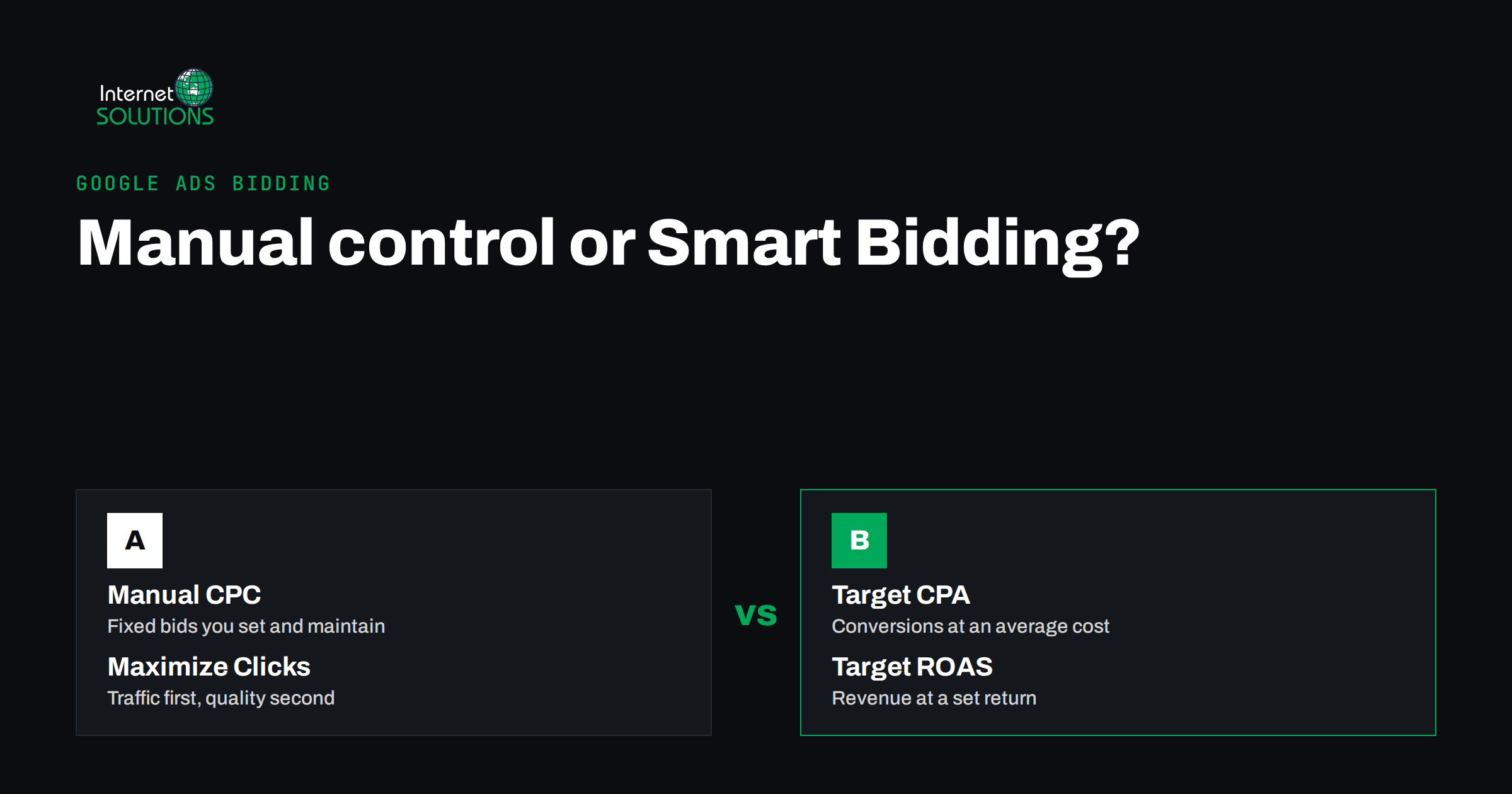
Google Ads bidding strategies decide how much you pay for every click and which auctions you enter at all. Pick the right one and the account quietly buys the traffic that turns into customers. Pick the wrong one and even a well-structured campaign with good ads burns budget on clicks that were never going to convert. Yet many advertisers choose a strategy once, during campaign setup, and never look at it again.
This guide explains the main Google Ads bidding strategies in plain terms: Manual CPC, Maximize Clicks, Maximize Conversions, Target CPA, Maximize Conversion Value and Target ROAS. For each one you will see what it optimises for, what data it needs, when it works and when it fails. At the end there is a simple path for moving an account from manual control to automated bidding without losing a month of performance in the process.
How Bidding Works in a Google Ads Auction
Every time someone searches, Google runs an auction among the advertisers whose keywords match that search. Your position and your cost are not decided by the bid alone. Google combines the bid with the expected quality of your ad and landing page, the context of the search and the expected impact of your assets. That combination is Ad Rank. A higher Ad Rank wins a better position, and you usually pay less than your maximum bid, because you only need to beat the advertiser below you.
A bidding strategy is simply the rule that sets your bid for each auction. With manual bidding, you set a maximum cost per click at keyword or ad group level and it stays the same whether the searcher is a likely buyer or a student doing homework. With automated bidding, Google sets a different bid for each auction, using signals you could never adjust by hand: device, location, time of day, browser, language, the exact search query, remarketing lists and many more. Google calls the conversion-focused family of these strategies Smart Bidding and describes the signals in its article About Smart Bidding.
Why the strategy matters more than the bid amount
Two campaigns with the same budget and keywords can produce very different results purely because of the strategy. One bids the same amount for every search; the other bids up when the signals look like a buyer and down when they look like a browser. Over thousands of auctions that difference adds up to real money. But automated strategies are only as good as the conversion data you feed them, which is why the choice of strategy and the quality of tracking are always one conversation.
The Main Google Ads Bidding Strategies Explained
Google groups its strategies by the goal they pursue. The help article Determine a bid strategy based on your goals lists them all. For most small and mid-sized businesses running Search campaigns, six matter.
Manual CPC
You set the maximum you are willing to pay for a click. Google will not exceed it. Manual CPC gives complete control and complete responsibility: every keyword needs a sensible bid, and you have to adjust them as competition, seasonality and results change. It is useful in brand-new accounts with no conversion history, in niches with very low volume, and in situations where you need strict cost control per keyword, such as brand terms. It becomes a burden once the account grows beyond a few dozen keywords.
Maximize Clicks
Google tries to get as many clicks as possible within your daily budget. You can cap the maximum CPC. It is a traffic strategy, not a sales strategy, and it tends to find the cheapest clicks, which are often the least valuable. It is acceptable for a short period to gather data in a new campaign, or when the objective genuinely is traffic, such as a content launch. It is rarely right for lead generation or e-commerce in the long run.
Maximize Conversions
Google tries to get the most conversions for your budget, bidding more for searches that look likely to convert. It spends the full budget, so if the budget is generous, the cost per conversion can rise. It is a good first step into Smart Bidding once conversion tracking is reliable. The details are in About Maximize conversions bidding.
Target CPA
Target CPA is Maximize Conversions with a target cost per acquisition added. Google tries to get as many conversions as possible at or near the average cost you set. Some conversions will cost more and some less; the target is an average, not a ceiling. It works best when the campaign already has steady conversion volume and you know what a lead or sale is worth to you.
Maximize Conversion Value
Instead of counting conversions equally, Google tries to maximise the total value they bring. This matters when conversions differ in worth, for example an online store where one order is 20 EUR and another 900 EUR, or a B2B company that assigns different values to a demo request and a newsletter signup. It requires that conversion values are passed into Google Ads accurately.
Target ROAS
Target ROAS adds a target return on ad spend to value-based bidding. If you set 400 percent, Google aims for 4 EUR of conversion value for every 1 EUR spent, on average. It is the natural end state for e-commerce accounts with reliable revenue tracking, and it is also the strategy most often set too aggressively, which starves the campaign of traffic.
Comparing the Strategies Side by Side
The table summarises what each strategy optimises for, what it needs before it can work, and where it typically fits.
| Strategy | Optimises for | Needs before it works | Best fit | Main risk |
|---|---|---|---|---|
| Manual CPC | Your fixed maximum bid | Time to manage bids | New accounts, brand terms, very low volume | Bids go stale; no auction-time signals |
| Maximize Clicks | Number of clicks | A budget | Short data-gathering phase, traffic goals | Cheap but low-quality clicks |
| Maximize Conversions | Number of conversions | Working conversion tracking | First step into Smart Bidding | Spends full budget; CPA can drift up |
| Target CPA | Conversions at an average cost | Steady conversion volume and a realistic target | Lead generation, services | Target set too low limits volume |
| Maximize Conversion Value | Total conversion value | Accurate conversion values | Stores, mixed-value leads | Wrong values teach the wrong lesson |
| Target ROAS | Value at a set return | Consistent revenue data over weeks | Mature e-commerce accounts | Target set too high chokes traffic |
Conversion Tracking Comes First
Every Smart Bidding strategy learns from the conversions you report. If tracking double-counts form submissions, counts page views as purchases or misses half of the phone calls, the algorithm will faithfully optimise toward the wrong outcome. Before switching any campaign to automated bidding, confirm three things.
- The primary conversion is the real business outcome. A purchase, a qualified lead form or a booked call, not a visit to the contact page or a scroll depth event. Secondary actions can be tracked but should not be set as primary goals for bidding.
- Counting is correct. Leads are usually counted once per click; purchases every time. A thank-you page that reloads should not create a second conversion.
- Values reflect reality. For value-based strategies, pass the actual order value, and for leads assign values that reflect how often each type becomes revenue.
If any of this is uncertain, fix it before touching bids. Our guide to conversion tracking with GA4, Google Tag Manager and the Meta pixel covers the setup and the common double-counting traps.
Choosing a Strategy for Your Situation
There is no single best strategy. The right one depends on how much data the campaign has and what the business needs from it.
A new account with no conversion history
Start with Manual CPC or Maximize Clicks with a CPC cap for the first weeks, with conversion tracking already installed. The goal of this phase is not profit but data: which keywords and searches produce conversions at all. Keep keyword lists tight and check the search terms report often.
A lead generation campaign with a handful of leads a month
With very low volume, the algorithm has little to learn from. Maximize Conversions can still work, but expect fluctuations. Consider tracking an earlier, still meaningful step, such as a completed form start plus submission, only if it correlates strongly with real leads. Do not set an aggressive Target CPA on five conversions a month.
A campaign with steady leads
Once a campaign produces conversions consistently every week, Target CPA becomes useful. Base the target on the actual average CPA of the last month or two, not on the number you wish it were. You can tighten it gradually later.
An online store with revenue tracking
Move from Maximize Conversions to Maximize Conversion Value, then to Target ROAS once the data is stable. Start the ROAS target at or slightly below the return the campaign already achieves. If you run Shopping or Performance Max campaigns, value-based bidding is where they perform best; our article on what Performance Max automates and what you still control explains how it fits alongside Search.
Switching Strategies Without Losing a Month
Every switch to or between automated strategies triggers a learning period in which Google recalibrates. Performance often wobbles for one to two weeks. A few rules keep the wobble small.
- Change one thing at a time. Do not switch the strategy, rewrite the ads and change the landing page in the same week. If results change, you will not know why.
- Use realistic targets. The most common mistake is setting a Target CPA 40 percent below the historical average. The campaign then bids so cautiously that it hardly spends, and the conclusion drawn is that Smart Bidding does not work.
- Keep budgets stable during learning. Large budget swings during the first weeks reset what the algorithm has learned.
- Judge on full conversion cycles. If customers typically convert five days after clicking, evaluating on day three will mislead you. Use a window at least as long as the conversion delay.
- Use experiments when stakes are high. Google Ads experiments let you split traffic between the old and new strategy and compare them fairly, instead of comparing this month with last month.
Common Bidding Mistakes and How to Avoid Them
Optimising toward a micro-conversion
If the primary conversion is a click on the phone number or a visit to the pricing page, Smart Bidding will find people who click phone numbers and visit pricing pages, not people who buy. Keep primary conversions close to revenue.
Mixing very different goals in one campaign
A campaign that combines brand searches, generic searches and competitor terms under one Target CPA will average them together. Brand terms convert cheaply and hide the fact that generic terms are expensive. Separate campaigns by intent so each target makes sense.
Starving the campaign with a tiny budget
If the daily budget only buys three or four clicks, no strategy has enough room to learn. Either concentrate the budget on fewer keywords or accept a longer learning phase. Our framework for setting a Google Ads budget helps size this properly.
Ignoring search terms because bidding is automated
Automated bidding sets prices, not relevance. You still need negative keywords and regular review of the search terms report. A strategy that bids efficiently on irrelevant searches is still wasting money.
Reacting to daily noise
Smart Bidding works on averages over time. A single expensive day is not a reason to change targets. Review weekly, change monthly, unless something is clearly broken.
What to Monitor Once Bidding Is Automated
Automation changes what you watch rather than whether you watch. A short weekly review covers most of it.
- Cost per conversion or ROAS against target, looked at over at least two weeks.
- Conversion volume, because a campaign can hit its CPA by simply buying fewer conversions.
- Search impression share lost to rank or budget, which shows whether the target or the budget is holding the campaign back.
- Search terms, for new irrelevant queries that need negatives.
- Conversion lag, so recent days are not judged before late conversions arrive.
- Tracking health, especially after website changes, which are the most common reason a well-performing campaign suddenly collapses.
If the account is large or the team is small, this is the kind of routine our Google Ads management service takes over, together with tracking, structure and reporting.
Frequently Asked Questions
Which Google Ads bidding strategy is best for a small business?
For most small businesses with working conversion tracking, Maximize Conversions is the best starting point, followed by Target CPA once the campaign produces conversions every week. Manual CPC is useful only at the very start or for tightly controlled brand campaigns.
How many conversions do I need before using Target CPA or Target ROAS?
Google does not require a strict minimum for every campaign, but automated strategies perform far more steadily with consistent weekly conversions. As a practical rule, if a campaign has fewer than a few conversions per week, use Maximize Conversions rather than a strict target.
Why did my costs rise after switching to Maximize Conversions?
Maximize Conversions tries to spend the whole daily budget. If the budget is larger than the campaign needs, it will bid on more expensive auctions to use it. Add a Target CPA or lower the budget to rein it in.
Is Manual CPC still worth using?
Yes, in narrow cases: new accounts without data, very low-volume niches and brand campaigns where you want strict cost control. For most growing accounts, manual bids cannot react to the auction-time signals that automated bidding uses.
How long is the learning period after changing a bid strategy?
Usually one to two weeks, longer for campaigns with few conversions or long conversion delays. Avoid other major changes during this time so results can be judged fairly.
Can I set a Target ROAS for a lead generation campaign?
Only if you assign realistic values to your leads, for example based on how often each lead type becomes a paying customer. Without meaningful values, Target CPA is the more honest choice.
The Bottom Line
Google Ads bidding strategies are tools for different stages of a campaign’s life. Manual CPC and Maximize Clicks help you gather data, Maximize Conversions and Target CPA turn reliable lead tracking into steady results, and value-based strategies with Target ROAS let online stores chase revenue instead of order counts. The strategy only works as well as the conversion data behind it, so fix tracking first, set targets from real history, change one thing at a time and keep reviewing search terms. Do that, and automated bidding stops being a black box and becomes the part of the account that works hardest for you.