

 English
 Lietuvių
 Latviešu
 Eesti
Eesti Русский
 Polski
 Українська
 Deutsch
 Italiano
 Español
 Français
 Português
 Čeština
 Magyar
 Română
 Ελληνικά
 Türkçe
 日本語
日本語 العربية
 हिन्दी
 Bahasa Indonesia
 Bahasa Melayu
 ไทย
ไทย Tiếng Việt
 বাংলা
বাংলাSearch Intent in SEO: Matching Pages to What Searchers Want
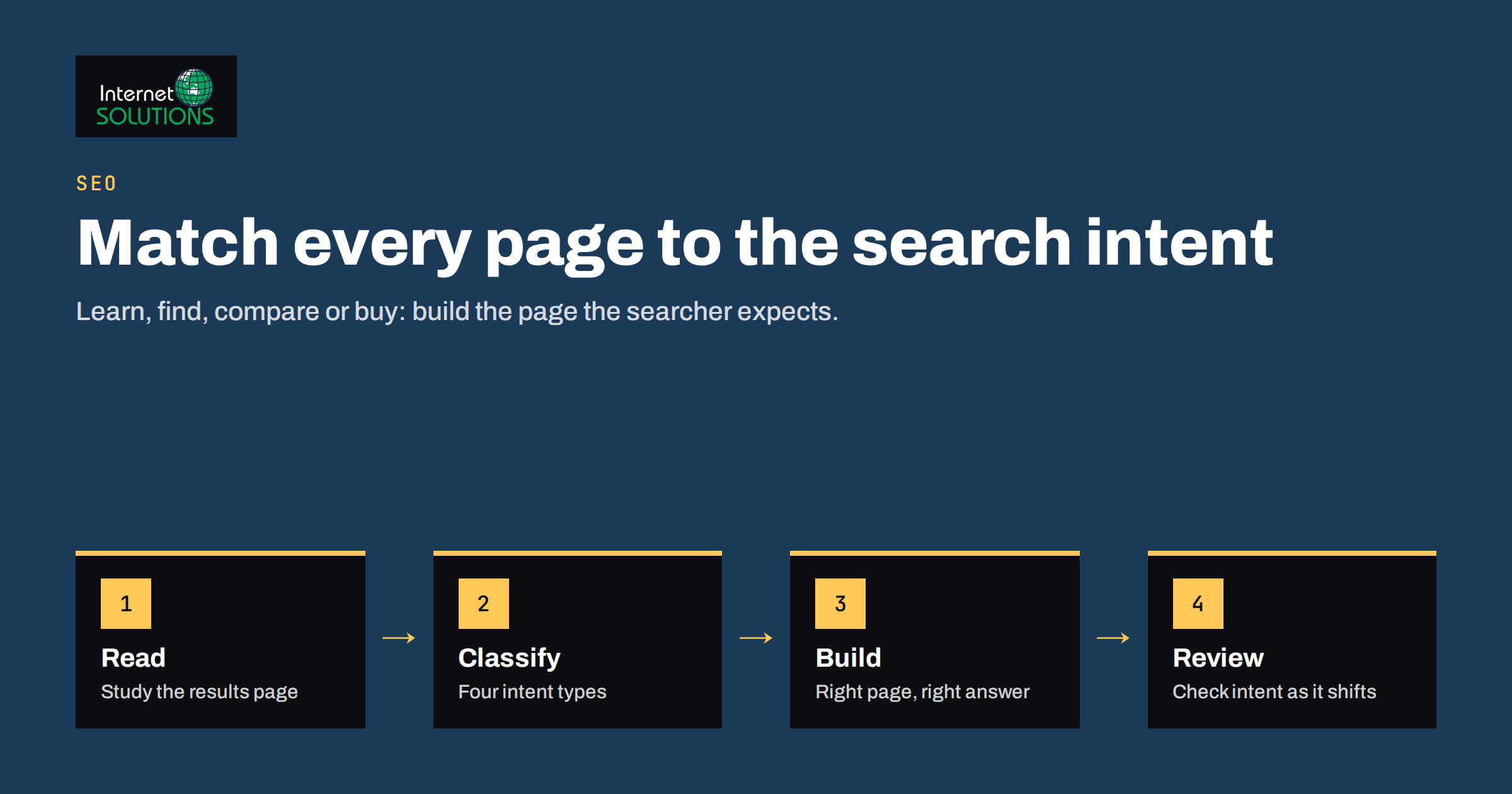
Two pages can use the same keyword, carry the same amount of text and still perform very differently. The page that ranks is usually the one that gives the searcher what they were looking for when they typed the query. That motivation is called search intent, and it is the most reliable explanation for why a well-written page sits on page three while a thinner one holds position one. Matching intent is not a trick. It is the practical meaning of writing for people instead of for a keyword list.
This guide explains the four common types of search intent, how to read a results page to find out what Google believes a query means, and how to shape page type, content and calls to action to fit. It builds on our guides to keyword research and the on-page SEO checklist, and it is written for business owners, marketers and developers who commission or build web pages.
What Search Intent Means
Search intent is the goal behind a query. Someone who searches for “how to reset a router” wants instructions. Someone who searches for “router deals” wants to compare prices and perhaps buy. Someone who searches for a brand name usually wants to reach that brand’s site. The words are only a clue, and the same words can hide different goals, which is why search engines study behaviour: which results people click, whether they come back to the results page and which pages end the search.
Search engines try to satisfy the most common goal for each query. When your page is the wrong kind of page for that goal, extra links and extra words rarely rescue it. A product page will not outrank a how-to guide for a question query, and a long article will not outrank a category page for a shopping query. The page type itself is part of the answer.
The Four Types of Search Intent
Most queries fall into four groups. The labels vary between authors, but the groups are stable.
- Informational. The searcher wants to learn something. Typical queries start with “what”, “how” or “why”, or name a topic (“core web vitals”, “dns records explained”).
- Navigational. The searcher wants to reach a specific site or page, such as a brand, a login page or a contact page.
- Commercial investigation. The searcher is comparing options before a decision. Queries include “best”, “vs”, “alternatives”, “reviews” and “pricing”.
- Transactional. The searcher is ready to act: buy, book, sign up, download or request a quote. Queries include “buy”, “order”, “near me”, “free trial” and “get a quote”.
Local intent is often treated as a separate fifth case, because a query such as “computer repair near me” asks for places, not pages. We cover it in local SEO for service businesses.
How to Read Intent From the Results Page
The fastest and most honest method is to search the keyword yourself and study what is already ranking. Google has tested thousands of variations and the first page is its current answer to the question “what do people want here?”. Look at five things.
- Page types. Are the results blog posts, product pages, category pages, tools, videos or forum threads? A page one made only of guides means a guide is expected.
- Content formats. Are the leading pages step-by-step instructions, lists, comparisons, definitions or calculators?
- Freshness. Do the results show recent dates? Fast-changing topics reward updated pages.
- Search features. Featured snippets, “People also ask” boxes, map packs, shopping results and video carousels each reveal what the engine believes is useful.
- Depth. Are the leaders short and direct, or long and thorough? Length is a symptom of the question, not a goal.
Take notes for each keyword. Over a few queries, you will start to recognise patterns that save time.
Matching the Page to the Intent
Once you know the intent, choose the right kind of page and make it obvious in the first screen.
| Intent | Best page type | What the page must do | Typical call to action |
|---|---|---|---|
| Informational | Guide, tutorial, glossary entry | Answer the question early, then add depth, examples and next steps | Read a related guide, subscribe, download a checklist |
| Navigational | Home, brand, login, contact page | Be easy to find and fast; make the target action one click away | Log in, call, visit the page |
| Commercial investigation | Comparison, review, buying guide | Compare options fairly, state criteria and show evidence | See pricing, book a demo, ask a question |
| Transactional | Product, service or category page; landing page | Show price or process, proof, delivery or booking details and remove friction | Buy, book, request a quote, start a trial |
The table is a starting point. Real queries mix intents, and the best pages serve the main one while quietly helping the neighbours. A product page can include a short guide on how to choose a size, and a guide can end with a clear route to the service it describes.
Write the Answer First
For informational queries, put the direct answer near the top. If the query is “how long does a domain transfer take”, say the typical range in the first paragraph and then explain the variables. Readers who get the answer stay for the detail, while readers who have to scroll through a long introduction leave. A short answer near the top also gives search engines a clean passage to quote. Our guide to title tags and meta descriptions shows how to promise that answer in the snippet.
For commercial and transactional queries, the equivalent is clarity about the offer: what it is, who it is for, what it costs or how pricing works, and what happens after the click. Hiding the price behind a form frustrates people who are ready to compare, and some of them will go to a competitor that is open about it.
One Page, One Main Intent
A page that tries to serve every intent usually serves none. A common mistake is a service page that begins with three paragraphs of general education, then lists features, then asks for contact details. The informational reader wanted a guide, the commercial reader wanted a comparison, and the transactional reader wanted the price. All three leave unsatisfied.
Decide the main intent of each page and let it lead. Give the other intents their own pages and connect them with internal links. This also avoids the problem described in our article on keyword cannibalization, where two pages compete for the same query because their intents were never separated.
Intent Changes the Keyword Plan
When you plan content, group keywords by intent as well as by topic. A topic such as “email migration” contains different needs.
- “what is an MX record” is informational and fits a short explainer.
- “email migration checklist” is informational with a practical tilt and fits a step-by-step guide.
- “best email hosting for small business” is commercial and fits a comparison.
- “email migration service” is transactional and fits a service page with a contact route.
This is the same idea behind topic clusters and pillar pages: each page has a clear job, and links between pages move the reader from learning to deciding.
Intent for Different Kinds of Business
The balance of intents differs by business, and your content plan should follow it.
- Local service businesses win mostly on transactional and local queries, with a few guides to prove expertise and answer common objections.
- Online stores need category pages for broad commercial queries, product pages for specific ones and buying guides for the questions in between.
- Software and SaaS companies need comparison and “alternative” pages, documentation for informational queries and a clear trial or demo route for transactional ones.
- Publishers and blogs live on informational intent and must keep content fresh and well structured, and they benefit from clear paths to newsletters or products.
Check Whether Intent Has Shifted
Intent is not fixed. A query that once returned guides can start returning products, or the other way round, as search behaviour and the engine’s understanding change. A page that slowly loses position without any technical change is a candidate for an intent review. Open Search Console, find the queries that bring impressions to the page, search them and compare the current results with your page. If the leaders have changed type or format, adjust yours or create the page type that now fits. Our guide to finding quick wins in Search Console shows how to find the pages worth reviewing first.
Another signal is behaviour on the page. If visitors arrive and leave within seconds, or never reach your call to action, ask whether the page matches what they expected. Titles and descriptions that promise something the page does not deliver create the same effect from the other side.
Practical Steps for Your Next Page
- Pick the main query and write down, in one sentence, what the searcher wants to achieve.
- Search it and record the page types, formats and features of the top results.
- Choose the page type that fits and make sure your site does not already have a page for the same intent.
- Write the answer or offer first, then supporting detail, evidence and examples.
- Add a suitable next step: a related guide for learners, a comparison for evaluators, a booking route for buyers.
- Review after a few months with Search Console data and adjust.
Google’s own guidance on creating helpful, reliable, people-first content makes the same point in different words: start from the person and what they need, and the ranking signals tend to follow. The documentation on title links is also worth reading, because the title is where the promise of a page is made.
Mistakes to Avoid
- Forcing a keyword into the wrong page type. If the results are all guides, a sales page will struggle however well it is optimised.
- Burying the answer. Long introductions and storytelling before the point lose informational readers.
- Using one page for several intents. Split them and link them.
- Ignoring the next step. A guide with no route forward wastes the trust it has built.
- Copying competitors blindly. The results show what works for the average site. Add what only you can say: real experience, data, local knowledge or a clearer process.
Where Our Services Fit
Intent analysis is part of the work in our SEO service. We review which queries matter to your business, check what the results pages reward, and plan or rework pages so each one has a clear job. If you already publish regularly, an intent review of your existing pages is often the fastest improvement, because it needs no new content, only the right match between page and purpose.
Frequently Asked Questions
What is search intent in SEO?
Search intent is the reason behind a search query: what the person wants to learn, find, compare or do. Search engines try to return pages that satisfy that goal, so a page needs to match both the topic and the intent to rank well.
How many types of search intent are there?
Most frameworks use four: informational, navigational, commercial investigation and transactional. Local intent is often added as a further case because it asks for places and businesses rather than articles.
How do I find the intent of a keyword?
Search the keyword and look at the top results. The page types, formats, freshness and search features show what the engine believes people want. If the first page is full of how-to guides, the intent is informational, whatever the words suggest.
Can one page target more than one intent?
It can serve a main intent and lightly support a related one, but a page that tries to cover all intents usually satisfies none. Give each main intent its own page and link the pages together.
Does search intent change over time?
Yes. Results for a query can change type or format as behaviour and search features change. Review pages that lose rankings without a technical cause, and compare them with the current results.
Does matching intent replace keyword research?
No. Keyword research finds the queries and their volume, while intent analysis tells you what kind of page to create for each. They work together, and the best plans group keywords by intent as well as by topic.
The Bottom Line
Search intent is the link between a query and the page that deserves to rank for it. Work out whether the searcher wants to learn, find a site, compare options or act, check the results page to confirm what the engine expects, and then build the right page type with the answer or offer at the top and a sensible next step at the end. Give each page one main intent, connect the pages with internal links and review them when rankings drift. That discipline costs little, avoids wasted content and makes every other SEO effort work harder.